Of every community Propick tracks through Dubai Land Department (DLD) data, Dubai Sports City posts the highest gross rental yield and the lowest price per square metre. That combination makes it one of the more interesting cash-flow stories in the Dubai market, and one of the least glamorous. This guide uses Propick's own DLD transaction and rent-contract analysis to walk through what a unit costs, what it yields, how much of the market is still off-plan, and where the community's real trade-offs sit, without the sales pitch.
Overview: Who Dubai Sports City Suits
Dubai Sports City is a freehold, sport-themed community that broke ground in the mid-2000s off Sheikh Mohammed Bin Zayed Road (E311), a good distance inland from the coast and Downtown. Its identity is built around active sports infrastructure rather than a mall or a marina: an 18-hole championship golf course designed by four-time Major winner Ernie Els (The Els Club Dubai), an international cricket stadium and training academy, and multiple football academies sit at the centre of the master plan, ringed by low- and mid-rise residential towers and a smaller cluster of villas. It sits immediately next to Motor City, home to the Dubai Autodrome racing circuit and the Dubai Kartdrome go-karting track (Dubai Autodrome).
That layout shapes who buys here: yield-focused investors chasing the highest cash return per dirham in Propick's comparison, and budget-conscious owner-occupiers who need a genuine entry point into Dubai freehold ownership. It suits far fewer buyers looking for a prestige address, a walkable core, or a short commute, since this is an inland, car-dependent community whose residential product is spread across many small and mid-sized developers rather than one master developer's polish.
Price per Square Metre and Realistic Unit Budgets
According to Propick's analysis of DLD transaction data, the community-wide median price for ready resale property in Dubai Sports City is AED 10,117 per square metre, based on a full n=1,000 ready-resale sample (our per-community data-pull cap) and the lowest price per square metre of any community we track. The median unit price across that sample is AED 660,000.
Dividing one figure by the other implies a typical unit size of roughly 65 square metres, which lines up with what is on the ground: the stock is overwhelmingly studios and compact one-bedroom units, with far fewer larger apartments or villas than in a master-planned community like Dubai Hills Estate. For context, JVC, itself one of Dubai's more affordable communities, trades at AED 13,697 per square metre, roughly 35% higher than Dubai Sports City's AED 10,117, per Propick's DLD-based comparison set. Budget on the low end for a studio or one-bedroom, and expect a real premium for anything larger, since bigger units are a small share of what actually trades.
On costs, the Dubai Land Department transfer fee is 4% of the sale price (Dubai Land Department, Property Sale Registration), and on the secondary market this is paid in practice by the buyer. Add a trustee office registration fee of AED 4,000 plus VAT for properties at or above AED 500,000 (Dubai Land Department, Property Sale Registration), a bigger relative bite on a AED 660,000 unit than in a higher-value community.
Rental Yield: The Investor Case
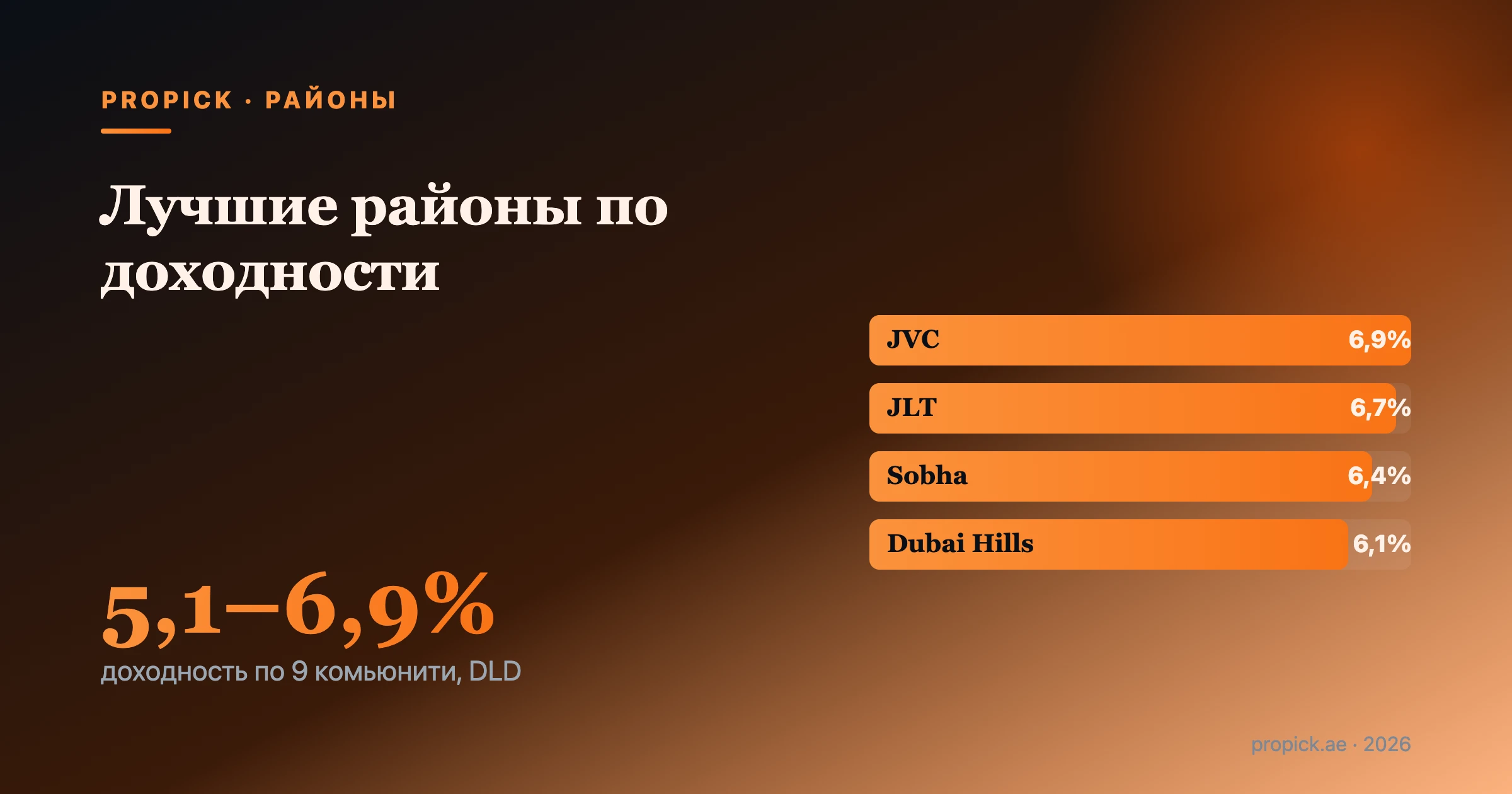
Gross rental yield in Dubai Sports City stands at 8.7%, based on Propick's matching of DLD sale and rent-contract data, the highest figure in our entire comparison set of sixteen communities. It clears JVT (7.8%), Dubai South (7.2%), and the cluster of communities at 6.9% (DAMAC Hills, Al Furjan and JVC), and it is well ahead of prime addresses such as Downtown Dubai (5.1%) and Palm Jumeirah (5.4%).
The mechanics are simple: rents in Dubai's budget apartment segment do not fall nearly as fast as sale prices do, so the cheapest entry price per square metre in the market also buys the most rental income per dirham invested. That is a genuinely strong core to the investor case here, but part of this yield premium also reflects Dubai Sports City's studio- and one-bedroom-heavy stock: smaller units carry structurally higher gross yields across virtually every Dubai community, not just here, so the comparison against communities with larger typical unit sizes, such as Dubai Hills Estate, Downtown Dubai, Palm Jumeirah and Sobha Hartland, is not fully like-for-like.
It comes with caveats. Gross yield does not net out service charges, which vary sharply between Dubai Sports City's many separate towers and owners' associations, nor does it capture vacancy or the tenant turnover typical of a budget-tier community. Verify actual achieved rents for the specific building, not just the community average, before underwriting a purchase.
Off-Plan Share: What 63% Means
63% of transactions in Dubai Sports City are off-plan, according to DLD data, drawn from the same 1,000-transaction sample. That places it in the middle of Propick's sixteen-community set: well below Meydan (93%) and JVT (83%), similar to Dubai Hills Estate (62%), and above the more mature resale markets of Dubai Marina (22%) and Sobha Hartland (20%).
In practice, this tells a different story here than in a newer master-planned district. Dubai Sports City has been building out for two decades, so a 63% off-plan share today mostly reflects a second wave of activity: a range of newer, smaller developers launching fresh towers on remaining plots, refreshing what was largely mid-2000s stock. The upside is a genuine choice between older, tested resale buildings with rental history and newer product on a payment plan. The downside is the usual one where off-plan supply is heavy: construction risk, handover timelines that can slip, and a steady pipeline of newly completed units competing for the same tenant pool.
Lifestyle, Connectivity and the Honest Trade-offs
Dubai Sports City's lifestyle case is built around participation, not proximity. The Els Club offers 18 holes designed by Ernie Els on-site (The Els Club Dubai), the community's cricket stadium and academy draw international teams and franchise cricket, and several football training academies operate from the same master plan. Next door, Motor City's Dubai Autodrome circuit and karting track add another layer of motorsport-adjacent lifestyle appeal (Dubai Autodrome).
What it does not offer is proximity to Dubai's core. There is no Dubai Metro station in or near Dubai Sports City, unlike Downtown's Burj Khalifa/Dubai Mall stop or Business Bay's Red Line station, so residents depend entirely on the road network, primarily Sheikh Mohammed Bin Zayed Road, for access to Downtown, the Marina and the airport corridor. Nor is it built around schools or retail the way Dubai Hills Estate or Arabian Ranches are: there is no anchor mall on-site, and families should look to neighbouring communities like Motor City or Arabian Ranches for schooling rather than assume an on-site campus.
The honest framing: Dubai Sports City is an academy and amenity hub for sport, not a lifestyle hub for shopping, schools or short commutes, and its residential stock is split across many separate developers rather than one consistent standard. Build quality and service charges vary noticeably from tower to tower, which is the trade-off for the lowest entry price and the highest yield in the market.
How Dubai Sports City Compares to Other Communities
| Area | AED/sqm | Gross yield | Off-plan share |
|---|---|---|---|
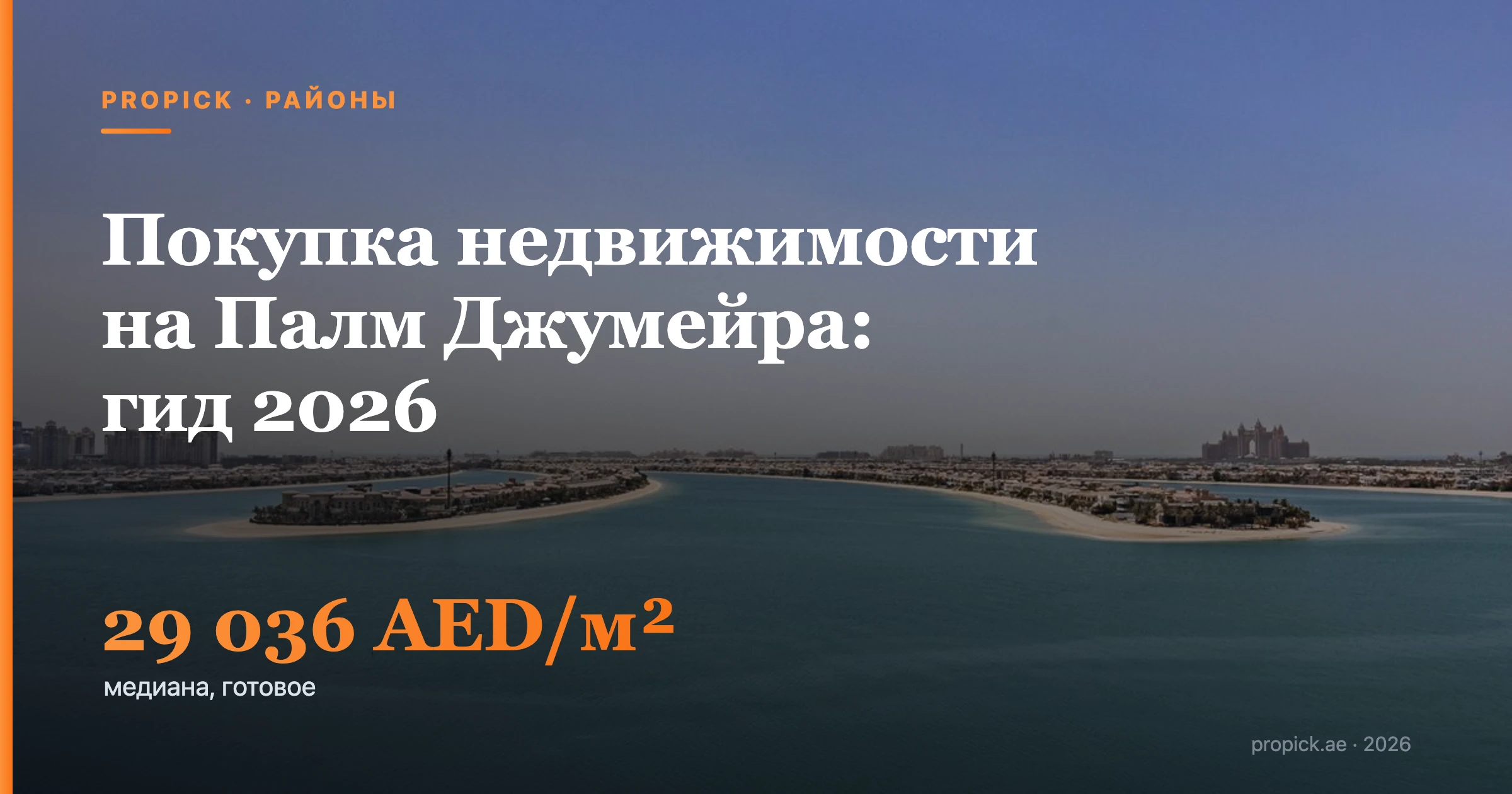
| Palm Jumeirah | 29,036 | 5.4% | 39% |
| Downtown Dubai | 26,478 | 5.1% | 32% |
| Dubai Creek Harbour | 25,224 | 5.4% | 70% |
| Dubai Hills Estate | 25,022 | 6.1% | 62% |
| Sobha Hartland | 21,649 | 6.4% | 20% |
| Dubai Marina | 21,028 | 5.2% | 22% |
| Business Bay | 20,306 | 5.9% | 50% |
| Meydan | 16,630 | 6.3% | 93% |
| JLT | 15,666 | 6.7% | 80% |
| DAMAC Hills | 15,405 | 6.9% | 42% |
| Al Furjan | 14,446 | 6.9% | 52% |
| Town Square | 14,398 | 6.7% | 54% |
| JVC | 13,697 | 6.9% | 51% |
| JVT | 13,140 | 7.8% | 83% |
| Dubai South | 11,743 | 7.2% | 76% |
| Dubai Sports City | 10,117 | 8.7% | 63% |
Source: Propick analysis of DLD community medians for ready property, July 2026, grouped by master project from DLD's own real estate datasets (Dubai Land Department, Open Data - Real Estate Data). Meydan's ready-resale sample is thin (n=237); Dubai Sports City's sample hits the full n=1,000 per-community data-pull cap. Arabian Ranches, a villa-only community, sits separately at 15,145 AED/sqm with a 4.4% yield and a 6.65M AED median, and is not directly comparable to the apartment-dominant communities above since it is a different product type.
The broad pattern in this table is that price and yield tend to move in opposite directions, though the relationship isn't perfectly monotonic: Palm Jumeirah's premium pricing still out-yields the slightly cheaper Downtown Dubai, and Sobha Hartland (6.4%) out-yields the pricier Dubai Hills Estate (25,022 AED/sqm, 6.1%), both reversals of the general trend. Dubai Sports City sits at the cheap, high-yield end of that broader scatter, the cheapest and highest-yielding community Propick tracks. Comparing it to JVT or Dubai South, the next two highest-yielding areas, is really a choice between similar risk profiles: budget-tier apartment stock, heavy off-plan activity, and a car-dependent, inland location, in exchange for the best gross returns on paper.
FAQ
Is Dubai Sports City a good investment in 2026? For pure cash-on-cash yield, it is the strongest performer in Propick's DLD comparison at 8.7% gross, ahead of every other community we track. It suits investors prioritising rental return over prestige, appreciation potential or a central location, and is less suited to buyers seeking a family-oriented, amenity-rich master plan.
What is the average price per square metre in Dubai Sports City? AED 10,117 per square metre for ready resale property, the lowest of any community in Propick's sixteen-community comparison, based on DLD transaction data as of July 2026. The community-wide median unit price is AED 660,000.
What rental yield can I expect in Dubai Sports City? Propick's DLD data shows a gross yield of 8.7%, the highest figure among the sixteen communities we track, ahead of JVT (7.8%), Dubai South (7.2%) and JVC (6.9%).
Is Dubai Sports City mostly off-plan or ready property? Off-plan accounts for 63% of transactions in a 1,000-transaction sample. That reflects a second wave of newer developers building on remaining plots within a community that has actually been active for two decades, alongside a meaningful resale market of older, completed towers.
Does Dubai Sports City have a metro station? No. There is no Dubai Metro station in or near the community. Residents rely on the road network, primarily Sheikh Mohammed Bin Zayed Road, for access to Downtown, Dubai Marina and the wider city.
Does a Dubai Sports City property qualify for the UAE Golden Visa? Rarely on a single unit. The real estate route requires a property, or combined portfolio, worth at least AED 2,000,000 (U.AE, Golden Visa), and Dubai Sports City's AED 660,000 median sits well under a third of that threshold. Reaching it here typically means combining several units or pairing a Sports City property with an asset in a higher-value community.
Sources
- Dubai Land Department, Open Data - Real Estate Data (community medians, prices, yields, off-plan share, transactions and rent contracts): https://dubailand.gov.ae/en/open-data/real-estate-data/
- Dubai Land Department, Property Sale Registration (transfer fee and trustee office registration fee structure): https://dubailand.gov.ae/en/eservices/property-sale-registration/
- The Official Portal of the UAE Government, Golden Visa: https://u.ae/en/information-and-services/visa-and-emirates-id/residence-visas/golden-visa
- The Els Club Dubai, official site (golf course designer and location within Dubai Sports City): https://elsclubdubai.com/
- Dubai Autodrome, official site (Motor City racing circuit and karting facility): https://www.dubaiautodrome.ae/