
Ask ten agents whether a villa or an apartment makes a better investment in Dubai and you will get ten confident, unsourced answers. We decided to check the record instead. Pulling ready-resale sale prices and matching them against active rent contracts registered with the Dubai Land Department, the picture that emerges is consistent and, for a market this hyped, surprisingly unglamorous for villas.
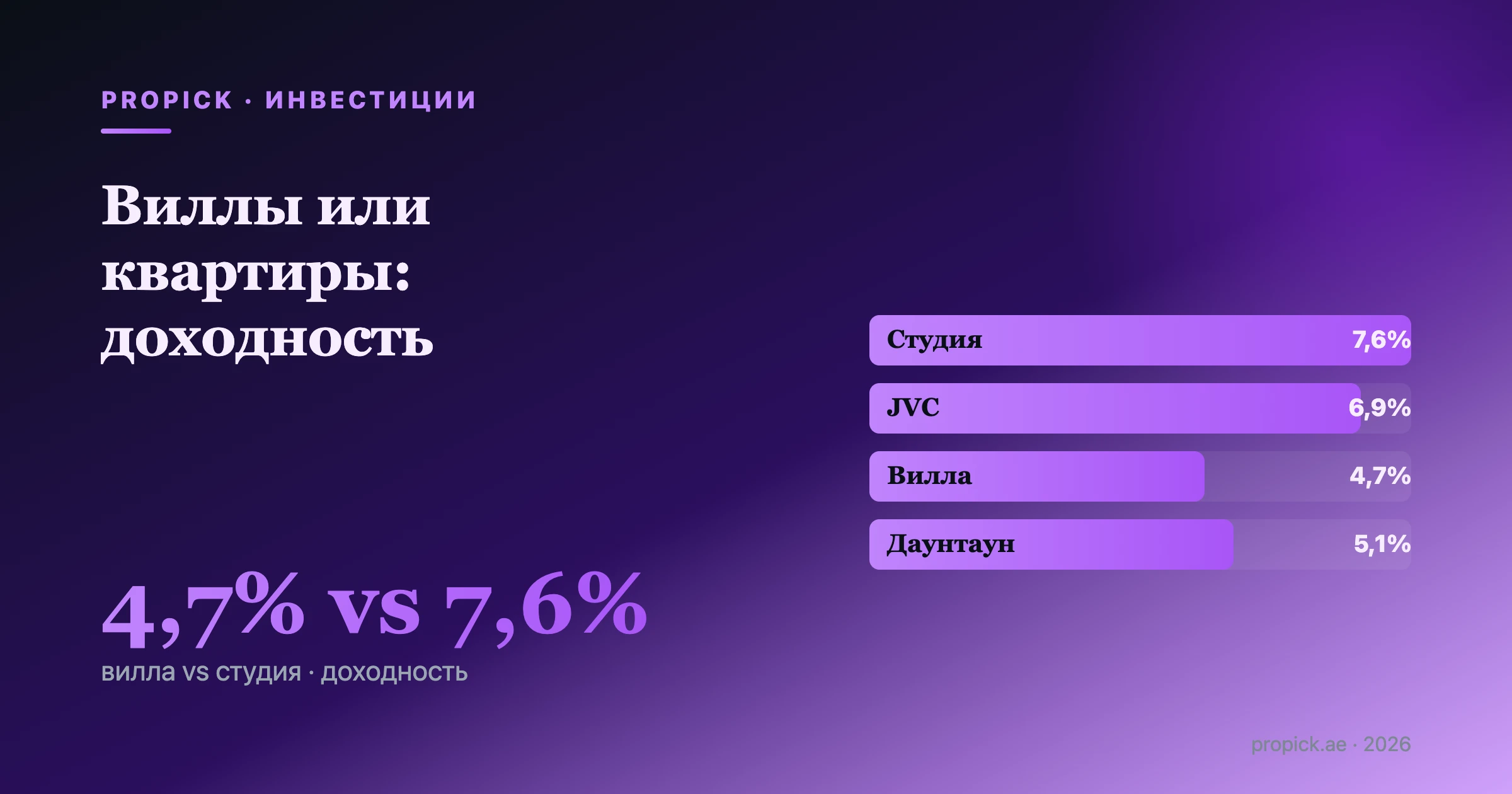
The headline: villas trade at a median of 15,230 AED per square meter and rent for 723 AED per square meter a year, a gross yield of about 4.7%. Apartments, across the communities we measured, run 5% to 7%, with studios at the top of that range near 7.6%. Villas win on capital appreciation and lifestyle. Apartments win on cash flow. Almost nobody in the market publishes this cut with real numbers attached, so here it is.
The core number: villas at 4.7%
Villas are Dubai's prestige product, and the price tag shows it. The median resale villa transacted for 3.8 million AED in our sample, more than five times the typical Dubai apartment. But rent has not kept pace with the price premium on a per-square-meter basis.
| Metric | Villa (median) |
|---|---|
| Price per sqm | 15,230 AED |
| Annual rent per sqm | 723 AED |
| Gross rental yield | 4.7% |
| Total transacted price | 3.8M AED |
A 4.7% gross yield is not weak by global standards, but it is the low end of what Dubai's own apartment market delivers, and it does not yet account for service charges, which typically run higher on villas with private gardens, pools, and larger built-up areas.
Apartments: 5% to 7%, and studios at the top
Apartments show a wider spread, and the pattern inside that spread is the more interesting story. Smaller units consistently out-yield larger ones. Studios lead the pack at roughly 7.6% gross, because rent scales with bedroom count more slowly than sale price does. A studio costs less per square meter to buy in absolute terms in most communities, while tenant demand per square meter of livable space stays high.
Community location matters as much as unit size. Below is the ready-resale, 2026 median breakdown across nine of Dubai's most actively traded apartment communities.
| Community | Price/sqm (median) | Gross yield | Implied annual rent/sqm |
|---|---|---|---|
| JVC (Jumeirah Village Circle) | 13,697 AED | 6.9% | ~945 AED |
| JLT (Jumeirah Lakes Towers) | 15,666 AED | 6.7% | ~1,050 AED |
| Sobha Hartland | 21,649 AED | 6.4% | ~1,386 AED |
| Dubai Hills Estate | 25,022 AED | 6.1% | ~1,526 AED |
| Business Bay | 20,306 AED | 5.9% | ~1,198 AED |
| Marina | 21,028 AED | 5.2% | ~1,094 AED |
| Palm Jumeirah | 29,036 AED | 5.4% | ~1,568 AED |
| Dubai Creek Harbour | 25,224 AED | 5.4% | ~1,362 AED |
| Downtown Dubai | 26,478 AED | 5.1% | ~1,350 AED |
Two things stand out. First, the most expensive communities per square meter (Palm Jumeirah, Downtown, Dubai Creek Harbour) sit at the bottom of the apartment yield range, in the same 5.1% to 5.4% band as villas. Second, the mid-market growth corridors (JVC, JLT, Business Bay, Sobha Hartland, Dubai Hills) all clear 5.9%, with JVC topping the table at 6.9%. Buyers chasing yield and buyers chasing prestige are, in effect, shopping in different aisles of the same market.
Why the gap exists
The mechanism is simple and it shows up in every dataset we can independently check. Villa and prime-address capital values move on scarcity, waterfront and branded-residence positioning, and lifestyle demand from end-users and second-home buyers. ValuStrat's own residential price index tracks villas and apartments as separate benchmarks, and in June 2026 the villa index held an annual gain of 2% (293.7 points against a January 2021 base of 100) while the apartment index posted an annual decline of 3% (169.1 points), extending a pattern of villas trading on a higher, more resilient trajectory than apartments (Khaleej Times, reporting ValuStrat's Dubai Residential VPI, June 2026). Rent, on the other hand, is set by what a household or a young professional will actually pay to live somewhere, and that ceiling rises far more slowly than land-scarce villa prices do.
Apartments in volume-driven, well-connected communities do not carry the same land-scarcity premium, so price per square meter stays lower relative to what tenants will pay, and the yield math works harder for the buyer. The Dubai Land Department's own figures show the market broadening rather than cooling through the first half of 2026, with Q1 alone posting a 31% year-on-year rise in transaction value and a 6% rise in volume to AED 252 billion (Dubai Land Department, Q1 2026 real estate transactions release), even as villas keep outpacing apartments on price growth within that expansion. That combination, rising volume alongside a villa capital-growth lead, is exactly the appreciation trade-off our yield numbers describe from the rental side.
None of this makes villas a poor asset. It makes them a different asset. A villa buyer is underwriting land value, lifestyle utility, and long-run capital appreciation in a supply-constrained segment. An apartment buyer, particularly in mid-market volume communities, is underwriting a cash-flowing rental business.
What this means for investors
- If the goal is monthly cash flow against the mortgage or a clean income yield, mid-market apartments in JVC, JLT, Business Bay, Sobha Hartland, or Dubai Hills currently outperform every villa community we measured.
- If the goal is capital preservation, prestige, and a long hold with personal use in mind, villas and prime-address apartments (Palm, Downtown, Creek Harbour) sit in a similar, lower-yield tier, and that is the price of scarcity, not a flaw in the asset.
- Studios and smaller-format units carry the highest gross yield in the market, which matters for investors optimizing purely for income, but they also carry higher tenant turnover and management overhead that this yield figure does not capture.
- On the secondary market, the DLD registration fee is 4% of the transacted price (Dubai Land Department, eServices fee schedule), and in practice this is paid by the buyer, so it belongs in any net-yield calculation on top of the gross figures above.
Methodology
This analysis uses Dubai Land Department open data published through DLD Open Data / data.dubai: the dld_transactions dataset for ready-resale sale prices and the dld_rent_contracts dataset (Ejari-registered) for active annual rents. We restricted the sample to ready-resale transactions, excluding off-plan and gifted or related-party transfers, and matched each transacted unit's community or master project against the corresponding registered rent contracts for comparable unit types in the same master_project_en grouping. Price and rent figures are reported as medians, not means, to reduce distortion from outlier penthouse and super-prime sales. Gross yield is calculated as median annual rent per square meter divided by median sale price per square meter for the same segment. All figures reflect the trailing dataset available as of July 2026 and are not adjusted for service charges, vacancy, or financing costs. This cut, comparing villas against a community-level apartment breakdown on a like-for-like price-per-square-meter and yield basis, is not something we have seen published elsewhere in this form.
FAQ
Is a 4.7% yield good for a villa in Dubai? It is a reasonable, market-consistent gross yield, but it sits at the low end of what Dubai residential real estate delivers overall. Villa buyers are typically underwriting capital appreciation and lifestyle value more than rental income.
Why do studios yield more than larger apartments? Rent does not scale proportionally with size the way sale price does. A studio's price per square meter is usually lower relative to what a single tenant will pay for the whole unit, which pushes gross yield higher, near 7.6% in our data.
Which Dubai community currently offers the best apartment yield? Among the communities in this dataset, JVC leads at approximately 6.9% gross yield, followed by JLT at 6.7% and Sobha Hartland at 6.4%.
Do prime communities like Downtown or Palm Jumeirah ever make sense for yield-focused investors? Less so on a pure yield basis. Both sit in the 5.1% to 5.4% range, similar to villas, because their capital values are driven by scarcity and prestige rather than rental economics.
Who pays the DLD transfer fee, and how does it affect net yield? The Dubai Land Department charges a 4% transfer fee on the transacted price, and on the secondary market this is paid by the buyer in practice. It is a one-time cost, not annual, but it should be factored into any first-year net return calculation.
How current is this data? The figures reflect ready-resale transactions and active Ejari rent contracts as captured from DLD Open Data / data.dubai as of July 2026. DLD data updates on a rolling basis, so yields shift gradually as new transactions and rent renewals are registered.
Sources
- Dubai Land Department, dld_transactions-open dataset, DLD Open Data
- Dubai Land Department, dld_rent_contracts-open dataset, DLD Open Data
- Dubai Land Department, Real Estate Open Data portal
- Dubai Land Department, official eServices fee schedule
- Khaleej Times, reporting ValuStrat's Dubai Residential VPI, June 2026
- Dubai Land Department, Q1 2026 real estate transactions release