An owner sees the neighbouring unit listed on Airbnb at AED 400-500 a night and assumes letting their own unit the same way would beat a standard tenancy by a wide margin. The logic is only half right. Short-term letting is legal in Dubai, but it is a separately regulated activity with its own licence, fees and fines. Without a permit from the Department of Economy and Tourism (DET, formerly DTCM), a listing on Airbnb or Booking.com is technically unlicensed.
This guide covers who needs a holiday home permit, what it costs, which charges apply per guest night, and how the economics compare with the long-term rental yields we have already calculated by community using DLD data.
Who needs a holiday home permit
Short-term residential letting in Dubai is governed by Decree No. (41) of 2013, which states that "no natural or legal person may conduct the Activity in the Emirate unless that person is licensed to do so by the DTCM." The rule applies emirate-wide, including free zones such as DIFC, and the sole regulator is DET, which issues the permit through its "Issue a new Holiday Homes permit" and "Apply for a holiday home permit" services.
The same law bars house-sharing: only a whole unit can be let, never individual rooms in a flat where someone else lives. The owner must supply electricity and water at no extra charge, take out an insurance policy protecting the guest, and register the property in DET's electronic system for hotel and tourism establishments.
A tenancy of six months or longer is registered in Ejari through DLD's RERA system. Short-term letting sits outside Ejari; the DET permit is the registration for that format, and switching to a standard tenancy requires a separate Ejari registration.
Getting the permit: building NOC and the application
Before applying, an owner needs written consent from the building's management company or Owners Association (OA) to run short-term lets there. Not every building permits this format, and the decision sits with the developer or OA, not DET; without consent, the application is rejected. Once the NOC is in hand, the application runs through the DET portal via "Register on ePermits". The permit is valid for one year, renewable through "Renew a Holiday Homes permit".
What the permit costs: the official fee schedule
Fees for this activity are set under Executive Council Resolution No. (49) of 2014:
- initial approval or renewal of approval: AED 100
- issuing a new permit or renewing it: AED 500
- amending permit details: AED 500
- the annual holiday home permit fee itself: AED 300 per bedroom, capped at AED 1,200 a year per unit
- initial inspection: AED 300; re-inspection: AED 300
A studio or one-bedroom flat costs a fraction of what a four-plus-bedroom villa does, but the recurring permit fee never exceeds the AED 1,200 cap, on top of the one-off charges for issuing or renewing the permit and for inspections.
As part of a temporary AED 1.5 billion economic incentives package approved by Dubai's Crown Prince in May 2026, DET is exempting holiday homes from permit and licence fees for a window of three to twelve months, alongside a matching exemption from Tourism Dirham collection; check current status on the DET portal before budgeting, since the schedule above is the standing legal fee structure, not a guaranteed live rate (Dubai Media Office, 21 May 2026).
Tourism Dirham and VAT: what adds to the nightly rate
Beyond the permit itself, a separate tourism levy, the Tourism Dirham, applies to every guest night. It was introduced by Executive Council Resolution No. (2) of 2014 and detailed in Administrative Resolution No. (2) of 2020. It is collected per night, capped at 30 consecutive nights, charged before check-in, and remitted to DET by the 16th of the following month as a separate invoice line, not a tax. The rate depends on the property category declared at registration, published on the Tourism Dirham page on the DET site.
Federal VAT applies on top. A tax-exempt "residential building" excludes a property operated as a hotel, motel, bed and breakfast, or serviced apartments where the guest gets services beyond mere occupation (Article 37 of the Executive Regulations to Federal Decree-Law No. 8 on VAT, Cabinet Decision No. (52) of 2017). Short-term letting falls into that category: the FTA classifies such properties as commercial, at the standard 5% VAT rate (FTA VAT Guide - Real Estate, VATGRE1). Mandatory VAT registration applies above AED 375,000 taxable turnover a year, voluntary from AED 187,500 (FTA: VAT registration).
Fines for unlicensed short-term letting
Penalties are set under the same Resolution No. (49) of 2014 and Decree No. (41) of 2013:
- letting without a permit: AED 5,000
- supplying false information to DET: AED 5,000
- obstructing DET inspectors: AED 10,000
- continuing to operate while the permit is suspended: AED 20,000
- no valid insurance policy in place: AED 2,000
- misrepresenting the property's category or classification: AED 1,000
A repeat offence within a year doubles the fine, up to a AED 100,000 ceiling. DET can also warn, suspend the activity for up to six months, or cancel the permit, with a separate AED 200-20,000 range for lesser breaches under Decree No. (41) of 2013.
Returns: how short-term letting differs from a long-term tenancy
DET and DLD do not publish an open dataset of actual occupancy or average daily rates for short-term rentals, so an official gross yield for Airbnb, the way it exists for long-term renting, is not available. Any "short-term rental yield" percentage on agency blogs is an estimate from platform-side analytics, not government statistics.
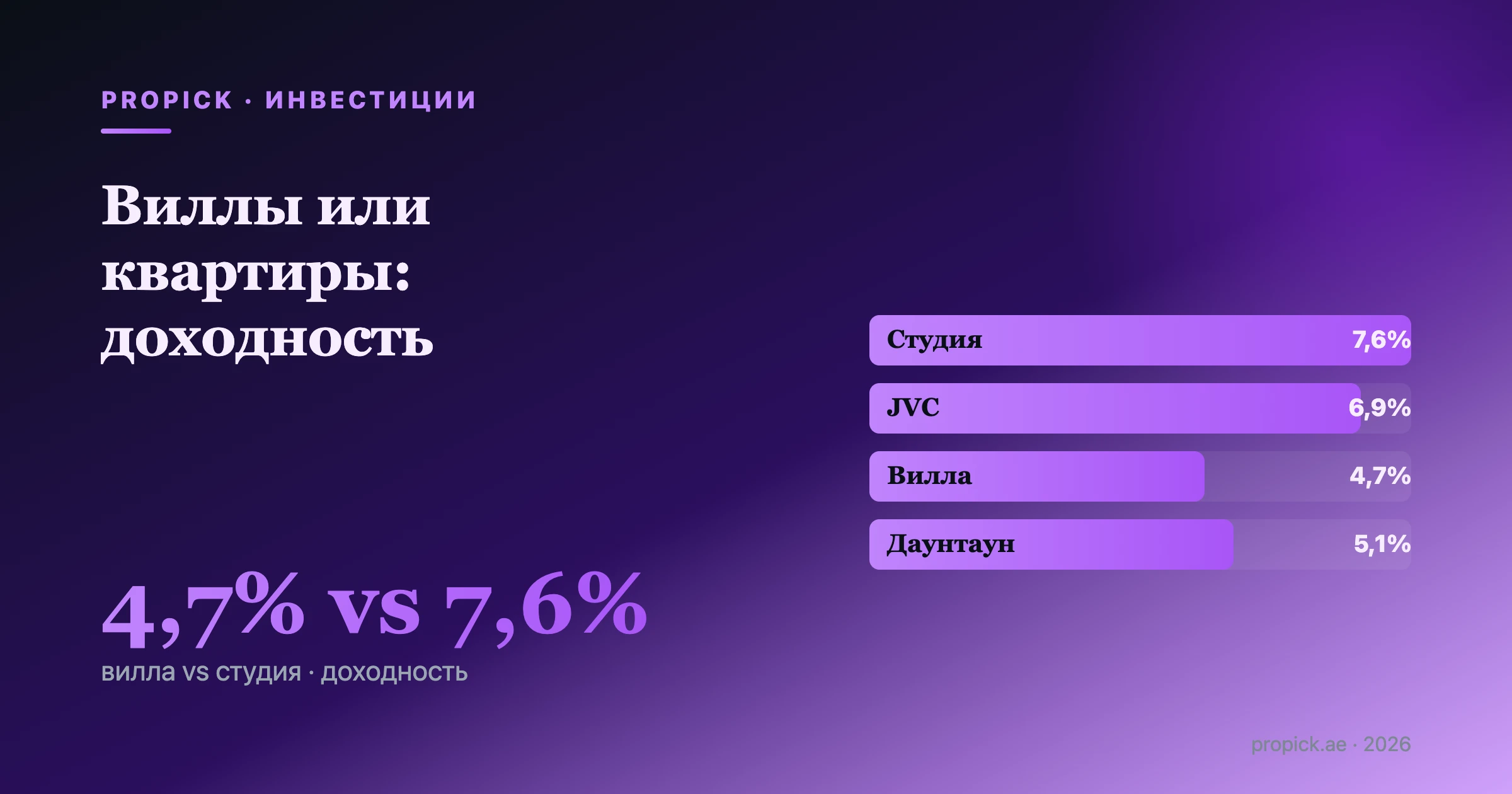
Long-term rental data is available, and we have already calculated it from dld_transactions and dld_rent_contracts. Here is the median gross yield across nine communities for ready apartments as of July 2026, with median prices by unit type:
| Community | AED/sqm | Yield (gross, long-term) | Off-plan share of deals | Studio (AED) | 1BR (AED) | 2BR (AED) |
|---|---|---|---|---|---|---|
| JVC | 13,697 | 6.9% | 51% | 610,000 | 1,000,000 | 1,450,000 |
| JLT | 15,666 | 6.7% | 80% | 772,517 | 1,125,000 | 1,950,000 |
| Sobha Hartland | 21,649 | 6.4% | 20% | 965,000 | 1,350,000 | 2,340,000 |
| Dubai Hills Estate | 25,022 | 6.1% | 62% | 1,020,000 | 1,485,000 | 2,400,000 |
| Business Bay | 20,306 | 5.9% | 50% | 1,020,000 | 1,500,000 | 2,254,058 |
| Palm Jumeirah | 29,036 | 5.4% | 39% | 1,500,000 | 3,050,000 | 4,700,000 |
| Dubai Creek Harbour | 25,224 | 5.4% | 70% | - | 1,730,000 | 2,650,000 |
| Dubai Marina | 21,028 | 5.2% | 22% | 1,060,000 | 1,690,000 | 2,600,000 |
| Downtown Dubai | 26,478 | 5.1% | 32% | 1,175,000 | 2,000,000 | 3,450,000 |
The theory is simple: in peak season, a daily rate can generate more revenue annualised than a fixed long-term contract. In practice, far more cost lines need subtracting: the permit and its renewal, inspections, the Tourism Dirham per night, 5% VAT on turnover, vacancy between bookings (especially in low season, when July and August are hot and arrivals thin out), cleaning, wear on furniture, and an operator's commission if the unit is not self-managed. Our full breakdown in rental yield by area in Dubai is a sound baseline before layering on any short-term premium.
Tourist demand has historically clustered in the same communities that top the price table above (Dubai Marina, Downtown, Business Bay, Palm Jumeirah), where competition among management companies is stiffest and a building permitting short lets is easiest to find. In more residential, budget-oriented communities such as JVC, tourist demand is thinner and OA consent is harder to secure.
Self-managing versus using an operator, and choosing a format
An owner managing units personally applies for the permit and deals directly with guests and booking platforms. A specialist management company must hold its own DED trade licence for the activity, separate from the owner's unit-level permit, and its fee is normally subject to 5% VAT as a service, even though letting residential property for six months or more is itself VAT-exempt. Before signing with an operator, confirm the building actually allows short stays; see the NOC section above.
If the priority is flexibility and stronger peak-season revenue, and you can handle the operational side, short-term letting may justify its extra costs. If the priority is predictable cash flow with minimal admin, long-term renting with an Ejari registration is simpler, and its returns by community are covered in the best areas in Dubai to buy. Either way, factor in the cost of ownership: the one-off DLD registration fee on purchase (4% of the transaction value, in practice paid in full by the buyer on the secondary market) and other charges are covered in taxes and fees when buying property in Dubai.
FAQ
Do I need a permit to list an apartment on Airbnb in Dubai? Yes. Under Decree No. (41) of 2013, short-term letting without a DET (formerly DTCM) permit is prohibited, regardless of ownership or platform.
How much does a holiday home permit cost? Under Resolution No. (49) of 2014, the annual fee is AED 300 per bedroom, capped at AED 1,200 per unit, plus AED 500 for issuing or renewing the permit, AED 100 for initial approval, and AED 300 per inspection.
What are the fines for letting without a permit? AED 5,000 for a first offence under Resolution No. (49) of 2014, doubling on repeat within a year up to a AED 100,000 ceiling; DET can also suspend or cancel the permit.
Is VAT payable on short-term rental income? Yes, at 5%. A unit where the guest gets services beyond occupancy, such as cleaning between stays, is not a "residential building" for VAT and is taxed as commercial property; see the FTA VAT Guide on real estate (VATGRE1).
How does short-term letting differ from an Ejari tenancy contract? Ejari registers tenancies of six months or longer through DLD's RERA system. Short-term letting is a separate DET activity where the permit itself is the registration.
How do I find out whether my building allows short-term letting? Get written consent (an NOC) from the management company or Owners Association. DET rejects applications without it; the decision rests with the developer or OA, not DET.
Sources
- Dubai Legislation. Decree No. (41) of 2013 Regulating the Activity of Leasing out Holiday Homes in the Emirate of Dubai. https://dlp.dubai.gov.ae/Legislation%20Reference/2013/Decree%20No.%20%2841%29%20of%202013.html
- Dubai Legislation. Executive Council Resolution No. (49) of 2014 Approving the Fees and Fines Related to the Activity of Leasing out Holiday Homes in the Emirate of Dubai. https://dlp.dubai.gov.ae/Legislation%20Reference/2014/Executive%20Council%20Resolution%20No.%20%2849%29%20of%202014.html
- Dubai Legislation. Executive Council Resolution No. (2) of 2014 (introducing the Tourism Dirham). https://dlp.dubai.gov.ae/Legislation%20Reference/2014/Executive%20Council%20Resolution%20No.%20%282%29%20of%202014.pdf
- Dubai Legislation. Administrative Resolution No. (2) of 2020 Prescribing the Rules for Calculating, Collecting, and Paying the Tourism Dirham Fee in the Emirate of Dubai. https://dlp.dubai.gov.ae/Legislation%20Reference/2020/Administrative%20Resolution%20No.%20%282%29%20of%202020%20Prescribing%20the%20Rules%20for%20Calculating,%20Collecting,%20and%20Paying%20the%20Tourism%20Dirham%20Fee%20in%20the%20Emirate%20of%20Dubai.html
- Dubai Department of Economy and Tourism (DET). Tourism Dirham. https://www.dubaidet.gov.ae/en/legislative-news/tourism-dirham-executive-council-resolution-no-2-of-2014
- Dubai Department of Economy and Tourism (DET). Issue a new Holiday Homes permit. https://www.dubaidet.gov.ae/en/our-services/for-consumers-and-students/issue-a-new-holiday-homes-permit
- Dubai Department of Economy and Tourism (DET). Apply for a holiday home permit. https://www.dubaidet.gov.ae/en/our-services/for-consumers-and-students/apply-for-a-holiday-home-permit
- Dubai Department of Economy and Tourism (DET). Renew a Holiday Homes permit. https://www.dubaidet.gov.ae/en/our-services/for-consumers-and-students/renew-a-holiday-home-permit
- Dubai Department of Economy and Tourism (DET). Register on the ePermits portal. https://www.dubaidet.gov.ae/en/our-services/for-consumers-and-students/register-on-epermits
- Federal Tax Authority (FTA). VAT Guide - Real Estate, VATGRE1 (April 2021), sections 3.1 and 6.2, definition of "residential building" and 5% VAT rate for commercial/serviced property. https://tax.gov.ae/DownloadOpenTextFile?fileUrl=en/VAT_VAT_Guides/Real_Estate_Guide/Real_Estate_Guide_VATGRE1_EN_19_04_2021_EN.pdf
- Federal Tax Authority (FTA). VAT Registration, mandatory threshold AED 375,000, voluntary AED 187,500. https://tax.gov.ae/en/taxes/Vat/vat.topics/registration.for.vat.aspx
- Dubai Land Department. Register/Renew Rental Contract (Ejari). https://dubailand.gov.ae/en/eservices/register-renew-ejari-contract/
- Dubai Land Department / DLD Open Data. Dataset "dld_transactions" (property sale transactions). https://dubailand.gov.ae/en/open-data/real-estate-data/
- Dubai Land Department / DLD Open Data. Dataset "dld_rent_contracts" (registered Ejari rental contracts). https://dubailand.gov.ae/en/open-data/real-estate-data/
- Dubai Land Department. Property Sale Registration (4% registration fee, in practice paid by the buyer on the secondary market). https://dubailand.gov.ae/en/eservices/property-sale-registration/
- Dubai Media Office. Hamdan bin Mohammed approves second, larger AED 1.5 billion economic incentives package, including temporary exemption from holiday home permit/licence fees and Tourism Dirham collection (21 May 2026). https://mediaoffice.ae/en/news/2026/may/21-05/hamdan-bin-mohammed