Buying a first apartment in Dubai is a decision. Buying a fourth or fifth is a strategy, and it needs different tools. Past a single unit, the question changes from "is this a good deal" to "does this asset do something the rest of my holdings do not."
Using Dubai Land Department (DLD) transaction and rent data, this guide covers scaling a portfolio: spreading risk across community and unit type, using leverage and refinancing to recycle equity, balancing cash flow against appreciation, budgeting overhead, and planning an exit before it becomes urgent. It is also honest about where portfolios stay concentrated, and where Dubai's liquidity is thinner than brochures suggest.
Why One Unit Is Not a Portfolio
A single Dubai apartment is a bet on one community, one unit type and one point in the price cycle. Our ready-resale data as of July 2026 shows why that matters: year-on-year price movement is far from uniform. Business Bay is up 6.9% and Palm Jumeirah up 5.3%, while Downtown Dubai is down 3.3% and Sobha Hartland down 4.2% over the same period. An investor holding only one of those communities had a very different year than one holding all four.
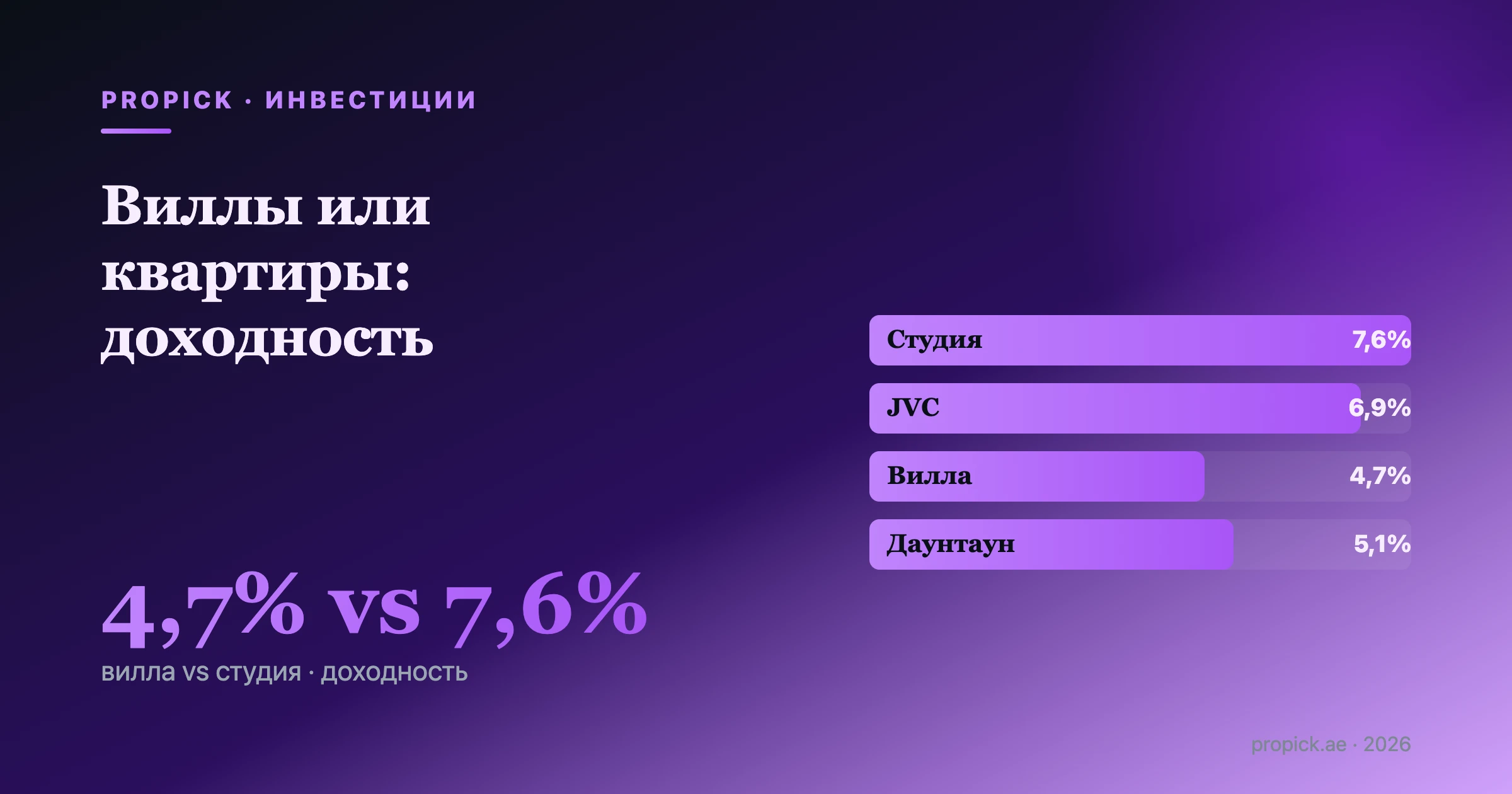
The same logic applies to unit type. A portfolio built entirely from studios captures the market's highest gross yield, around 7.6%, but concentrates tenant turnover. One built entirely from villas captures appreciation and lower turnover, but ties up more capital per unit for about 4.7% on a median transacted price of 3.8 million AED. Spreading across both hedges against being wrong about which segment wins over the next five years, not against Dubai itself.
The Yield-vs-Capital Map
Every community sits somewhere on a line between cash flow and capital growth, and the two rarely peak together. Ready-resale medians from DLD's Open Data portal:
| Community | Price/sqm (median) | Gross yield | YoY price change |
|---|---|---|---|
| JVC | 13,697 AED | 6.9% | not measured here |
| JLT | 15,666 AED | 6.7% | not measured here |
| Sobha Hartland | 21,649 AED | 6.4% | -4.2% |
| Dubai Hills Estate | 25,022 AED | 6.1% | not measured here |
| Business Bay | 20,306 AED | 5.9% | +6.9% |
| Marina | 21,028 AED | 5.2% | +3.0% |
| Dubai Creek Harbour | 25,224 AED | 5.4% | not measured here |
| Palm Jumeirah | 29,036 AED | 5.4% | +5.3% |
| Downtown Dubai | 26,478 AED | 5.1% | -3.3% |
The highest per-square-meter prices (Palm, Downtown, Creek Harbour) sit at the bottom of the yield range, because buyers there pay for scarcity and address, not rental arithmetic. The mid-market volume communities (JVC, JLT, Business Bay, Sobha Hartland, Dubai Hills) clear 5.9% to 6.9% gross, doing more of the cash-flow work. Pairing a Palm or Downtown unit for long-run growth with two or three JVC- or Business Bay-type units for cash flow is a different portfolio than five units in one price band.
Diversifying by Type and Tenure
Unit type and hold structure add two more axes beyond community. Villas are capital-heavy and appreciation-leaning, with lower tenant turnover. Studios sit opposite: the highest gross yield at approximately 7.6%, smaller outlay per unit, but more tenant changeover and management work per rent dirham collected. Mid-market one- and two-bedroom apartments sit between the two.
Ready versus off-plan is a separate axis. Off-plan carries construction and completion risk but a lower entry price and a spread payment plan; ready property carries immediate income and a verifiable rent history but ties up full capital upfront. Deal volume in our dataset skews heavily toward outright sales, around 81%, against roughly 14% financed through a mortgage, a reminder that most buyers here are not leveraged.
Using Leverage: What a Bank Will Actually Lend
Leverage is how a portfolio scales faster than savings alone, under one rulebook that governs every licensed UAE bank. Article 3 of the CBUAE's mortgage regulations gives an expatriate buying a first home up to 80% loan-to-value (LTV) under AED 5 million and 70% above it. The figure that matters for a portfolio builder differs: a second or subsequent property is capped at a flat 60% LTV regardless of price, and off-plan purchases at 50% for every buyer category. Each purchase past the first needs proportionally more cash, a ceiling that does not loosen with a strong repayment record.
Two more limits bind alongside LTV: a Debt Burden Ratio (DBR) cap of 50% of gross income across all loans, tested against a rate stressed 2 to 4 points above the offer, with two months' rent deducted for an investment unit; and a loan-amount ceiling of 7 times annual income for expatriates (8 for nationals). A "keep buying at 60% LTV" strategy usually hits the DBR or income-multiple ceiling before it hits LTV, so model both from the start.
Recycling Equity Through Refinancing
Where leverage gets interesting for a multi-unit investor is refinancing, known locally as a mortgage buy-out. If a community has appreciated since purchase, the gap between the outstanding loan and current market value is what makes equity release possible: an owner refinances for more than the remaining balance, against current value, and takes the difference in cash to fund the next purchase.
Switching banks requires a liability letter and early settlement from the outgoing lender. The CBUAE's fee schedule for bank loans and other services caps the early settlement fee on a home loan at 1% of the outstanding balance or AED 10,000, whichever is less, plus a fresh valuation from the incoming bank. At DLD, a new mortgage registration costs 0.25% of the loan amount, and releasing the old one costs a fixed AED 1,000 fee. Neither is the 4% transfer fee: refinancing does not change ownership, so that charge does not apply. The cash-out portion still sits under the same LTV and DBR caps and adds to total interest paid, so treat recycled equity as new leverage, not a windfall.
Cash Flow vs Appreciation: Setting the Mix
Every unit contributes to one of two things: monthly income or long-run capital gain, rarely both at once. The community table above makes the trade-off explicit: a Palm or Downtown unit at 5.1% to 5.4% gross yield underwrites scarcity and appreciation; a JVC or JLT unit at 6.7% to 6.9% underwrites income. Neither is objectively better; the question is whether the portfolio needs to service debt now or compound capital over a longer hold.
A portfolio with no cash-flowing assets is exposed if rates rise or a refinance falls through. One with no appreciation-leaning assets caps long-run upside and may miss a recovery in communities currently repricing. Most investors past two or three units deliberately split: a core of cash-flowing mid-market units funding debt service, and a smaller allocation to lower-yield communities held for the multi-year trade.
Management Overhead at Scale
One rented unit runs on a phone and a spreadsheet. Five or ten units across different communities usually cannot, and overhead is where portfolio-level returns quietly erode if not budgeted honestly. Every tenancy must be registered through DLD's Ejari system, and any rent increase on renewal should be checked against the DLD Rental Index first. A licensed manager typically charges a percentage of collected rent plus a fee per new tenant, so the highest-yield studios and JVC-type units also generate the most transactions to manage. A unit run as a short-term let instead needs a separate permit from the Department of Economy and Tourism, with its own insurance rules and higher fees against booking revenue.
Service charge scales with unit count and is easy to underbudget across a mixed portfolio. Under Law No. (6) of 2019, the obligation sits with the owner regardless of occupancy, and the figure for each building is only reliably checked through the DLD Service Charge Index via Mollak, since neighboring towers in one community can carry very different approved rates. Check it per asset, not as a community average.
Concentration and Liquidity Risk, Honestly
Diversification reduces risk; it does not remove it. Concentration does not disappear just because a portfolio holds multiple units: five apartments bought in the same 12-month window in similar mid-market communities are still exposed to a single point in the price and rate cycle, whatever the different postcodes suggest.
Liquidity is also uneven. Mid-market apartments in high-volume communities like JVC and JLT typically resell faster than villas or ultra-prime units, simply because the buyer pool is larger, so a portfolio heavy in villas or prime units should assume a longer marketing period on exit. Off-plan assignment before handover is processed through the interim property register and, in practice, requires the developer's administrative sign-off before DLD registers the transfer, a step ready-property sales skip. Investors combining several units to reach the AED 2 million Golden Visa threshold should also weigh that selling one qualifying unit can affect the visa.
Planning the Exit Before You Need To
An exit plan should shape which units get bought, not get written the year a sale becomes necessary. Two costs are fixed regardless of timing: the DLD transfer fee, effectively 4% of the transacted price and paid in practice by the buyer on a secondary sale, and any outstanding mortgage, which must be settled and released from title before a clean transfer can register. Beyond that, liquidity should drive selective disposal: the higher-yield, faster-turnover mid-market unit is usually the quicker sale; the prime or villa asset held for appreciation needs a longer runway and should ideally be exited into strength, not under time pressure. A portfolio built with exit in mind holds a mix of quickly liquidated and patiently held assets, so a need for cash never forces a sale of the wrong unit at the wrong point in its cycle.
FAQ
How many Dubai properties count as a "portfolio" rather than a few units? No regulatory threshold exists. The practical shift happens once an investor manages exposure across community, unit type and leverage rather than judging each purchase alone, sometimes as early as a second or third unit.
How much can I borrow against a second Dubai investment property? Under CBUAE rules, a second or subsequent property for an expatriate is capped at 60% loan-to-value regardless of price, below the 70-80% on a first home, and separately subject to the 50% DBR cap and the income-multiple ceiling.
Does refinancing one property to buy another trigger the 4% DLD fee? No. The 4% fee applies to a change of ownership. Refinancing only changes which bank holds the mortgage, triggering the smaller registration and release fees instead.
Should I prioritize cash flow or appreciation across my portfolio? Most experienced investors hold both: mid-market, higher-yield units (JVC, JLT, Business Bay) for income to cover debt service, alongside a smaller allocation to prime or villa assets for long-run capital growth.
What overhead do investors underestimate most at scale? Service charge, billed per building rather than per portfolio and varying sharply between towers in the same community. Check the DLD Service Charge Index per asset rather than assuming a community average.
Sources
- Dubai Land Department, Open Data portal, dld_transactions and dld_rent_contracts datasets: https://dubailand.gov.ae/en/open-data/real-estate-data/
- Central Bank of the UAE, CBUAE Rulebook, Article (3): Important Ratios (Circular 31/2013, in force): https://rulebook.centralbank.ae/en/rulebook/article-3-important-ratios
- Central Bank of the UAE, CBUAE Rulebook, Regulation No. 29/2011 Regarding Bank Loans & Other Services Offered to Individual Customers, Appendix No. 2 (fee schedule, home loan early settlement and liability letter fees): https://rulebook.centralbank.ae/en/rulebook/appendix-no-2
- Dubai Land Department, Request for Mortgage Registration (0.25% fee): https://dubailand.gov.ae/en/eservices/request-for-mortgage-registration/
- Dubai Land Department, Mortgage Release / Termination service (AED 1,000 fee): https://dubailand.gov.ae/en/eservices/request-for-mortgage-termination/
- Dubai Land Department, Property Sale Registration (4% transfer fee, paid in practice by the buyer on the secondary market): https://dubailand.gov.ae/en/eservices/property-sale-registration/
- Dubai Land Department, Register/Renew Tenancy Contract (Ejari) service: https://dubailand.gov.ae/en/eservices/register-renew-ejari-contract/
- Dubai Land Department, Rental Index calculator: https://dubailand.gov.ae/en/eservices/rental-index/rental-index/
- Dubai Land Department, Service Charge Index Overview: https://dubailand.gov.ae/en/eservices/service-charge-index-overview/
- Mollak (RERA/DLD), About Us: https://mollak.dubailand.gov.ae/publicpages/about-us.html
- Government of Dubai Legal Affairs Department, Law No. (6) of 2019 Concerning Ownership of Jointly Owned Real Property in the Emirate of Dubai: https://dlp.dubai.gov.ae/Legislation%20Reference/2019/Law%20No.%20%286%29%20of%202019%20Concerning%20Ownership%20of%20Jointly%20Owned%20Real%20Property%20in%20the%20Emirate%20of%20Dubai.html
- Dubai Legislation Portal, Law No. (13) of 2008 Regulating the Interim Real Property Register in the Emirate of Dubai: https://dlp.dubai.gov.ae/Legislation%20Reference/2008/Law%20No.%20%2813%29%20of%202008.html
- Dubai Department of Economy and Tourism (DET), Holiday Home Permit application: https://www.dubaidet.gov.ae/en/our-services/for-consumers-and-students/apply-for-a-holiday-home-permit
- Dubai Land Department, Golden Visa application, Investor (AED 2 million combined-property threshold): https://dubailand.gov.ae/en/eservices/request-for-golden-visa-investor/