Every quarter, a fresh headline reports how many billion dirhams changed hands in Dubai real estate. What almost nobody reports is how those deals were actually funded. Was the buyer wiring cash from an offshore account, or was a bank standing behind the purchase with a mortgage? That distinction matters more than the headline transaction value, because it tells you how exposed the market really is to interest rates, bank credit conditions, and the kind of buyer showing up at the trustee office.
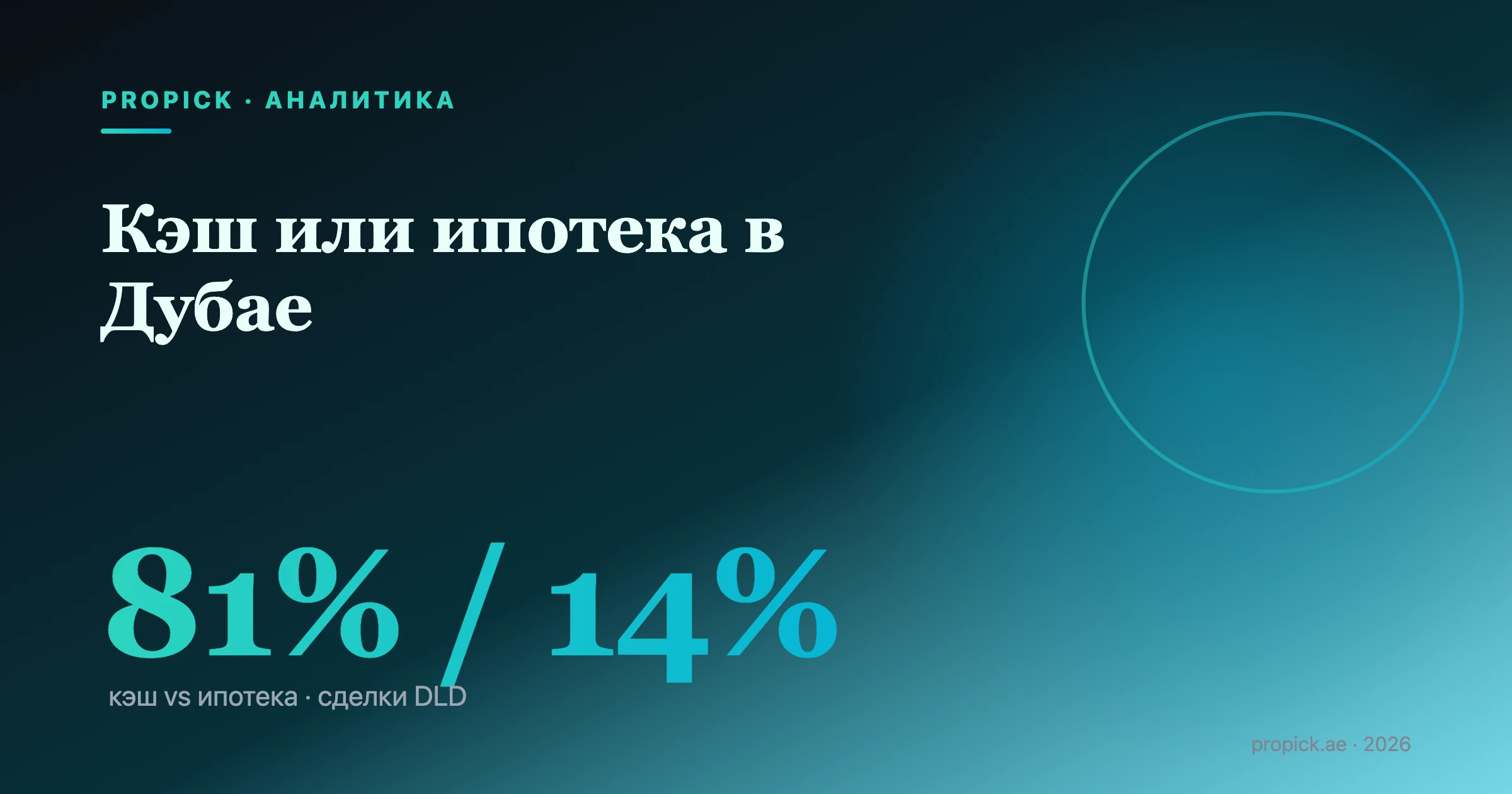
Propick pulled a sample of roughly 3,000 residential unit transactions registered with the Dubai Land Department (DLD) in 2026 and classified each one by deal structure, not just by sale value. The result confirms something the market has long assumed but rarely quantified with real registry data: Dubai is overwhelmingly a cash market. Outright sales account for about 81% of residential unit transactions. Mortgage registrations sit at roughly 14%. Gift transfers, typically used for intra-family transfers of ownership, make up about 4%. This is our own cut of DLD's transaction and mortgage registration data, and to our knowledge it is not a split that any other Dubai property outlet publishes on a regular basis.
The real split: what the deal-structure breakdown shows
DLD's public dashboards report sales, mortgages and gifts as separate procedure types, each with its own count and value. What they do not do is stitch those three procedure types together into a single percentage-of-total picture for residential units in a given period. That is the gap this analysis fills.
| Deal structure | Share of residential unit transactions | What it means |
|---|---|---|
| Outright sale (cash) | ~81% | Buyer pays the full price without a registered mortgage |
| Mortgage registration | ~14% | Buyer takes bank financing, registered against the title |
| Gift transfer | ~4% | Ownership moves without a sale price, usually within a family |
| Unclassified / other | ~1% | Corporate transfers, court orders, and edge cases |
Two things stand out. First, the gap between cash and mortgage is not close, it is roughly six to one. Second, gift transfers, at 4%, are not a rounding error. They are large enough to be a real feature of how Dubai property changes hands, likely reflecting estate planning and intra-family restructuring among long-term owner-investors, and any analysis that lumps gifts in with "cash sales" is overstating the true outright-purchase figure.
Why Dubai runs cash-first
The 81% cash share is not a one-off blip. It reflects who is actually buying. Dubai's investor base skews heavily toward overseas and GCC buyers who are not seeking or do not qualify for UAE bank financing, developers who structure their own off-plan payment plans as an alternative to a mortgage, and a large share of high-net-worth buyers for whom a mortgage is a financing choice rather than a necessity.
Mortgage activity is real, just from a much smaller base. For the full year 2025, Dubai Land Department data reported by Gulf News put mortgage transactions at AED 179.26 billion across roughly 50,974 deals, against a market that recorded 214,912 sales transactions worth AED 682.49 billion and 9,556 gift transfers worth AED 57.25 billion in the same year. Mortgages are a meaningful and active financing channel, but they sit inside a market where outright sales transactions still outnumber them by roughly four to one.
That combination, a small but growing mortgage segment sitting inside a much larger cash-dominated market, is the structural reason Dubai's transaction volumes have historically held up better than mortgage-heavy markets when borrowing costs move. A rate cut helps the 14%. It barely touches the 81%.
Methodology
This is our own computation, not a republished DLD chart, so the method matters. We drew a sample of approximately 3,000 residential unit transactions registered with the Dubai Land Department in 2026, sourced from the DLD transaction and mortgage registration datasets published through the DLD Open Data portal. Each record was classified into one of four deal-structure buckets, sale (outright, no mortgage registered against the title at the time of transfer), mortgage (a mortgage registration procedure tied to the same unit and transfer window), gift (a registered gift transfer, typically zero or nominal consideration), or unclassified (corporate transfers, court-ordered transfers, and other low-frequency procedure types).
We restricted the sample to residential unit transactions to keep the split comparable across deal types and excluded land plots and commercial units, where financing patterns differ meaningfully. Shares are rounded to the nearest whole percentage point, which is why the four buckets sum to slightly under 100%. Because DLD records sales and mortgage registrations as separate procedures rather than a single combined "how was this paid for" field, our classification maps mortgage registrations back to their underlying sale transaction by unit and date rather than counting each dataset in isolation, which is what allows the 81/14/4 split to be expressed as shares of one total rather than as three unrelated totals. Data reflects registrations as of July 2026 and will shift modestly as the year's later transactions are registered and classified.
What the cash-heavy market means for buyers
For a cash buyer, the practical cost stack is simpler: purchase price, plus the DLD transfer fee of 4% of the sale value, which in practice is paid in full by the buyer on the vast majority of secondary-market deals, plus the usual trustee office and admin charges. There is no bank valuation, no mortgage registration fee, and no loan-to-value ceiling to work around.
For a mortgage buyer, the same 4% DLD fee applies, but it sits alongside a separate mortgage contract registration fee, set at 0.25% of the mortgage value, plus the lender's own valuation and processing charges, plus the loan-to-value limits set by the UAE Central Bank that determine how much of the price the bank will actually finance. None of that is a reason to avoid a mortgage. It is a reason to budget for it as a materially different, and typically costlier upfront, path to the same title deed.
What it means for market resilience
The structural read is the more important one for anyone watching Dubai from the outside. A market where 81% of unit sales do not depend on bank credit is far less mechanically sensitive to a central bank rate decision than a market where most buyers are financed. When the US Federal Reserve or the UAE Central Bank moves rates, it reprices the cost of debt for the 14% of transactions that carry a mortgage, and by extension, for developers relying on end-user mortgage buyers to absorb inventory. It does very little to the incentives of the 81% paying cash.
That does not make Dubai immune to a slowdown, cash buyers still respond to price, yield, and sentiment. But it does mean that rate-driven mortgage market stress, of the kind that has hit heavily leveraged markets elsewhere, transmits far more slowly and with far less force here. Mortgage lending is a real and active part of the market, one worth tracking as it expands. It is happening inside a market where cash, not credit, still sets the pace.
FAQ
Does an 81% cash share mean Dubai buyers don't use debt at all? No. It means outright cash purchases outnumber mortgage-registered purchases by roughly six to one in our residential sample. Mortgage volume is real, DLD recorded roughly 50,974 mortgage transactions worth AED 179.26 billion across 2025, it is simply a minority of deals against 214,912 outright sales that same year.
Why is mortgage penetration so much lower in Dubai than in markets like the UK or the US? Dubai's buyer base is heavily international and GCC-based, and a large share of that base either does not seek UAE bank financing or buys through developer payment plans instead of a bank loan. Local end-users are more likely to use mortgages, but they are a smaller share of total transaction volume than in owner-occupier-dominated markets.
Who actually pays the 4% DLD transfer fee, buyer or seller? In practice, on secondary-market resale transactions, the buyer conventionally absorbs the full 4% as part of the standard Memorandum of Understanding, though this is a market convention rather than a legal requirement.
Does the low mortgage share make Dubai immune to interest rate moves? It reduces mechanical exposure to rate-driven mortgage stress, since only about 14% of unit sales carry a registered mortgage. It does not remove sentiment-driven or yield-driven sensitivity among cash buyers, who still respond to pricing and rental returns.
Is the cash-versus-mortgage split the same for off-plan and ready secondary properties? Our sample spans registered residential unit transactions broadly. Off-plan buyers frequently use developer payment plans rather than bank mortgages during construction, and often only approach a mortgage lender at or after handover, which is one reason the cash share stays high across the market rather than being concentrated in one segment.
Where can readers check DLD's own mortgage and transaction data directly? DLD publishes transaction and mortgage registration datasets through the DLD Open Data portal (dubailand.gov.ae/en/open-data) and its own dubailand.gov.ae dashboards. Our sample and classification method are described above under Methodology.
Sources
- Dubai Land Department, transaction and mortgage registration datasets, via DLD Open Data portal (dubailand.gov.ae/en/open-data) and dubailand.gov.ae
- Gulf News, "Dubai property market closes 2025 with record Dh682.5 billion in sales", citing Dubai Land Department full-year 2025 sale, mortgage and gift registration totals
- Dubai Media Office, "Dubai's real estate market records new historic milestone with transactions exceeding AED917 billion in 2025"
- Dubai Land Department & Al Tamimi & Company, "Know Your Rights for Real Estate Investors in Dubai", fee schedule for sale, gift and mortgage contract registration (p.27)