Every buyer asks the same three questions before wiring money to Dubai: is the market still going up, could prices crash, and what return can I realistically expect. In 2026 the honest answer is more nuanced than either the bulls or the bears are selling. Official data shows a market cooling from an extraordinary run, correcting in specific segments, and still delivering rental yields most mature cities cannot match.
This article works from the primary source that matters most, the Dubai Land Department's own transaction and rental registration data, cross-checked against the latest reports from CBRE, JLL and ValuStrat.
For a full area-by-area price breakdown, see our companion piece on Dubai property prices by area in 2026. For the yield side specifically, read Dubai rental yield by area in 2026.
What the official data actually shows in 2026
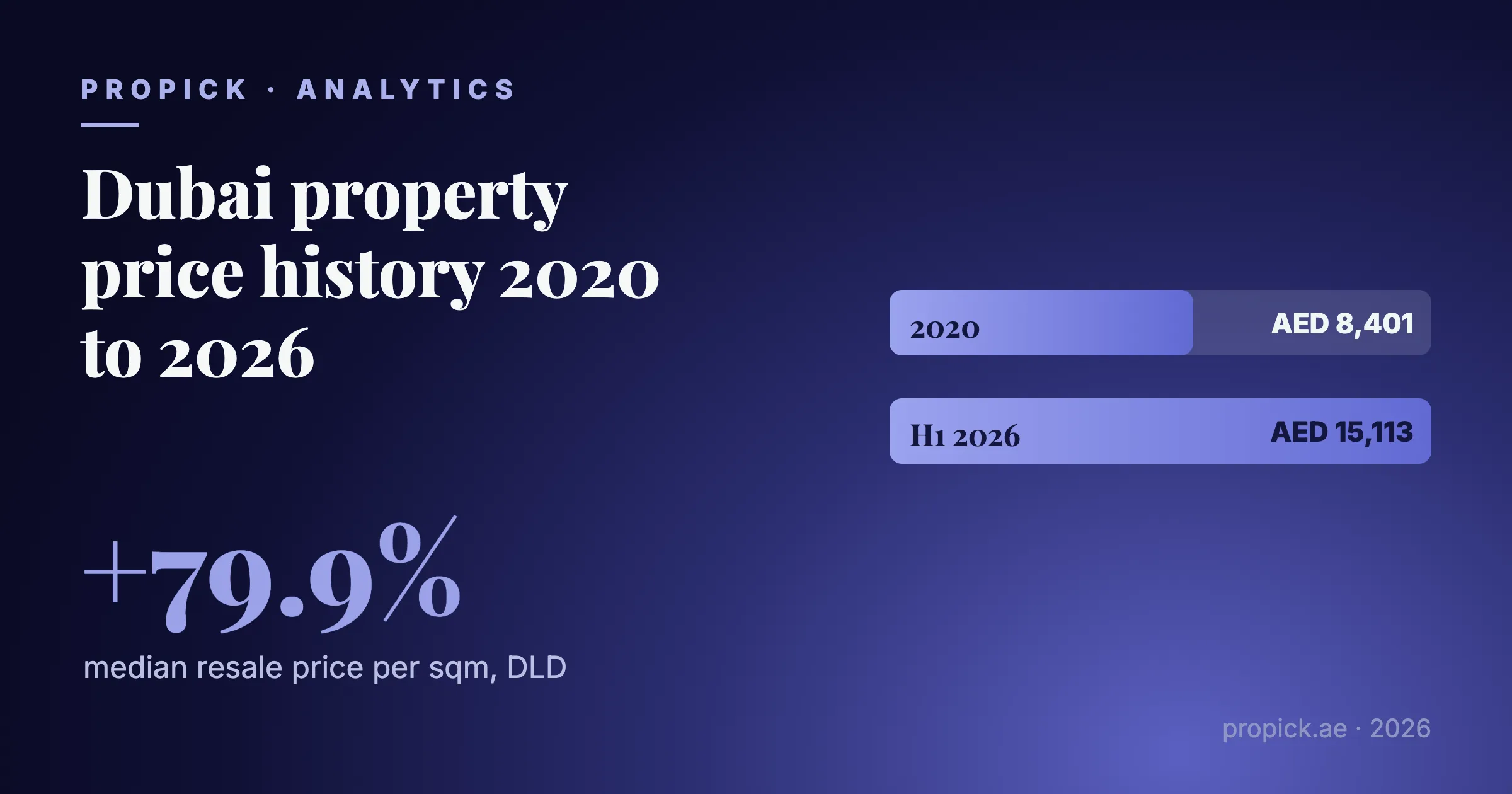
The Dubai Land Department's Residential Properties Price Index (RPPI), the emirate's own benchmark, recorded overall residential sale prices up 6.09% year-on-year as of April 2026, with apartments up 5.49% and villas outperforming at 9.86% annual growth, even as the index eased 1.76% month-on-month, a sign of a market decelerating from its recent peak rather than one accelerating further (DLD RPPI, dubailand.gov.ae).
Transaction volume tells a similar story of moderation, not collapse. Dubai recorded around 45,200 residential transactions in Q1 2026, up 3.9% year-on-year but down 17.1% quarter-on-quarter, with off-plan sales accounting for roughly 72% of the quarter's deals (DLD open data, dubailand.gov.ae). CBRE's Q1 2026 review puts total residential activity above 45,000 transactions worth AED 137 billion, with sales price growth easing to around 9% annually and rental growth slowing to 4.1% (CBRE UAE Real Estate Market Review Q1 2026).
Momentum carried into the second quarter. JLL reports Dubai real estate transaction value reached AED 108.11 billion (USD 29.4 billion) in Q2 2026, and that new project launches in the first half of 2026 crossed AED 275 billion, the largest first-half development pipeline in the emirate's history (JLL UAE Living Market Dynamics). That scale of new supply is exactly why the "will it crash" question deserves a straight answer, covered below.
Our DLD snapshot: yields by community, ready apartments (July 2026)
Rather than repeat generic averages, we pulled our own snapshot directly from the Dubai Land Department's open datasets: dld_transactions (sales) and dld_rent_contracts (new Ejari rental registrations), filtered to ready, existing apartments only and grouped by community (master project), using medians on up to 1,000 of the most recent records per community as of July 2026. Gross yield here is median new annual rent per square metre divided by median ready resale price per square metre, calculated from the same official dld_transactions and dld_rent_contracts datasets on DLD Open Data. Off-plan launch prices are excluded from the price column and shown only as a share of total deals.
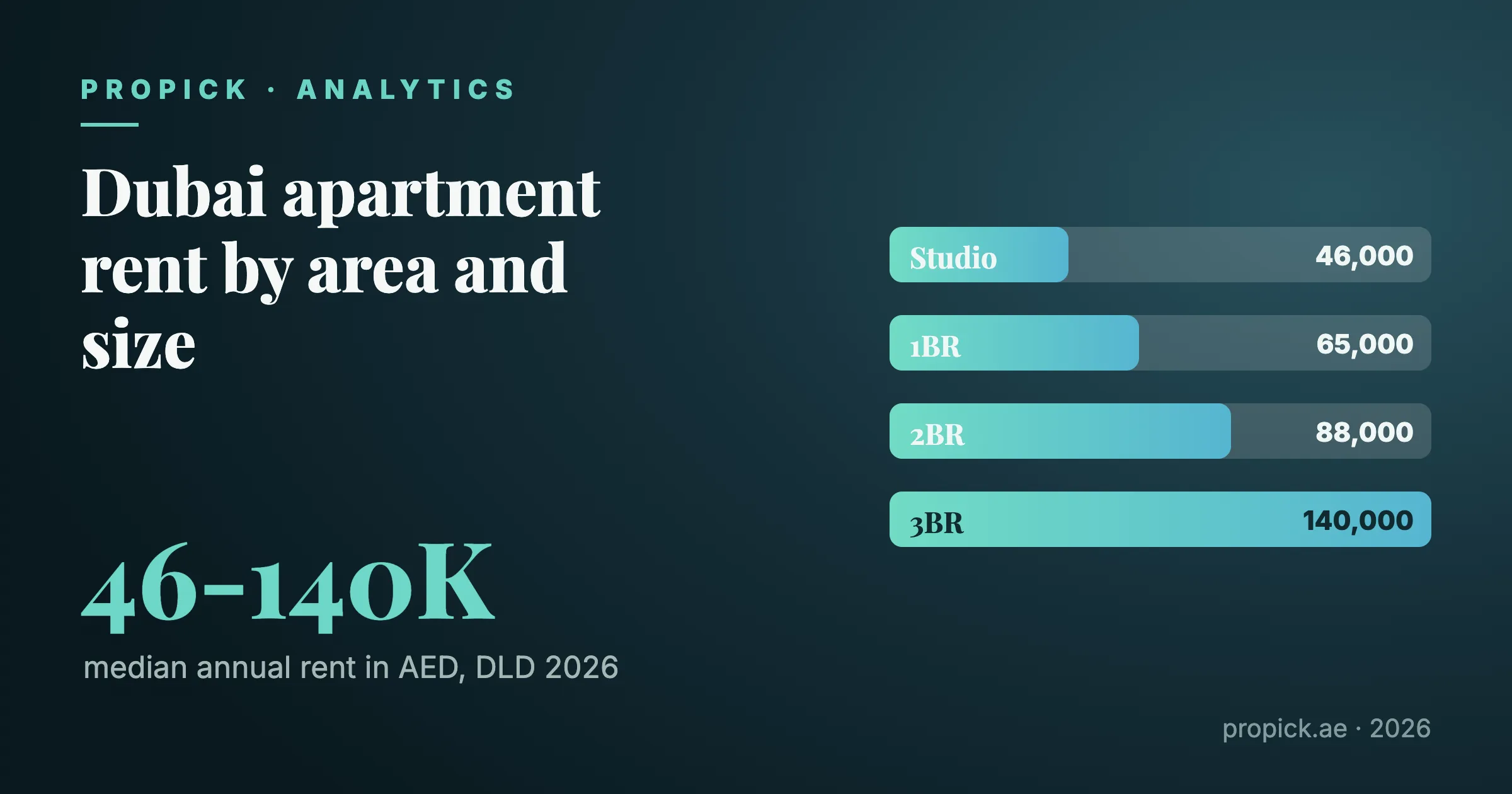
| Community | Price (AED/sqm) | Gross yield | Off-plan share | Studio | 1BR | 2BR (median AED) |
|---|---|---|---|---|---|---|
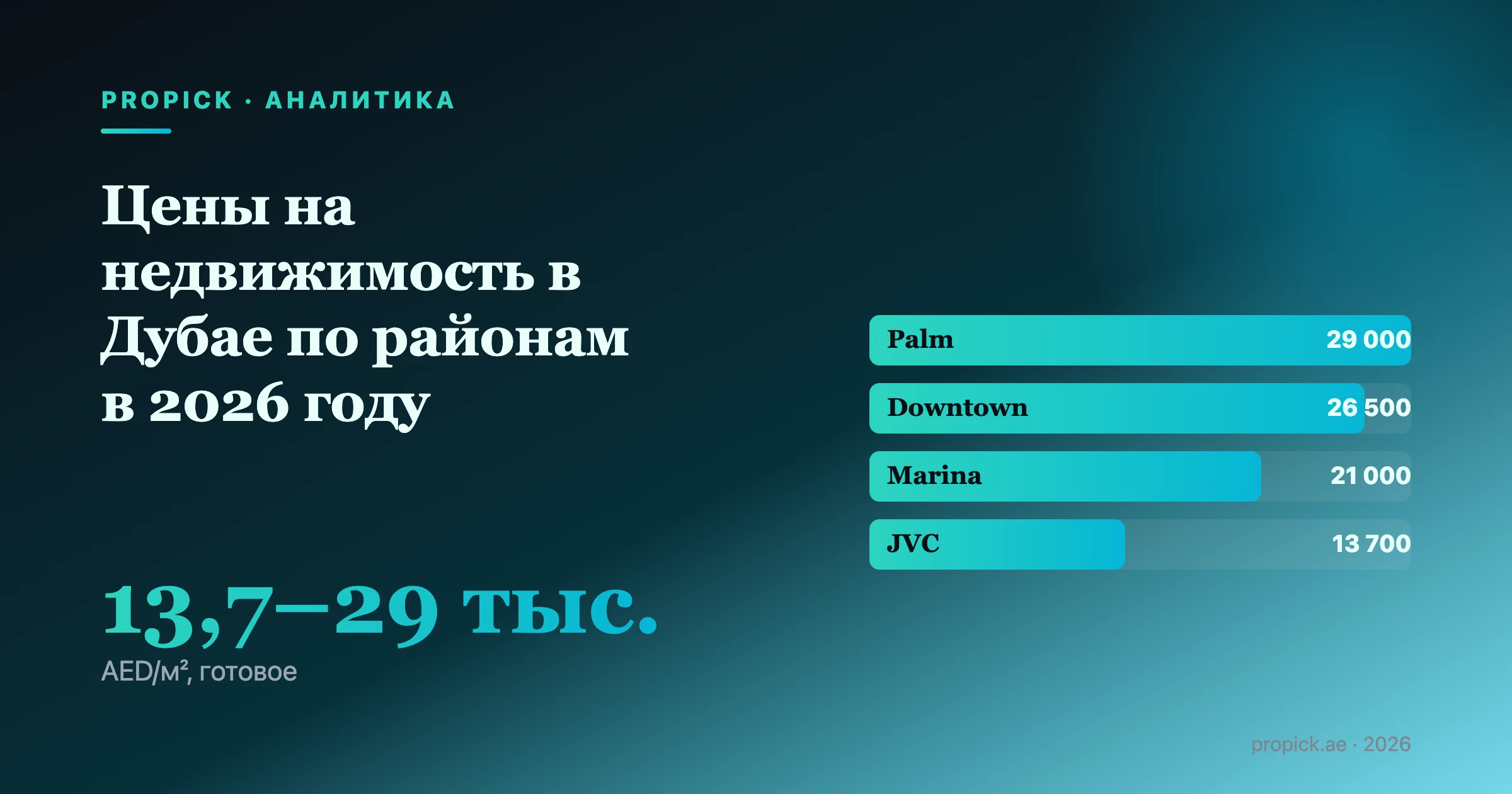
| Palm Jumeirah | 29,036 | 5.4% | 39% | 1,500,000 | 3,050,000 | 4,700,000 |
| Downtown (Burj Khalifa) | 26,478 | 5.1% | 32% | 1,175,000 | 2,000,000 | 3,450,000 |
| Dubai Creek Harbour | 25,224 | 5.4% | 70% | - | 1,730,000 | 2,650,000 |
| Dubai Hills Estate | 25,022 | 6.1% | 62% | 1,020,000 | 1,485,000 | 2,400,000 |
| Sobha Hartland | 21,649 | 6.4% | 20% | 965,000 | 1,350,000 | 2,340,000 |
| Dubai Marina | 21,028 | 5.2% | 22% | 1,060,000 | 1,690,000 | 2,600,000 |
| Business Bay | 20,306 | 5.9% | 50% | 1,020,000 | 1,500,000 | 2,254,058 |
| JLT | 15,666 | 6.7% | 80% | 772,517 | 1,125,000 | 1,950,000 |
| JVC | 13,697 | 6.9% | 51% | 610,000 | 1,000,000 | 1,450,000 |
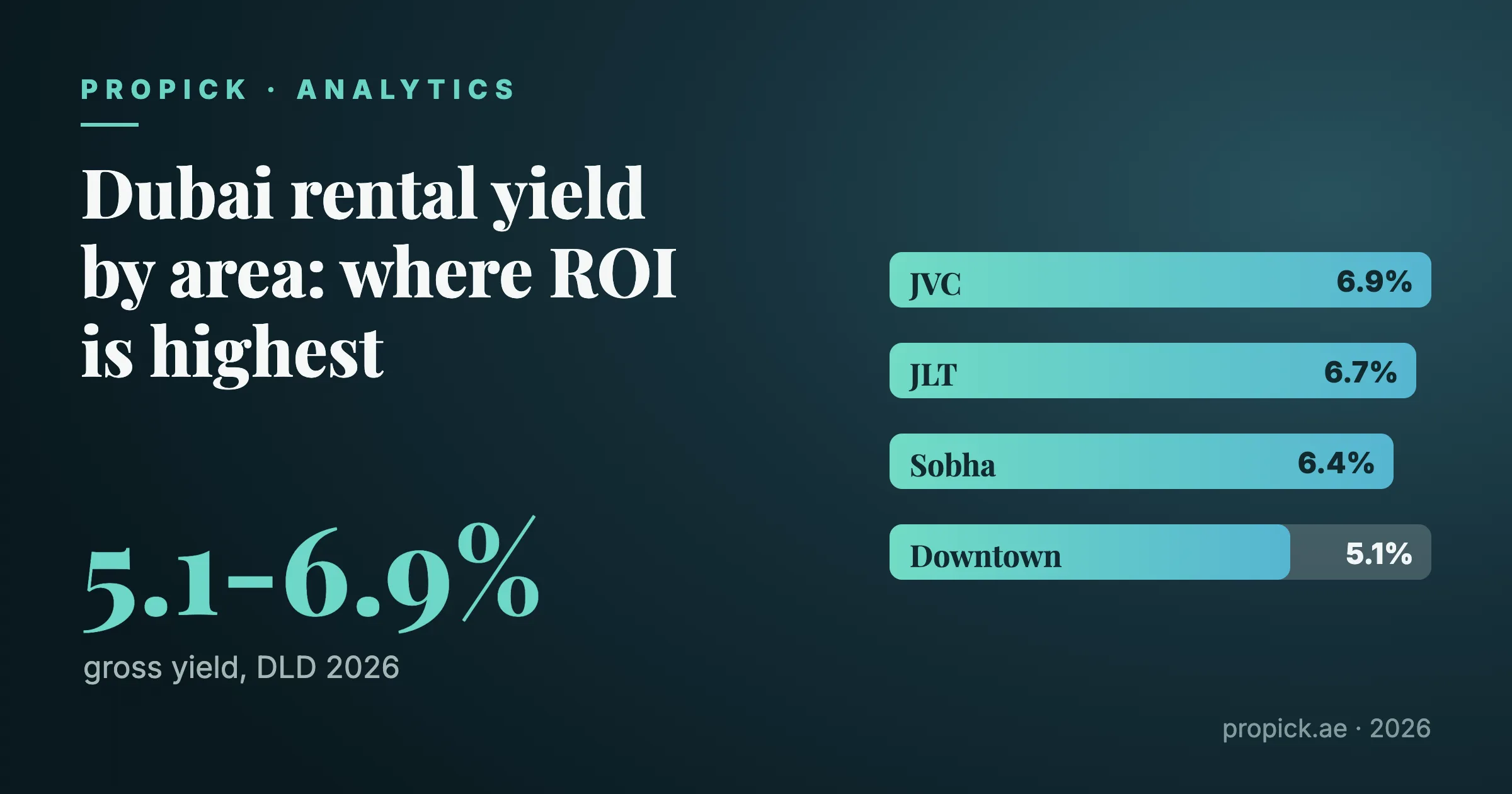
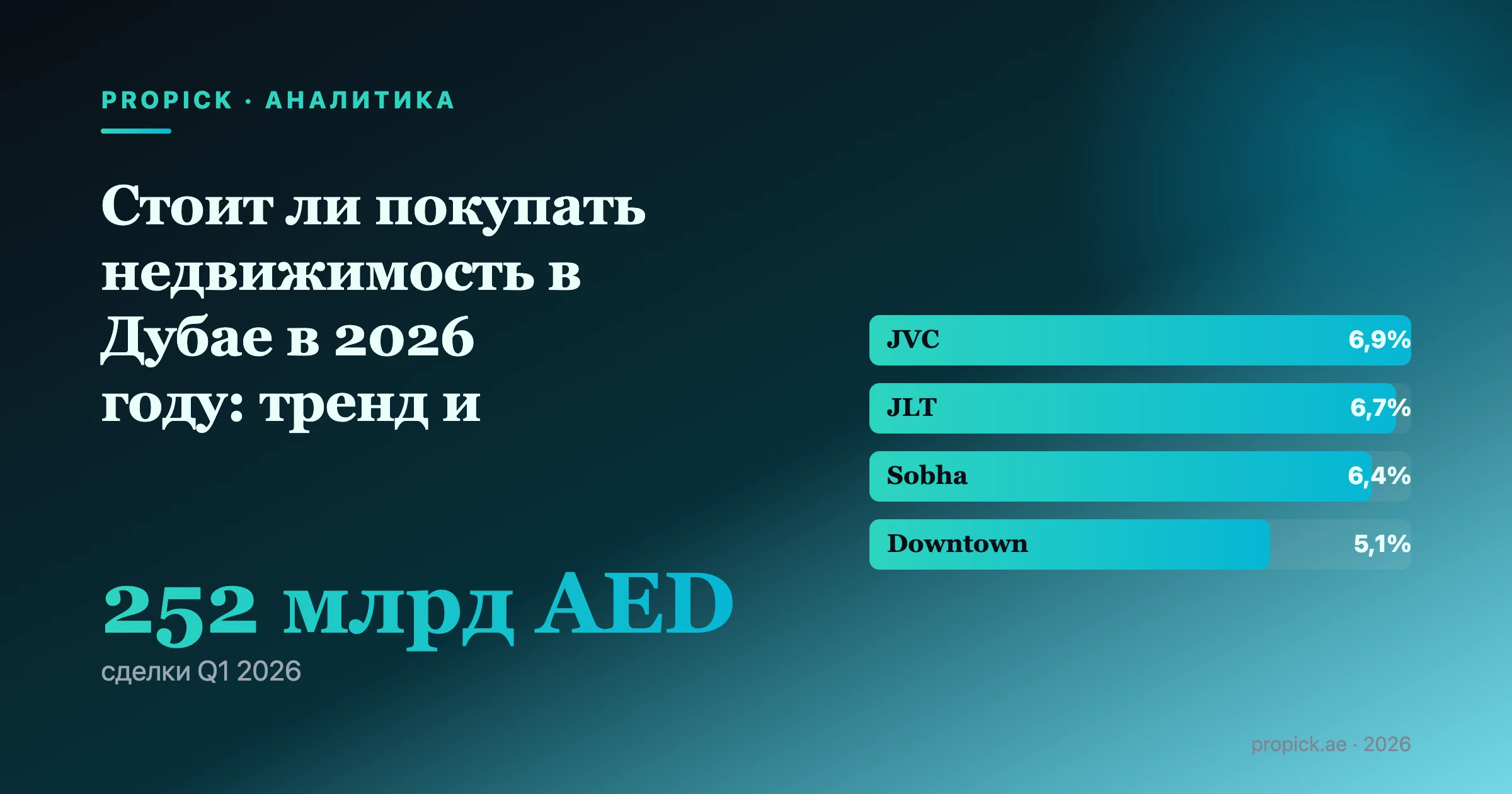
The pattern is consistent with what a mature, data-driven market should show: entry price and gross yield move in opposite directions. Palm Jumeirah and Downtown command the highest per-square-metre prices and the lowest yields around 5%, functioning more like capital-preservation assets in a global luxury portfolio. JVC and JLT sit at the other end, with yields near 7% on much lower ticket sizes, the profile that suits a buyer optimising for cash flow rather than trophy value. Dubai Hills Estate and Sobha Hartland occupy a middle ground, combining above-average yield with meaningfully higher off-plan concentration in current deal flow.
Is Dubai real estate a good investment? The case for
Four structural factors support a "yes," and none of them depend on short-term price momentum.
Yield. Even the lowest figure in the table above, 5.1% gross on Downtown, beats residential rental yields in London, Paris, Singapore or most US coastal metros, with no annual property tax and no capital gains tax on individual resale. Unlike many countries where property is taxed annually and again on sale, Dubai's individual transactions are limited to transaction-level fees, chiefly the 4% DLD registration fee, in practice almost always paid in full by the buyer on the Dubai secondary market.
Rental protection with upside. RERA's Rental Increase Calculator, based on Decree No. 43 of 2013, caps annual rent increases on renewal in fixed bands from 0% up to 20% depending on how far below the market benchmark the current rent sits, giving landlords a codified, government-published path to move rent toward market rate rather than an unregulated free-for-all (Dubai Land Department Rental Index).
Residency upside. A freehold purchase from AED 2 million qualifies the owner for the 10-year Golden Visa investor route, and a February 2026 federal policy update dropped the older requirement that buyers on a mortgaged property first pay 50% of the price in cash, so financed purchases now qualify once the Dubai Land Department valuation reaches the threshold (DLD Golden Visa application, investor).
Demand still outpacing a slower economy. CBRE flags that the UAE's 2026 GDP growth outlook has been revised down to just 0.3% amid regional disruption, yet residential transaction value and rental demand have both held up, which CBRE attributes to structural undersupply and Dubai's role as a destination for international capital rather than domestic consumption (CBRE UAE Real Estate Market Review Q1 2026).
Will Dubai prices crash? What CBRE, JLL and ValuStrat actually say
This is the honest, uncomfortable middle of the story, and it deserves specifics rather than reassurance.
ValuStrat's own Residential Price Index (VPI) shows Dubai property values have been in an active correction since late February 2026, falling a cumulative 10% by June 2026, though the pace of decline slowed through the month and annual growth remained close to flat at roughly +0.1%. Villas held up better than apartments, with the villa sub-index up around 2% year-on-year versus apartments down about 3% over the same period (ValuStrat Dubai Residential VPI, June 2026).
That is a correction, not a crash, and it is concentrated. JLL's data shows why supply is the variable to watch, not demand: it projects roughly 59,000 new residential units across Dubai and Abu Dhabi through the rest of 2026, and nearly 92,000 more in 2027, on top of an H1 2026 launch pipeline that already crossed AED 275 billion (JLL UAE Living Market Dynamics). Absorbing that volume without broad price weakness will depend heavily on population growth and end-user demand keeping pace with completions, community by community rather than city-wide.
Read together, the three reports agree on the same shape: a market rebalancing after a multi-year run, softening in the more speculative, heavily off-plan segments where supply is concentrated, and holding firmer in established, low off-plan-share communities with genuine end-user rental demand, exactly the pattern visible in the Palm Jumeirah, Downtown and Dubai Marina rows of the table above.
Risks worth weighing before you buy
Supply concentration is the main one. Communities with an off-plan share above 60 to 70%, Dubai Creek Harbour and JLT in our snapshot, are more exposed to handover-driven price pressure over the next 18 to 24 months as JLL's projected unit pipeline lands. A second risk is currency and rate exposure for anyone financing outside the AED-pegged dirham. A third is liquidity risk in speculative sub-markets, where resale volumes can thin out quickly if sentiment shifts, a dynamic CBRE links to the regional uncertainty behind the 2026 GDP downgrade. None of this is hidden; it is visible in the same DLD, CBRE, JLL and ValuStrat data cited throughout this piece.
Off-plan or ready: what the data implies
Off-plan shares in our snapshot range from 20% in Sobha Hartland to 80% in JLT, and that spread reflects genuinely different investment profiles. Off-plan buying in supply-heavy communities offers payment-plan leverage and lower entry pricing, but more exposure to the completion wave JLL is forecasting. Ready property in low off-plan-share communities costs more per square metre but delivers an immediate, verifiable rent roll against the Ejari data used here. We cover the trade-off in full in Off-Plan vs Ready Property in Dubai.
FAQ
Is Dubai real estate still a good investment in 2026? Yes, on fundamentals. Gross yields of 5 to 7% on ready apartments, according to our July 2026 DLD-based snapshot, remain well above most global gateway cities, and no annual property tax applies to individual owners. Growth has moderated from the pace of 2023 to 2025, per the DLD RPPI, but rents and transaction volumes are still holding.
Will Dubai property prices crash in 2026? No broad crash is indicated in the data available as of July 2026. ValuStrat records a cumulative 10% correction in its VPI since late February 2026, with the pace of decline slowing by June and annual growth near flat, a correction concentrated in supply-heavy segments rather than a market-wide collapse (ValuStrat VPI, June 2026). The variable to watch is supply absorption: JLL expects around 59,000 new residential units across Dubai and Abu Dhabi through the remainder of 2026 and nearly 92,000 more in 2027, following an H1 2026 launch pipeline of over AED 275 billion, so how completions land community by community will matter more than city-wide demand (JLL UAE Living Market Dynamics).
Can buying property in Dubai qualify me for a Golden Visa? Yes. A freehold property (or combination of up to three properties) worth AED 2 million or more, ready or off-plan, qualifies the owner for a renewable 10-year residency under the UAE's Golden Visa investor route. Since a February 2026 policy update, mortgaged properties qualify once the Dubai Land Department valuation reaches AED 2 million, without the older requirement to have paid 50% of the price in cash (DLD Golden Visa application, investor; Ministry of Economy and Tourism, Golden Visa investor conditions).
Which Dubai communities have the highest rental yields? In our July 2026 DLD-based snapshot of ready apartments, JVC (6.9%), JLT (6.7%) and Sobha Hartland (6.4%) lead on gross yield, while Palm Jumeirah and Downtown Dubai offer the lowest yields (around 5%) but the strongest capital-value profile.
What taxes and fees apply when buying property in Dubai? The main transaction cost is the 4% DLD registration fee, in practice almost always paid in full by the buyer on the Dubai secondary market, plus a trustee office fee and minor administrative charges. There is no annual property tax and no capital gains tax on individual resale (DLD Property Sale Registration).
How much can a landlord raise rent in Dubai each year? Under RERA's rental increase framework (Decree No. 43 of 2013), the allowed increase is banded from 0% up to 20% depending on how far the current rent sits below the official rental benchmark, checked via the Dubai Land Department's rental index tools (DLD Rental Index).
Sources
- Dubai Land Department, Residential Properties Price Index (RPPI): dubailand.gov.ae/en/open-data/residential-properties-price-index-rppi
- Dubai Land Department, Real Estate Open Data: dubailand.gov.ae/en/open-data/real-estate-data
- DLD Open Data, dataset dld_transactions: DLD Open Data
- DLD Open Data, dataset dld_rent_contracts (Ejari): DLD Open Data
- Dubai Land Department, Property Sale Registration (DLD fees): dubailand.gov.ae/en/eservices/property-sale-registration
- Dubai Land Department, Rental Index / Rent Increase Calculator: dubailand.gov.ae/en/eservices/rental-index
- CBRE, UAE Real Estate Market Review Q1 2026: cbre.ae/insights/figures/uae-real-estate-market-review-q1-2026
- JLL, UAE Living Market Dynamics Q1 2026: jll.com/en-ae/insights/market-dynamics/uae-living
- ValuStrat, Dubai Residential VPI, June 2026: valustrat.com/pages/dubai-property-price-declines-slow-to-1-in-june-2026
- Dubai Land Department, Golden Visa application (Investor): dubailand.gov.ae/en/eservices/request-for-golden-visa-investor
- Ministry of Economy and Tourism (UAE), Golden Visa investor conditions: moet.gov.ae/en/-/what-are-the-conditions-for-granting-a-golden-visa-to-an-investor-in-real-estate