An office floor in Business Bay and an apartment two streets away can carry a similar price tag and a completely different investment profile. Commercial property, offices, retail units, warehouses, showrooms, runs on different tax treatment, different lease habits, different financing, and a different risk shape than the residential units most overseas buyers start with. That does not make it worse, just a different underwriting exercise, and the numbers only work once you know where the rules diverge: VAT, leasing, tenant risk, financing, ownership, and finally yield.
VAT: the line residential does not cross
The single biggest structural difference is tax. UAE VAT, introduced at a standard rate of 5% on 1 January 2018, treats commercial and residential real estate on opposite tracks. The Federal Tax Authority's Real Estate VAT Guide is explicit: the sale or lease of commercial property is subject to VAT at the standard 5% rate, on the full consideration, with no first-supply exemption. A residential unit is zero-rated only on its first supply and exempt on every resale after that; a commercial asset carries VAT on every sale and every lease, for as long as it stays commercial.
Buying an office or retail unit on the secondary market also carries a distinct payment step: the buyer generally pays the 5% VAT directly to the FTA or an FTA-nominated bank before DLD completes the ownership transfer, producing a payment reference the Land Department requires before it registers the sale. A VAT-exempt residential resale has no such step.
There is an upside too. Because commercial rent and sales are taxable supplies, a landlord or seller can recover input VAT on related costs in full, fit-out, maintenance, agency fees, unlike a residential landlord on an exempt unit. Once a commercial landlord's taxable rental income clears the mandatory VAT registration threshold of AED 375,000 over a trailing 12 months, registration is compulsory and 5% must be charged on the rent itself.
DLD registration and Ejari: same system, different lease habits
DLD charges a 4% registration fee on the transacted price to transfer any property, commercial or residential, and on the secondary market this is paid in practice by the buyer, on top of the 5% VAT a commercial buyer separately owes. Trustee office, title deed, and map charges apply the same way regardless of property type.
Leasing runs through the same registration system. Ejari is the Dubai Land Department's tenancy registration eService, and under Article 4(2) of Law No. 26 of 2007 every lease contract in the emirate, residential or commercial, must be registered with RERA, and no government department or court will hear a rental dispute on a contract that is not registered. A commercial landlord who skips registration to save the fee loses the ability to enforce the lease if a tenant stops paying.
Commercial diverges inside the same law's eviction grounds, though. Article 25(1) of Law No. 26 of 2007, as amended by Law No. 33 of 2008, lists the breaches that let a landlord seek eviction mid-term, and one ground is written specifically for commercial premises: the tenant leaving business premises unoccupied without a valid reason for 30 consecutive days, or 90 non-consecutive days in a year. No equivalent exists for a residential lease, and it addresses a real commercial problem, a tenant who signs a long lease and then leaves a unit dark for years, tying up the landlord's asset.
Lease structures and terms
Residential tenancies default to annual renewal, with any rent increase capped by Decree No. 43 of 2013 against the RERA-approved rental index. Commercial leasing looks different in practice, even under the same landlord-tenant law. Office and retail leases typically run multi-year terms rather than the residential annual default, sometimes extending considerably longer for an anchor retailer or a headquarters floor, with rent escalation built into the contract rather than benchmarked against the index each renewal. Security is usually a bank guarantee or post-dated cheques covering several months' rent, and fit-out contributions, rent-free build-out periods, and service charge pass-through are all negotiated individually rather than defaulted by law. A buyer underwriting a commercial asset needs to read the actual lease, not assume a market default. Where the rental index is relevant to a specific commercial category, the DLD Rental Index calculator is the tool to check it; confirm coverage for your unit type case by case.
Tenant profile and vacancy risk
A residential landlord rents to a household or an individual professional. A commercial landlord rents to a business, a corporate tenant, a retail brand, a clinic, a logistics operator, which changes both the credit assessment and the risk shape. A single well-vetted corporate tenant on a five-year lease can be a lower-turnover, more predictable income stream than a residential unit turning over every year or two. But the downside is concentrated, not diversified: one office floor or retail unit usually has one tenant, so losing that tenant stops 100% of that unit's income at once, and re-letting commercial space typically takes longer, since a new occupier often needs to fit out the space before moving in. A ten-unit residential building spreads vacancy risk across many small, fast-turning tenancies; a single commercial unit does not, which is the trade-off behind its typically longer, stickier leases.
Financing: a different lending track
Dubai mortgage lending for individuals buying a home runs on a single published rulebook. Under Article 3 of CBUAE Circular 31/2013, an expatriate buying a first home for owner-occupation can borrow up to 80% of value under AED 5 million (70% above that), while a second property or straight investment purchase is capped at 60% LTV regardless of price, with a 25-year maximum tenor and a 50% Debt Burden Ratio ceiling on income.
That rulebook is built around individual borrowers acquiring residential property. Commercial real estate, especially bought through a company rather than an individual, generally sits outside this consumer LTV framework and is underwritten instead as business lending, at each bank's own discretion. In practice this usually means a lower loan-to-value than the residential ceilings above, a shorter tenor, closer scrutiny of the asset's actual tenancy (banks commonly want a signed lease before lending against income-producing commercial space), and pricing set deal by deal rather than off a published rate card. Exact commercial LTV and tenor terms are not published in a single regulator table the way residential mortgage terms are, so get a term sheet directly from prospective lenders rather than assuming residential terms carry across.
Foreign ownership rules
The freehold ownership right that makes Dubai attractive to overseas buyers is not limited to homes. The official UAE government portal confirms that foreigners who do not reside in the UAE, as well as resident expatriates, can acquire ownership without restriction in designated freehold areas, and the Dubai Land Department's own FAQ confirms the same. The underlying legislation does not carve out property use as a separate test: Law No. 7 of 2006 on Real Property Registration defines "Real Property" broadly, and Regulation No. 3 of 2006 lists the designated ownership areas without limiting them to residential plots, so the freehold right extends to commercial units, offices, retail, and warehouses on freehold land the same way it covers apartments and villas, in developments such as Business Bay, JLT, Downtown, and Dubai South. Confirm the specific plot's freehold status and which registry governs it directly with DLD rather than relying on a district's marketing label, since freehold status attaches to zones and plots, not whole neighborhoods, and a small number of special-status zones apply their own registration arrangements.
Yields: commercial versus residential, in context
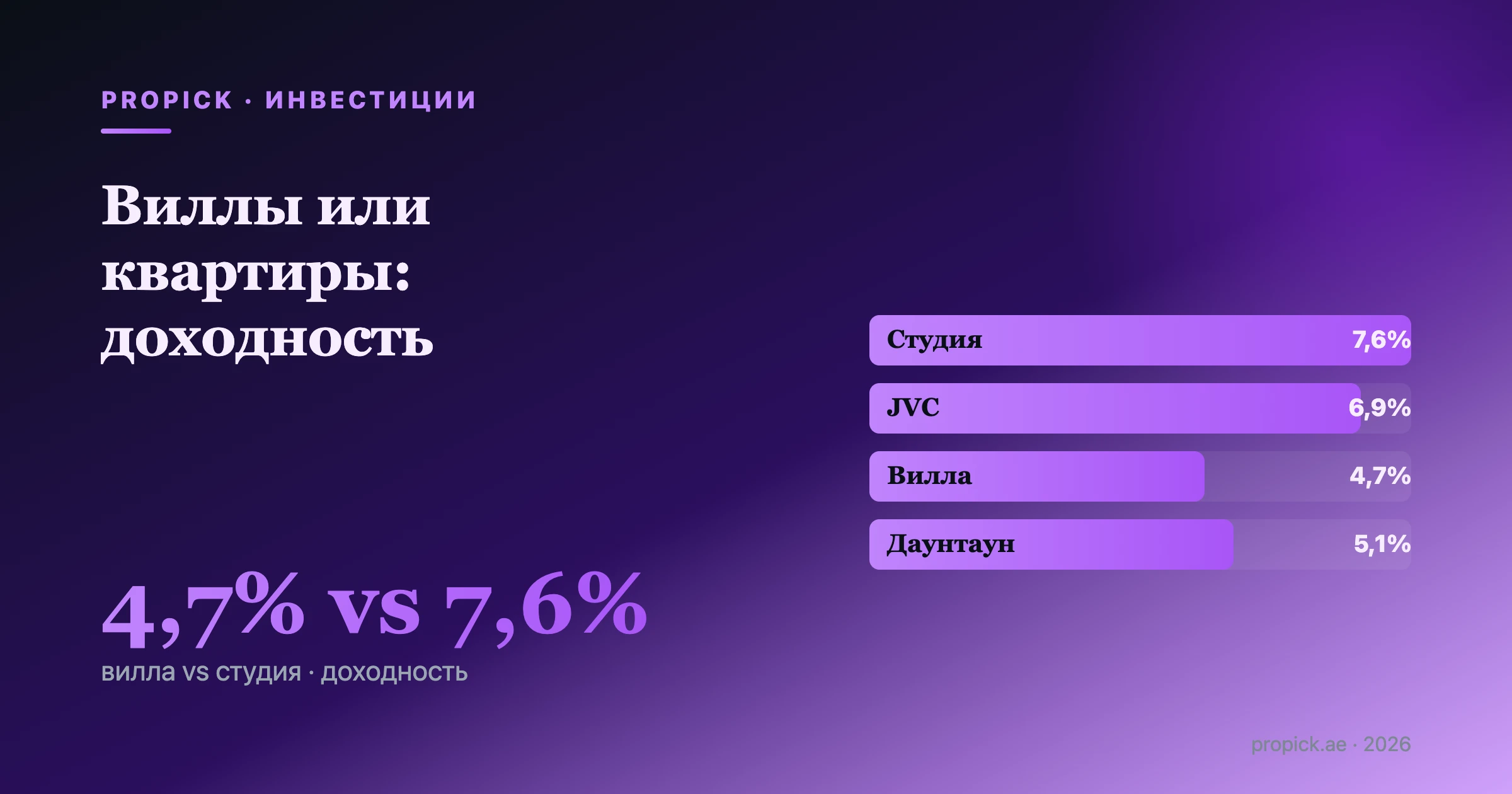
Dubai's own residential resale data gives a clear benchmark to compare against. Ready-resale apartments across the city's most active communities run roughly 5.1% to 6.9% gross, JVC tops the table at about 6.9%, Downtown and Palm Jumeirah sit at the low end near 5.1% to 5.4%, and studios as a category lead all unit types at around 7.6%. Villas trail at roughly 4.7% gross. Methodology: figures are calculated from ready (existing-home) resale transactions and executed rent contracts, grouped by master project rather than by district label, since off-plan-inclusive averages understate true resale yields (source: DLD via DLD Open Data, dld_transactions and dld_rent_contracts, July 2026).
Commercial assets are commonly reported by market research firms as yielding above this residential range, on the logic that longer leases with escalation clauses and cost pass-through can produce a cleaner net return than a gross residential figure that still leaves the landlord holding the service charge bill. DLD does not publish a commercial-specific yield series on the same public basis as the residential data above, so treat any commercial yield figure you see quoted as a market estimate, not an official DLD number, and verify it against the specific asset's actual lease and service charge terms before underwriting a deal.
The bottom line for investors
Commercial property in Dubai is not simply "residential with a bigger cheque." It carries 5% VAT on every sale and lease, it registers through the same Ejari and DLD system but with commercial-specific lease terms and eviction grounds, it is typically financed outside the residential mortgage rulebook, and it concentrates vacancy risk into fewer, larger tenancies in exchange for potentially longer, stickier leases. Foreign buyers have the same freehold access as for homes. Whether that trade-off suits an investor comes down to the lease already in place, or the one you can realistically sign, more than any headline yield number.
FAQ
Do I pay VAT when buying commercial property in Dubai? Yes. The sale of commercial property is subject to VAT at the standard 5% rate on the full price, with no first-supply exemption, unlike a residential resale, which is VAT-exempt.
Is the DLD transfer fee different for commercial property? No. The 4% DLD registration fee applies the same way to commercial and residential transfers, and on the secondary market it is paid in practice by the buyer. Commercial buyers separately owe 5% VAT on top of that fee.
Do commercial leases in Dubai need to be Ejari-registered? Yes. Under Article 4(2) of Law No. 26 of 2007, every lease contract in the emirate, residential or commercial, must be registered, using the Ejari eService, and no government department or court will hear a rental dispute without a registered contract.
Can foreigners own commercial property in Dubai? Yes, on the same freehold basis as residential property. Foreign nationals, resident or not, can acquire ownership without restriction in Dubai's designated freehold areas, and the underlying property definition and designated-areas rules do not limit that right to homes, so it includes commercial units within freehold master developments.
Can I get a standard residential mortgage to buy an office or retail unit? Generally not on the same terms. CBUAE's published LTV and DBR framework under Circular 31/2013 is built around individual borrowers buying residential property. Commercial acquisitions are typically financed as business or commercial lending, underwritten bank by bank with their own LTV, tenor and documentation requirements.
Are commercial yields in Dubai actually higher than residential? They are commonly reported as higher by market research sources, since longer leases and cost pass-through can produce a cleaner net return. DLD's public residential data shows gross yields of roughly 4.7% to 7.6% depending on property type and community; DLD does not publish an equivalent public commercial series, so treat quoted commercial yield figures as market estimates to verify against the specific asset's lease.
Sources
- Federal Tax Authority. Real Estate VAT Guide (VATGRE1), April 2021. https://tax.gov.ae/DownloadOpenTextFile?fileUrl=en/VAT_VAT_Guides/Real_Estate_Guide/Real_Estate_Guide_VATGRE1_EN_19_04_2021_EN.pdf
- Federal Tax Authority. VAT Registration thresholds and process. https://tax.gov.ae/en/services/vat.registration.aspx
- Dubai Land Department. Property Sale Registration (4% transfer fee). https://dubailand.gov.ae/en/eservices/property-sale-registration/
- Dubai Land Department. Register/Renew Ejari Tenancy Contract eService. https://dubailand.gov.ae/en/eservices/register-renew-ejari-contract/
- Dubai Legislation Portal. Law No. (26) of 2007 Regulating the Relationship Between Landlords and Tenants in the Emirate of Dubai. https://dlp.dubai.gov.ae/Legislation%20Reference/2007/Law%20No.%20%2826%29%20of%202007.html
- Dubai Legislation Portal. Law No. (33) of 2008 Amending Law No. (26) of 2007. https://dlp.dubai.gov.ae/Legislation%20Reference/2009/Law%20No.%20%2833%29%20of%202008%20Amending%20Law%20No.%20%2826%29%20of%202007.html
- Dubai Legislation Portal. Decree No. (43) of 2013 Determining Rent Increase for Real Property in the Emirate of Dubai. https://dlp.dubai.gov.ae/Legislation%20Reference/2013/Decree%20No.%20%2843%29%20of%202013%20Determining%20Rent%20Increase%20for%20Real%20Property.html
- Dubai Land Department. Rental Index / Rental Increase Calculator eService. https://dubailand.gov.ae/en/eservices/rental-index/rental-index/
- The Official Portal of the UAE Government (u.ae). Expatriates buying a property in the UAE. https://u.ae/en/information-and-services/moving-to-the-uae/expatriates-buying-a-property-in-the-uae
- Dubai Land Department. Frequently Asked Questions. https://dubailand.gov.ae/en/frequently-asked-questions/
- Dubai Legislation Portal. Law No. (7) of 2006 Concerning Real Property Registration in the Emirate of Dubai. https://dlp.dubai.gov.ae/Legislation%20Reference/2006/Law%20No.%20%287%29%20of%202006.html
- Dubai Legislation Portal. Regulation No. (3) of 2006 Determining Areas for Ownership by Non-UAE Nationals of Real Property in the Emirate of Dubai. https://dlp.dubai.gov.ae/Legislation%20Reference/2006/Regulation%20No.%20%283%29%20of%202006.html
- Central Bank of the UAE. CBUAE Rulebook, Regulations Regarding Mortgage Loans, Article (3): Important Ratios (Circular 31/2013). https://rulebook.centralbank.ae/en/rulebook/article-3-important-ratios
- Dubai Land Department. dld_transactions and dld_rent_contracts open datasets, via DLD Open Data / data.dubai. https://dubailand.gov.ae/en/open-data/real-estate-data/