Nobody can tell you with certainty what Dubai property prices will do in 2027. Anyone who claims otherwise is selling something. What Propick can do is show what the current data actually says: our own year-over-year community figures, the supply already in the pipeline, and what the major research houses are reporting, and let that build a more honest picture than a single headline number allows.
This is a read of signals, not a forecast. Dubai's market has surprised both bulls and bears before, and 2026 itself already shows a split personality: some communities still climbing, others visibly cooling. That split is the most useful data point here.
What our 2026 data actually shows
Propick tracks ready-resale prices across Dubai's communities using DLD transaction data. Year-over-year, the picture is not uniform:
| Community | YoY ready-resale price change |
|---|---|
| Business Bay | +6.9% |
| Palm Jumeirah | +5.3% |
| Dubai Marina | +3.0% |
| Downtown Dubai | -3.3% |
| Sobha Hartland | -4.2% |
Source: DLD dld_transactions via DLD Open Data, ready-resale medians, Propick analysis, as of July 2026.
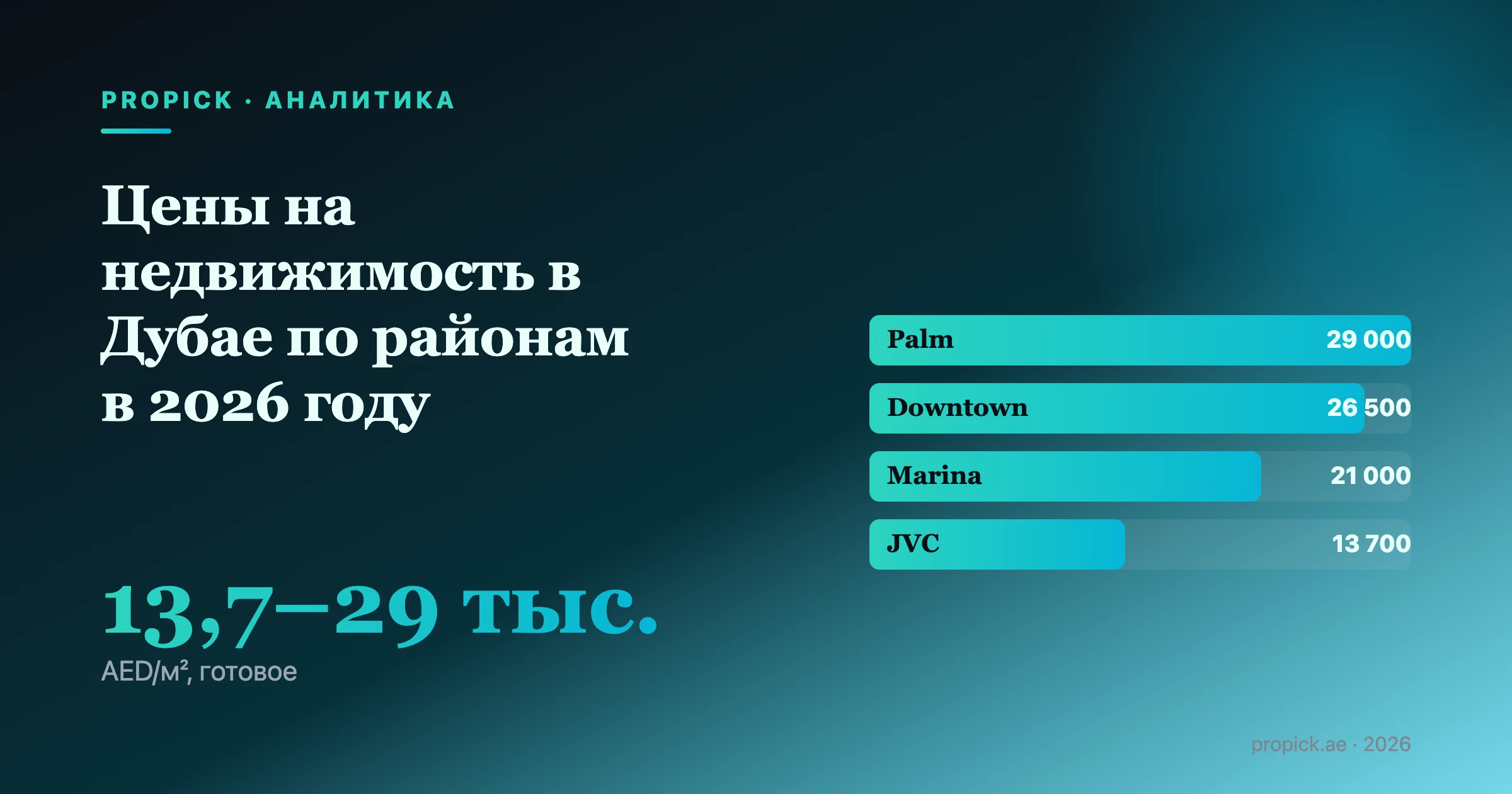
Business Bay leads, up 6.9%, the strongest gainer in our tracking. Palm Jumeirah, the most expensive community we track at 29,036 AED/sqm, is still adding value on top of that, though ultra-prime enclaves such as Jumeirah Bay Island and boutique villa communities like Al Barari and Emirates Hills are commonly reported to command even higher prices per sqft and sit outside the 16 communities in this dataset. Marina holds a modest but real 3.0% gain. Downtown Dubai and Sobha Hartland, by contrast, are both down, 3.3% and 4.2% respectively. Two well-known, previously red-hot communities are cooling at the same time two others keep climbing. That is not a citywide trend line, it is a divergence, and treating it as one number hides more than it reveals.
Why Business Bay is rising while Downtown and Sobha cool
There is no single confirmed cause, but the pattern fits a few things happening together. Downtown Dubai and Sobha Hartland both ran up hard during Dubai's 2022 to 2024 post-pandemic boom, Downtown as the established prime address, Sobha Hartland as one of the fastest-selling new communities of that cycle. A pullback after a sharp run-up is a normal digestion phase, not necessarily the start of a multi-year decline. Business Bay, meanwhile, still prices well below Downtown (20,306 AED/sqm versus 26,478) and Marina (21,028), carries a stronger 5.9% gross yield than either, and is absorbing its own substantial construction pipeline, a 50% off-plan share, without yet showing rental stress. It reads as a community catching up from a comparatively low base rather than one overheating.
One year of data is one year of data. Propick will keep tracking this quarterly, and a single-year swing in either direction is a signal worth watching, not a verdict.
The supply signal: where off-plan share is highest
Off-plan share, the percentage of a community's recent transactions that are still new-build launches rather than completed resales, is the closest thing to a forward supply indicator in this dataset. A high share means a large share of that community's total footprint has not been delivered yet, and will be handed over in the next one to three years.
| Community | Price (AED/sqm) | Gross yield | Off-plan share |
|---|---|---|---|
| Palm Jumeirah | 29,036 | 5.4% | 39% |
| Downtown Dubai | 26,478 | 5.1% | 32% |
| Dubai Creek Harbour | 25,224 | 5.4% | 70% |
| Dubai Hills Estate | 25,022 | 6.1% | 62% |
| Sobha Hartland | 21,649 | 6.4% | 20% |
| Dubai Marina | 21,028 | 5.2% | 22% |
| Business Bay | 20,306 | 5.9% | 50% |
| Meydan | 16,630 | 6.3% | 93% |
| JLT | 15,666 | 6.7% | 80% |
| DAMAC Hills | 15,405 | 6.9% | 42% |
| Al Furjan | 14,446 | 6.9% | 52% |
| Town Square | 14,398 | 6.7% | 54% |
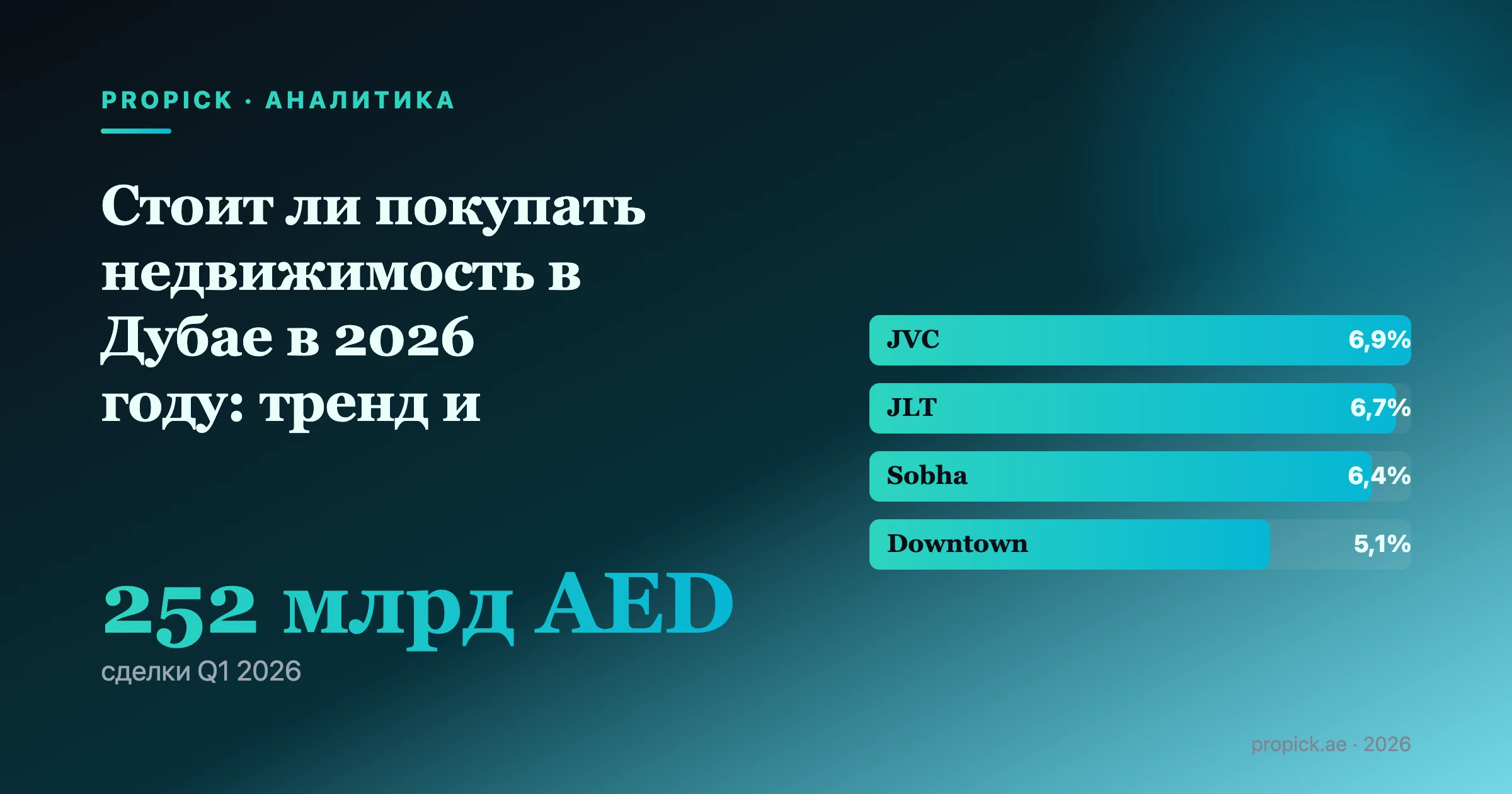
| JVC | 13,697 | 6.9% | 51% |
| JVT | 13,140 | 7.8% | 83% |
| Dubai South | 11,743 | 7.2% | 76% |
| Dubai Sports City | 10,117 | 8.7% | 63% |
Source: DLD dld_transactions and dld_rent_contracts via DLD Open Data, ready-resale medians, as of July 2026. DAMAC Hills figure blends villas and apartments.
Meydan (93%), JVT (83%), JLT (80%) and Dubai South (76%) carry the heaviest forward pipelines on this list, with Dubai Creek Harbour (70%) and Dubai Sports City (63%) not far behind. That is not automatically a warning sign, high off-plan share is also why several of these communities carry the strongest yields in the city, but their finished neighborhood, and their finished rental supply, still looks quite different from today. A wave of handovers landing faster than tenant and buyer demand absorbs them is the classic mechanism behind localized price and rent softening, worth watching in exactly these communities through 2026 and 2027, separately from any citywide narrative. Buying off-plan in any of them still routes payments through a project-specific escrow account under Dubai Law No. 8 of 2007, protecting your deposit from developer insolvency, but that protects your money, not the community's future price.
Transaction momentum and what the research houses are seeing
Propick's dataset is a granular, community-level view. For the citywide picture, the established research houses add a useful cross-check. CBRE's quarterly UAE market review, JLL's UAE research and ValuStrat's monthly Residential Price Index each describe a broadly similar pattern through the first half of 2026: transaction volumes staying resilient even as the pace of price growth moderates from the sharper gains of 2022 to 2024. None of the three has called an outright citywide correction, and none is promising another multi-year boom. Read against our own community split, that fits: activity still high, but gains increasingly concentrated in specific communities rather than lifting every address at once.
The rate backdrop: EIBOR and the dirham peg
The dirham's peg to the US dollar means the Central Bank of the UAE tracks US Federal Reserve policy rather than setting an independent rate. EIBOR, the interbank benchmark that prices most Dubai mortgages, has come down from its 2023 peak as the Fed's cutting cycle, underway since late 2024, has continued into 2026, easing financing costs at the margin for leveraged buyers. How much further it falls, and how fast, is a US inflation and Fed policy question, not a Dubai one, and nobody can call that with precision this far out.
What the rate environment does not change is the loan-to-value structure. The Central Bank's Article 3 on Important Ratios still caps an expatriate's first mortgaged home at 80% LTV under AED 5 million, and off-plan purchases at 50% LTV regardless of buyer category. Cheaper financing helps monthly affordability; it does not loosen how much cash a buyer needs upfront, especially in the high off-plan-share communities above.
Three scenarios into 2027, not one forecast
Given all of the above, three plausible paths are worth naming, deliberately without ranking one as the confident base case.
Broad-based moderation. Price growth slows further but stays positive across most established communities, Downtown and Sobha stabilize after their current pullback the way Business Bay is doing now from an earlier dip, and yields compress slightly as prices firm. This is the scenario most consistent with what CBRE, JLL and ValuStrat have described through mid-2026.
A supply-driven correction in high off-plan-share communities. Meydan, JVT, JLT, Dubai South and Creek Harbour see handovers land faster than rental and resale demand absorbs them, pressuring rents and resale prices specifically there, while more built-out, lower off-plan-share communities like Sobha Hartland or Marina stay comparatively insulated.
Renewed acceleration. If Fed rate cuts run faster than expected and Dubai's population and tourism growth keep outpacing new supply, 2027 could look more like 2023 than a moderating market, with Downtown and Sobha resuming gains and Business Bay's momentum extending further.
None of these is a prediction. They are shapes the current data could plausibly take, and which one plays out will only be visible in the data itself, not in a forecast written today.
What this means depending on why you are buying
An end-user buying a home to live in has the least reason to time any of this. Community fundamentals, commute, schools, lifestyle, matter more than a one-year price swing either way.
A yield-focused investor should treat the gross yield figures above as the more dependable number here, since they are anchored to actual current rents, not a price scenario. Dubai Sports City's 8.7%, JVT's 7.8% and Dubai South's 7.2% are real today regardless of which 2027 scenario materializes, though all three carry high off-plan shares and the supply risk that comes with them.
A buyer betting mainly on capital appreciation carries the most uncertainty here and should size that bet accordingly. Business Bay and Palm Jumeirah's current momentum, and Downtown and Sobha's current dip, are one-year data points, not confirmed multi-year trends, and the transfer fee alone, 4% of the sale price, paid in practice in full by the buyer on the secondary market, is a real cost a short holding period has to clear before a price bet turns a profit.
FAQ
Will Dubai property prices go up or down in 2027? Nobody can say with certainty. Our 2026 data shows a split market, Business Bay and Palm Jumeirah rising, Downtown and Sobha Hartland cooling, and reputable research houses like CBRE, JLL and ValuStrat describe moderating but still positive growth through mid-2026. Treat any confident single-number forecast for 2027 with skepticism.
Which Dubai community is performing best right now? Business Bay, up 6.9% year-on-year in Propick's ready-resale tracking as of July 2026, the strongest gain of any community we track, ahead of Palm Jumeirah at 5.3% and Dubai Marina at 3.0%.
Why are Downtown Dubai and Sobha Hartland prices falling? Both are down year-on-year, Downtown 3.3% and Sobha Hartland 4.2%, most consistent with a cooling-off after both ran up sharply during 2022 to 2024. It is a one-year data point, not a confirmed multi-year trend.
What does high off-plan share mean for a community's future? It signals a large share of that community's total supply has not been delivered yet. Meydan (93%), JVT (83%) and JLT (80%) carry the heaviest pipelines in Propick's tracking, which supports strong current yields but also means more handovers, and more competition for tenants and buyers, are still coming through 2026 and 2027.
How do interest rates affect the Dubai market outlook? The dirham's US dollar peg means the Central Bank of the UAE mirrors Fed policy. EIBOR, which prices most Dubai mortgages, has eased from its 2023 peak as the Fed's cutting cycle has continued into 2026, helping affordability at the margin, though the 80% LTV cap for ready homes and 50% for off-plan has not changed.
Is now a good time to buy in Dubai? Depends entirely on why you are buying. For an end-user, community fit matters more than market timing. For a yield investor, current gross yields (up to 8.7% in Dubai Sports City) are real today regardless of any 2027 scenario. For a buyer betting on price appreciation alone, the honest answer is that the data shows a divergent market and genuine uncertainty, not a guaranteed upside.
Sources
- Dubai Land Department / DLD Open Data, dld_transactions and dld_rent_contracts (open datasets), Propick analysis: https://dubailand.gov.ae/en/open-data/real-estate-data/
- Dubai Land Department, Property Sale Registration (DLD registration fee): https://dubailand.gov.ae/en/eservices/property-sale-registration/
- Dubai Legislation Portal, Law No. (8) of 2007 Concerning Escrow Accounts for Real Estate Development in the Emirate of Dubai: https://dlp.dubai.gov.ae/Legislation%20Reference/2007/Law%20No.%20%288%29%20of%202007.html
- Central Bank of the UAE, Rulebook, Article (3): Important Ratios (Circular 31/2013): https://rulebook.centralbank.ae/en/rulebook/article-3-important-ratios
- Central Bank of the UAE, official site: https://www.centralbank.ae/en/
- CBRE, UAE Real Estate Market Review, Q1 2026: https://www.cbre.ae/insights/figures/uae-real-estate-market-review-q1-2026
- JLL, UAE Insights: https://www.jll.com/en-ae/insights
- ValuStrat, Dubai VPI Residential Values, June 2026: https://valustrat.com/products/dubai-vpi-residential-values-june-2026