Dubai and Berlin sit at opposite ends of the same decision. One market hands an investor a flat 4 percent entry fee and no recurring tax bill of any kind. The other runs a full European tax stack: a transfer tax on entry, an annual tax every year of ownership, income tax on rent, and a capital gains tax that only fades away after a decade. Both cities are liquid, both have real rental demand, and both are marketed to the same type of buyer, someone looking for either a strong net yield or a defensive, low-volatility asset in a stable currency. This piece lays out the actual numbers on both sides so the comparison is a tax and yield calculation, not a sales pitch.
Price levels
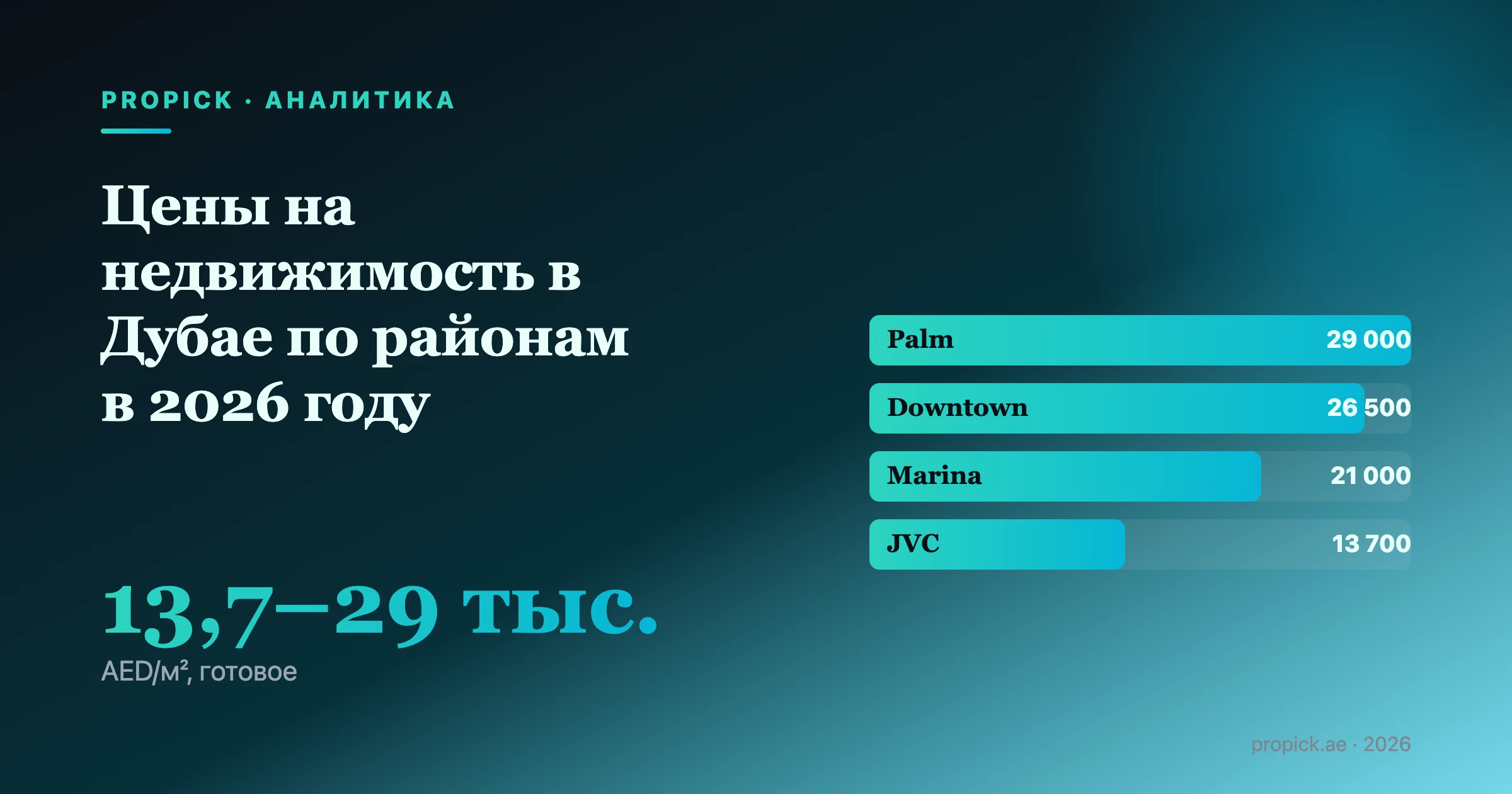
Dubai's prime submarkets, priced per the Dubai Land Department, run from AED 19,360 per square metre in Dubai Marina (about USD 5,272 at the AED 3.6725 peg) to AED 26,323 in Downtown Dubai (about USD 7,168) and AED 28,702 on Palm Jumeirah (about USD 7,815) (DLD Open Data, Real Estate Data).
Berlin's official transaction data tells a different story about what "prime" even means. According to the Gutachterausschuss fuer Grundstueckswerte in Berlin (the Senate-run land valuation committee that records every notarised sale in the city), the citywide average price for an existing condominium (Eigentumswohnung) in 2024 was EUR 5,251 per square metre of living space, down 1 percent year on year, while units in newly built developments averaged EUR 7,912 per square metre, up 1 percent (Immobilienmarktbericht Berlin 2024/2025, Gutachterausschuss Berlin). Berlin's market has been essentially flat for two years, which is itself the point of the city as an asset class: it is priced for stability, not appreciation.
Rental yield
Dubai's gross yields, drawn from DLD-linked market data, run 5.4 to 6.3 percent in prime areas such as Downtown and the Marina, and 7 to 9 percent in more affordable, high-demand communities.
Germany does not publish a per-community gross yield series the way Dubai does, but the same Berlin market report gives the closest official proxy: whole rental apartment buildings (reine Mietwohnhaeuser) sold in 2024 at a mean price of 23.5 times their annual net cold rent, versus 26.0 times in 2023. Inverted, that is an implied gross yield of about 4.3 percent in 2024, up from roughly 3.8 percent a year earlier (Immobilienmarktbericht Berlin 2024/2025, Gutachterausschuss Berlin). That figure is for entire buildings bought as institutional-style investments; a single Berlin apartment bought for buy-to-let typically prices at a per-unit premium to a whole-building deal, and its achievable rent is itself constrained by rent-control rules described below, so an individual investor's real yield tends to sit at or below that 4.3 percent building-level benchmark, not above it.
Transaction costs: entry
Dubai's only transaction cost is the DLD registration fee of 4 percent of the sale value, paid in practice by the buyer (DLD, Property Sale Registration).
Berlin stacks two costs on entry. First, Grunderwerbsteuer, the state-level real estate transfer tax: Land Berlin's own tax authority confirms a rate of 6 percent of the purchase price for any transaction completed since 1 January 2014, up from 5 percent in 2012 to 2013 and 4.5 percent before that (Berlin Senatsverwaltung fuer Finanzen, Grunderwerbsteuer FAQ). That rate sits on top of a federal base rate of 3.5 percent set in the Grunderwerbsteuergesetz, which German states are constitutionally free to raise, and Berlin, like most states, has done so (Grunderwerbsteuergesetz, Section 11). Second, every German property sale must be certified by a notary under Section 311b of the Civil Code, and that certification plus the subsequent land registry (Grundbuch) entry typically costs a further 1.5 to 2 percent of the price, billed under the Court and Notary Costs Act (GNotKG) (BGB, Section 311b, notarisation requirement). Add it up and a Berlin buyer typically pays 7.5 to 8 percent before the keys change hands, roughly double Dubai's flat 4 percent.
Ongoing costs: the annual tax Dubai does not have
Dubai has no annual property tax at all. Berlin has Grundsteuer, and 2025 was the first year it was charged under Germany's reformed system. After a 2018 constitutional court ruling found the old valuation method unconstitutional, the federal Grundsteuer-Reformgesetz of November 2019 forced a nationwide revaluation, and Berlin's own tax authority confirms the city's Abgeordnetenhaus (state parliament) set the new Hebesatz, the multiplier applied to the assessed tax base, at 470 percent for residential and commercial land from 2025 onward (Berlin Senatsverwaltung fuer Finanzen, Grundsteuer FAQ). That number looks alarming out of context, but the same official FAQ walks through why it is not: a reassessed value of EUR 150,000 is first multiplied by a tax coefficient of 0.31 per thousand to produce a EUR 46.50 base amount, and only that base amount is multiplied by the 470 percent Hebesatz, landing at an annual bill of about EUR 218.55, an effective rate far below one percent of value.
On top of Grundsteuer, rental income itself is taxed under Section 21 of the Income Tax Act (EStG) at the landlord's ordinary progressive income tax rate, which runs up to 42 percent on income between roughly EUR 69,879 and EUR 277,825, and 45 percent above that (EStG, Section 32a, tax tariff). Dubai charges no income tax on rent at all.
Exit tax: the 10-year rule vs zero
Dubai has no capital gains tax on property, full stop. Germany's Section 23 EStG imposes tax on the gain from a private property sale if the seller held it for less than ten years, the so-called Spekulationssteuer; the one broad exemption is a property that served as the owner's own home in the sale year and the two years before it, which can be sold gain-free at any time (EStG, Section 23, private disposal transactions). For a pure buy-to-let investor who never lives in the unit, the ten-year clock is the only way out of the tax.
Tenant protections: why Berlin yields stay low
Berlin's low, stable yield is not an accident of pricing, it is policy. Section 556d of the Civil Code, the Mietpreisbremse (rent brake), caps the rent a landlord can charge a new tenant at no more than 10 percent above the locally published reference rent in designated tight-market areas, and Berlin has been such an area for years (BGB, Section 556d, rent brake). That rule structurally limits how much a Berlin landlord can raise rent to match a rising purchase price, which is the mechanical reason the city's price-to-rent multiple has stayed high (and its yield low) even as headline prices flattened.
Dubai vs Berlin at a glance
| Metric | Dubai | Berlin |
|---|---|---|
| Prime price level | AED 19,360 to 28,702/sqm (Marina to Palm), DLD Open Data | EUR 5,251/sqm citywide average (existing), EUR 7,912/sqm new-build, Gutachterausschuss Berlin |
| Gross rental yield | 5.4 to 6.3% prime; 7 to 9% affordable | About 4.3% implied (whole rental buildings, 2024); individual buy-to-let units typically lower |
| Purchase/transfer tax | DLD fee: 4% of sale value, paid in practice by the buyer | Grunderwerbsteuer 6% plus notary and land registry fees of about 1.5 to 2%: roughly 7.5 to 8% total |
| Annual property tax | None | Grundsteuer, Hebesatz 470% since 2025 on the reassessed base (effective rate well under 1% of value) |
| Tax on rental income | None | Progressive income tax under Section 21 EStG, up to 42% (45% above EUR 277,825) |
| Capital gains tax | None | Spekulationssteuer under Section 23 EStG if sold within 10 years; exempt if owner-occupied |
| Rent control | None comparable cited here | Mietpreisbremse caps new-tenancy rent at 10% above local reference rent (Section 556d BGB) |
Which investor fits which market
An investor optimising for net yield and a simple tax bill will find Dubai the more efficient market on paper: a single 4 percent entry fee, no annual tax, no tax on rent, and no capital gains tax regardless of holding period. An investor drawn to Berlin is typically not chasing yield at all, they are buying into a large, liquid, rule-of-law European capital with strong long-run demand and structurally capped rent growth, and accepting a heavier, multi-layered tax bill (transfer tax, notary fees, annual Grundsteuer, income tax on rent, and a 10-year exposure to capital gains tax) as the cost of that stability. Both are rational strategies for the right investor profile; they are simply optimising for different things, and the tax code of each city is not a footnote to that choice, it is most of the choice.
FAQ
What is the total transfer tax when buying property in Dubai? A flat DLD registration fee of 4 percent of the sale value, paid in practice by the buyer, with no separate transfer or stamp tax layered on top (DLD, Property Sale Registration).
What is Germany's Grunderwerbsteuer, and how much is it in Berlin? It is a state-level real estate transfer tax charged on every property purchase. Berlin's rate has been 6 percent of the purchase price since 1 January 2014, confirmed directly by the city's own tax authority (Berlin Senatsverwaltung fuer Finanzen, Grunderwerbsteuer FAQ).
Does Dubai have an annual property tax like Germany's Grundsteuer? No. Dubai has no annual property tax at all. Berlin's Grundsteuer was reformed nationwide from 2025 and now applies a 470 percent Hebesatz to a small reassessed tax base, producing an effective rate that is well under 1 percent of a property's market value in most cases (Berlin Senatsverwaltung fuer Finanzen, Grundsteuer FAQ).
Can a German seller ever avoid capital gains tax on a rental property? Only by holding it for more than 10 years, or by living in it as a primary residence in the sale year and the two years before, under Section 23 EStG. Dubai has no capital gains tax on property regardless of how long it is held (EStG, Section 23).
Why are Berlin rental yields lower than Dubai's? Partly because Berlin prices have risen over the past decade while achievable rent has not kept pace, and partly by policy: the Mietpreisbremse caps what a landlord can charge a new tenant at no more than 10 percent above the local reference rent in designated tight-market zones, which structurally limits rent growth relative to price (BGB, Section 556d).
Sources
- Dubai Land Department, Property Sale Registration
- Dubai Land Department, Open Data: Real Estate Data
- Berlin Senatsverwaltung fuer Finanzen, Grunderwerbsteuer FAQ
- Berlin Senatsverwaltung fuer Finanzen, Grundsteuer FAQ
- Gutachterausschuss fuer Grundstueckswerte in Berlin, Immobilienmarktbericht Berlin 2024/2025
- Grunderwerbsteuergesetz (GrEStG), Section 11, tax rate
- Buergerliches Gesetzbuch (BGB), Section 311b, notarisation of land contracts
- Buergerliches Gesetzbuch (BGB), Section 556d, Mietpreisbremse
- Einkommensteuergesetz (EStG), Section 21, income from letting
- Einkommensteuergesetz (EStG), Section 23, private disposal transactions
- Einkommensteuergesetz (EStG), Section 32a, tax tariff