Indian nationals are consistently one of the largest buyer groups in Dubai's residential market, and it is easy to see why: no income tax, no capital gains tax, and a currency pegged to the US dollar. Many of the same buyers already own property in Mumbai, India's most expensive real estate market, or are weighing whether to buy there instead. This is a straight, numbers-first comparison of entry price, rental yield, and the full tax bill on both sides, so the decision comes down to arithmetic rather than sentiment.
Price: What a Square Metre Actually Costs
Dubai's prime districts are not cheap, but they are transparent. Per Dubai Land Department (DLD) open data for 2026, average prices run AED 19,360 per square metre in Dubai Marina, AED 26,323 per square metre in Downtown Dubai, and AED 28,702 per square metre on Palm Jumeirah (DLD Open Data). At the dirham's fixed peg of AED 3.6725 to the US dollar, unchanged since 1997, that works out to roughly $5,270, $7,170, and $7,815 per square metre.
Mumbai looks different in structure. Knight Frank India's Q1 2026 market report puts the city's weighted average residential price at INR 36,049 per square foot, up 4% year on year, based on unsold inventory across active projects (Knight Frank India, "India Real Estate: Office and Residential Market, Jan-Mar 2026"). That converts to roughly INR 388,000, or about $4,020 at current exchange rates, per square metre. Crucially, this is a citywide average, not a prime-only figure. Mumbai's premier addresses (Malabar Hill, Worli, Bandra) sit well above it, while outer suburbs pull the average down. Even so, Dubai's Downtown and Palm Jumeirah command a clear premium over Mumbai's citywide figure, and Dubai Marina trades close to it.
Demand in Mumbai has stayed strong regardless: the city recorded 80,221 property registrations in the first half of 2026, up 6% year on year and the strongest first-half performance since 2013, with stamp duty collections rising 4% to INR 6,968 crore over the same period (Knight Frank India, via ET Realty).
Rental Yield: The Income Gap
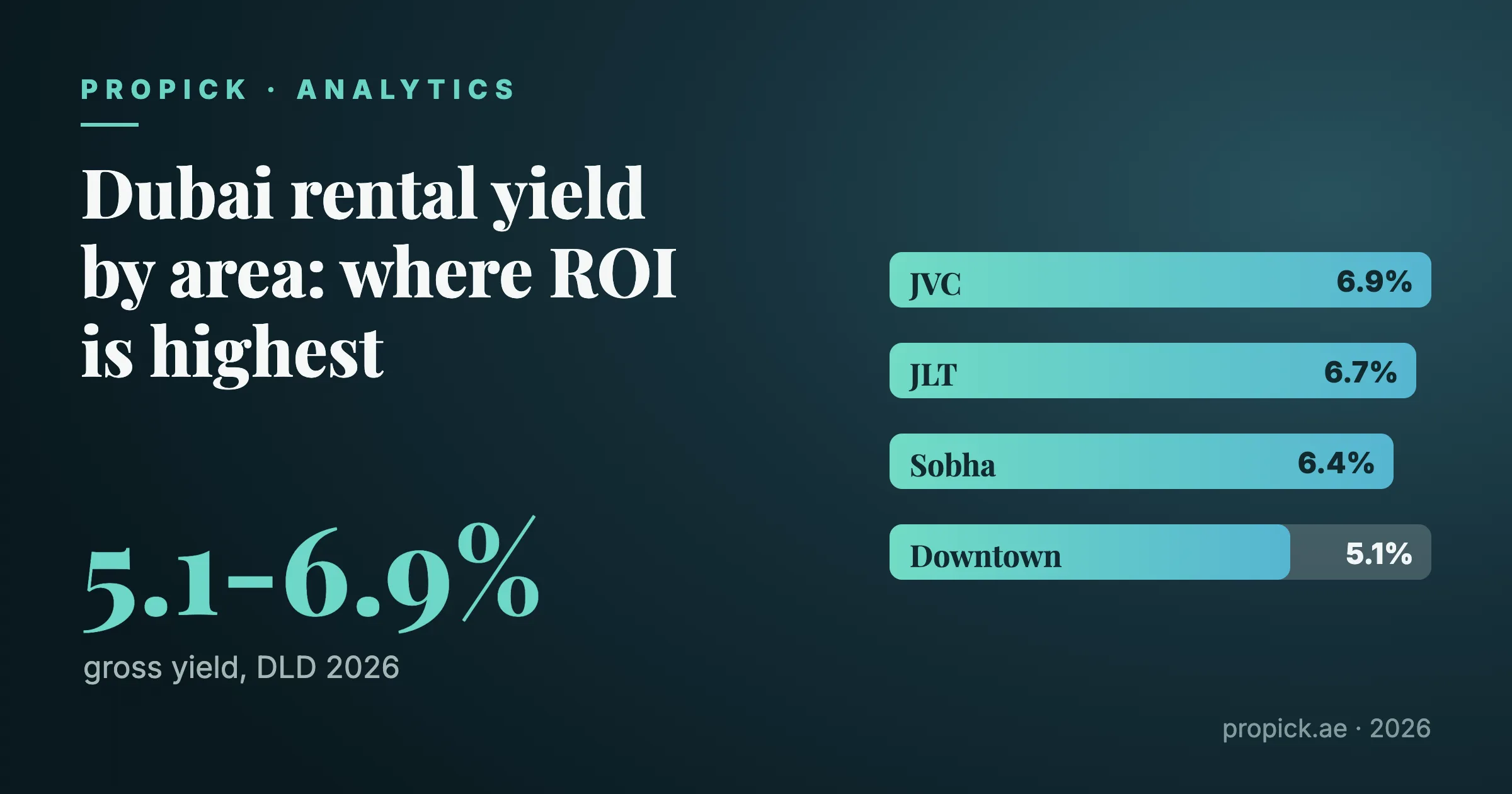
This is where the two markets diverge sharply. Dubai's gross rental yields run 5.4% to 6.3% in prime areas and 7% to 9% in more affordable segments. Mumbai's average gross rental yield, by contrast, is a reported 2% to 2.5% per annum as of 2025, among the lowest of any major Indian city (Moneycontrol). The gap reflects years of capital values rising faster than rents: ANAROCK data covering 2021 to 2024 showed capital values in India's top seven cities up 128%, while rental values in many of the same micro-markets grew far less over the same stretch (ANAROCK data, via ET Realty). In practical terms, a Dubai rental property can generate two to three times Mumbai's income yield before any tax is applied, and Dubai's income is also entirely untaxed.
The Tax Bill: Where the Real Gap Opens Up
Dubai keeps this section short. There is a one-time DLD registration fee of 4% of the sale value, paid in practice by the buyer (DLD). Beyond that: no annual property tax, no capital gains tax on resale, and no income tax on rental income.
Mumbai carries a longer list, at every stage of ownership.
At purchase: Maharashtra's stamp duty schedule charges buyers roughly 5% stamp duty plus a 1% metro cess in Mumbai (about 6% combined), with a 1% rebate when the sole registered owner is a woman (IGR Maharashtra). Stamp duty is charged on whichever is higher, the agreement value or the state's "ready reckoner rate," which Maharashtra raised by an average of 3.39% in Mumbai for FY26 (Mint). Registration charges add roughly 1% more, typically capped at a fixed rupee amount on higher-value deals.
Every year after: Mumbai's civic body, the MCGM, runs a capital-value-based property tax. Residential units with a carpet area of 500 square feet or less have been fully exempt from every component of this tax since 1 January 2022; larger units continue to pay annually, with statutory caps limiting how fast the bill can rise between revaluations (MCGM, RTI Manual V).
On exit: since the Finance (No. 2) Act 2024, long-term capital gains on immovable property held more than 24 months are taxed at a flat 12.5% without indexation, for any transfer on or after 23 July 2024 (Ministry of Finance, Press Information Bureau).
On rental income: rent is taxed at the owner's applicable slab rate. If the landlord is an NRI, the tenant is legally required to withhold TDS under Section 195 of the Income-tax Act, 1961, typically at 31.2% (30% plus surcharge and cess), with no minimum rent threshold, unlike the lower TDS that applies when the landlord is an Indian resident (Income-tax Act, 1961, Section 195, Income Tax Department of India).
Currency and Getting Your Money Out
The dirham has been pegged to the US dollar at AED 3.6725 since 1997, so a Dubai property's dollar value moves only with the market, not with currency swings, and there is no cap on moving rental income or sale proceeds internationally beyond normal banking checks.
The rupee floats, and has depreciated against the dollar over time, meaning INR-denominated gains in Mumbai can be quietly eroded once converted. For NRIs specifically, repatriating rental income or sale proceeds out of an NRO account is capped at USD 1 million per financial year under the RBI's FEMA Master Direction on Remittance of Assets, and banks typically require a chartered accountant's certificate (Form 15CB) alongside Form 15CA before releasing funds (RBI).
Dubai vs Mumbai at a Glance
| Factor | Dubai | Mumbai |
|---|---|---|
| Entry price per sqm (prime) | AED 19,360 to 28,702 (~$5,270-7,815) | INR 388,000 ($4,020), citywide average |
| Gross rental yield | 5.4% to 9% | 2% to 2.5% |
| One-time transaction cost | 4% DLD fee | ~6% stamp duty plus ~1% registration |
| Annual property tax | None | Capital-value based (units under 500 sq ft exempt) |
| Capital gains tax on sale | None | 12.5% LTCG, no indexation, 24-month hold |
| Tax on rental income | None | Slab rate; 31.2% TDS if landlord is NRI |
| Currency | AED, pegged to USD | INR, floating |
| Repatriation limit for NRIs | No cap | USD 1 million per year (NRO route) |
Bottom Line
If the goal is income, Dubai is not a close call. Gross yields alone run two to three times Mumbai's, before accounting for the fact that Dubai's income is entirely tax-free while Mumbai's is taxed at slab rates or a steep NRI TDS. If the goal is a rupee-linked foothold in India for family use or long-term appreciation, Mumbai still has a case, particularly for a compact unit under 500 square feet that sidesteps the annual property tax altogether. For many NRI investors these are not competing choices: Dubai for yield and liquidity, Mumbai for a base at home. But on the pure math of price, yield, and tax, Dubai currently does more of the heavy lifting.
FAQ
Is Dubai property really tax-free for Indian buyers? On the UAE side, yes: no annual property tax, no capital gains tax, and no tax on rental income. The only mandatory charge is the DLD's 4% registration fee, paid in practice by the buyer. Indian tax residents should still confirm their own disclosure obligations for foreign assets with a tax advisor, since India taxes the global income of its residents.
Why are Mumbai's rental yields so low? Because prices have risen far faster than rents for years. Mumbai's average gross yield sits around 2% to 2.5%, against Dubai's prime range of 5.4% to 6.3% and its affordable-segment range of 7% to 9%.
What tax does an NRI pay when selling a Mumbai flat? Long-term capital gains, for property held more than 24 months, are taxed at a flat 12.5% without indexation for any sale on or after 23 July 2024, under the Finance (No. 2) Act 2024.
How much rent or sale proceeds can an NRI actually move out of India? Up to USD 1 million per financial year from an NRO account, covering both rental income and sale proceeds, under RBI's FEMA rules, generally with a chartered accountant's Form 15CB and a Form 15CA on file with the bank.
Does Mumbai have an annual property tax the way some cities do? Yes. The MCGM levies a capital-value-based property tax every year, though residential units of 500 square feet carpet area or less have been fully exempt from it since January 2022.
Sources
- Dubai Land Department, Property Sale Registration (4% fee)
- Dubai Land Department, Open Data, Real Estate Data
- Knight Frank India, India Real Estate: Office and Residential Market, Jan-Mar 2026
- Knight Frank India data, via ET Realty, Mumbai Property Registrations Surge 6% in H1 2026
- ANAROCK data, via ET Realty, Capital Values in Top Seven Cities Rise 128% Between 2021 and 2024
- Moneycontrol, Maximum City, Minimum Returns
- Inspector General of Registration, Government of Maharashtra, igrmaharashtra.gov.in
- Mint, Mumbai Circle Rate Revised; Ready Reckoner Rates
- Municipal Corporation of Greater Mumbai (MCGM), RTI Manual V, Capital Value System, portal.mcgm.gov.in
- Ministry of Finance, Government of India, Press Information Bureau, Capital Gains Taxation Simplified and Rationalised
- Ministry of Finance, Government of India, Press Information Bureau, FAQs on Budget 2024 Capital Gains Changes
- Income Tax Department of India, Income-tax Act 1961 Section 195 (TDS on payments to non-residents): https://www.incometax.gov.in/iec/foportal/
- Reserve Bank of India, Master Direction, Remittance of Assets