An international investor weighing Dubai against New York in 2026 is comparing two very different cost structures wrapped around two very different tax systems. Dubai offers a flat, low entry cost and a rental yield that stays almost entirely in the owner's pocket. New York offers one of the world's deepest and most liquid residential markets, but layers a statutory annual property tax, a buyer-paid mansion tax, transfer taxes on both the state and city level, and federal capital gains and income tax on top of the purchase price and the rent. Below is a head-to-head on price, yield and the full tax stack, using official Dubai Land Department (DLD) data and primary US, New York State and New York City tax sources.
Price per Square Metre: Dubai's Discount vs Manhattan's Premium
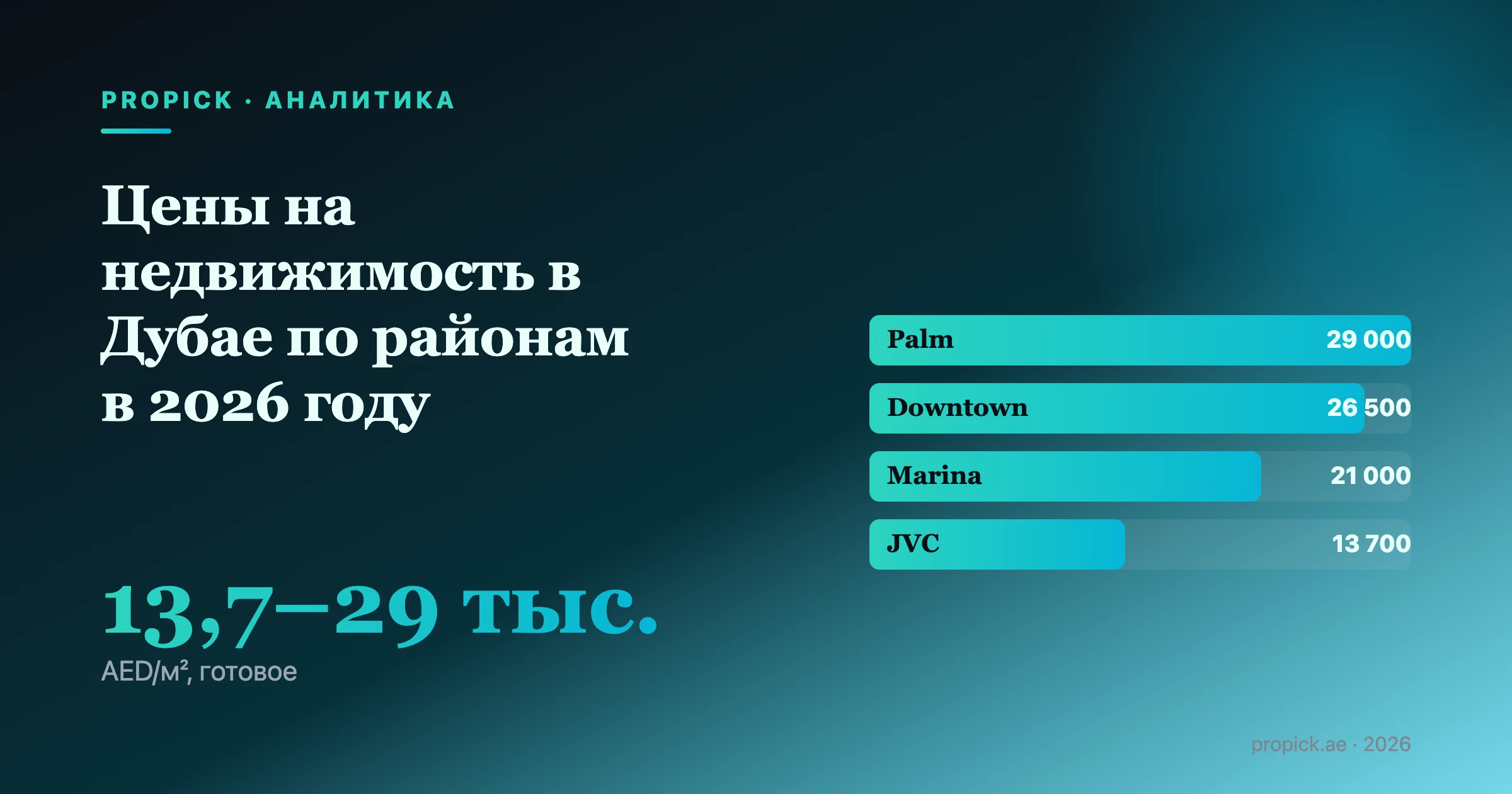
Dubai prices, per the Dubai Land Department's Open Data portal, put Dubai Marina at a median AED 19,360 per square metre (about USD 5,270 at the pegged rate of AED 3.6725 per dollar), Downtown Dubai at AED 26,323/sqm (about USD 7,167), and Palm Jumeirah at AED 28,702/sqm (about USD 7,815), based on 2026 transaction data (DLD Open Data).
New York City does not publish an official price-per-square-metre series in the way Dubai does; NYC's Department of Finance tracks assessed value for tax purposes, not a market price-per-square-foot index, so there is no single government benchmark to line up against DLD's figures on a like-for-like basis. What is not in dispute, and is confirmed by the tax data below rather than a market index, is that Manhattan sits at the very top of NYC's own property tax class structure by assessed value per unit, and it is one of the most expensive residential markets in the world on any commonly cited industry measure. Because no primary US or NY government source publishes a comparable per-sqm figure, this comparison is best read as directional: Manhattan's prime market trades at a steep multiple of Dubai's prime districts, while Dubai's DLD data is granular enough to price down to the building and quarter.
Rental Yields: Quantity Over Quality
Dubai Land Department data shows gross rental yields of 5.4% to 6.3% in prime districts (Marina, Downtown, Palm Jumeirah) and 7% to 9% in more affordable districts further from the coastline (DLD Open Data).
New York has no equivalent official yield series either, and unlike the Dubai case there is no simple, primary-sourced substitute to derive one from, since neither NYC nor NY State publishes a citywide average sale price per unit alongside average rent. What the tax law itself confirms indirectly is the shape of the problem: New York's Class 2 property tax, discussed below, is levied on assessed value precisely because market prices in dense residential buildings are so high relative to typical rents that income-based valuation, rather than a flat market comparison, is how the city's own assessors approach the asset class. Industry commentary consistently describes Manhattan gross yields as structurally compressed compared with most global cities, a function of very high purchase prices relative to achievable rents, but because no primary or Forbes-tier source in scope for this article publishes a specific current figure, no single percentage is cited here. Dubai's own yield range, sourced directly to DLD, stands on its own without needing a New York number to look attractive by comparison.
Purchase-Side Taxes: One Flat Fee vs a Buyer-Paid Mansion Tax Stack
Dubai's transaction tax is simple: the Dubai Land Department charges a registration fee of 4% of the sale value, paid in practice by the buyer, with no separate buyer/seller split and no surcharge for foreign nationality (Dubai Land Department, property sale registration).
New York stacks several distinct taxes on a purchase, and unlike Dubai's single fee, who pays which piece is defined by statute. New York State imposes a base real estate transfer tax of $2 per $500 of consideration (0.4%), paid by the seller, plus an additional base tax of $1.25 per $500 (0.25%) on residential sales of $3 million or more, also seller-paid. On top of that, the state levies a "mansion tax" of 1% of the full purchase price on any residence sold for $1 million or more, and, specifically within New York City, a supplemental tax on residential sales of $2 million or more at an incremental rate between 0.25% and 2.9% depending on price. Both the mansion tax and the supplemental tax are paid by the buyer (New York State Department of Taxation and Finance, real estate transfer tax). A buyer closing on a Manhattan condo priced well above $1 million is therefore paying a mansion tax on top of the purchase price before even accounting for legal, title and mortgage recording costs, a structure with no Dubai equivalent.
Annual Property Taxes: None vs a Statutory Class 2 Rate
Dubai levies no recurring annual property tax. There is a municipality housing fee, generally around 5% of the annual rental value, collected through DEWA utility bills, but it is modest compared with a Western property tax and applies whether the owner rents the unit out or not.
New York City taxes real property annually under a four-class system. Condominiums, cooperatives and larger rental buildings fall under Class 2, and the New York City Department of Finance sets the Class 2 tax rate for fiscal year 2026 at 12.439% of assessed value (NYC Department of Finance, property tax rates). This is not a rate on market value: assessed value for Class 2 co-ops and condos is calculated by the Department of Finance using an income-based methodology rather than the sale price, and annual increases in assessed value are capped, so the effective burden on a given unit's market value is materially lower than the headline 12.439% figure and varies by building and assessment history. Even so, it is a genuine, compounding annual cost that a Dubai owner simply does not have.
Capital Gains Tax: Zero vs Federal Rates Plus FIRPTA Withholding
Dubai charges no capital gains tax on the sale of real estate, for residents or non-residents.
The United States taxes gains on the sale of investment real estate at the federal level regardless of the seller's residency. For long-term gains, the Internal Revenue Service applies rates of 0%, 15% or 20% depending on the seller's taxable income, with the higher brackets covering most investment-property sellers; a separate rate of up to 25% applies to "unrecaptured Section 1250 gain," the portion of the gain attributable to depreciation previously claimed on the property (IRS, Topic no. 409, Capital gains and losses). New York State has no separate capital gains tax regime; gains are simply added to ordinary income and taxed under the state's income tax schedule described below.
Foreign investors face an additional mechanism at closing. Under the Foreign Investment in Real Property Tax Act (FIRPTA), a buyer purchasing US real property from a foreign seller must generally withhold 15% of the total amount realized on the sale and remit it to the IRS, regardless of whether the seller actually owes tax on a gain; the withholding is a prepayment reconciled against the seller's final US tax liability when they file a return, and reduced rates or exemptions apply only where the buyer intends to use the property as a residence and the price falls under specific thresholds, which does not typically apply to an investment purchase (IRS, FIRPTA withholding). Dubai's zero-CGT position has no FIRPTA-style withholding mechanism to offset it.
Income Tax on Rental Profit: Zero vs Federal, State and City Layers
Dubai imposes no personal income tax on rental income, so gross yield and net yield are, tax-wise, almost the same number.
In the United States, a nonresident alien earning US rental income is, by default, subject to a flat 30% withholding tax on the gross rent, with no deductions allowed; most foreign owners instead file an election under Internal Revenue Code Section 871(d) to treat the rental income as effectively connected with a US trade or business, which lets them deduct expenses and be taxed at graduated rates on net income instead of 30% on gross, at the cost of filing a US nonresident tax return every year (IRS, Nonresident aliens, real property located in the US). On top of the federal layer, New York State taxes rental profit as ordinary income, with a top marginal rate of 10.9% on New York adjusted gross income above $25 million, and New York City adds its own local personal income tax of up to 3.876% on top of that for city residents (New York State Department of Taxation and Finance, Form IT-201-I instructions). A nonresident owner is not subject to NYC's local income tax, since that layer is residency-based, but remains liable for New York State tax on New York-source rental income regardless of where the owner lives. New York City is one of the few major US cities that layers its own income tax on top of the state, a structure Dubai's tax-free rental income has nothing to compare against.
Comparison Table
| Metric | Dubai | New York |
|---|---|---|
| Price per sqm (prime) | AED 19,360 to 28,702 (~USD 5,270 to 7,815) DLD | No official per-sqm series; Manhattan prime widely reported as several multiples of Dubai's prime districts |
| Gross rental yield | 5.4-6.3% prime, 7-9% affordable DLD | No official series; industry commentary describes yields as structurally compressed versus global peers |
| Purchase tax | 4% flat, buyer pays DLD | NYS transfer tax 0.4-0.65% (seller) + 1% mansion tax on $1M+ and 0.25-2.9% NYC supplemental tax on $2M+ (both buyer) tax.ny.gov |
| NYC seller-side transfer tax | n/a | RPTT 1% up to $500K, 1.425% above nyc.gov |
| Annual property tax | None (only a modest DEWA housing fee) | Class 2 statutory rate 12.439% of assessed (not market) value, FY2026 nyc.gov |
| Capital gains tax | None | Federal 0/15/20%, up to 25% on depreciation recapture; 15% FIRPTA withholding at closing for foreign sellers IRS |
| Income tax on rent | None | Federal 30% flat on gross, or graduated rates on net income by election; NYS up to 10.9%; NYC residents +3.876% tax.ny.gov |
Which Market Fits Which Investor
The two markets reward different priorities. Dubai's advantage is almost entirely fiscal: a flat 4% entry cost, no annual property tax, no capital gains tax, no income tax on rent, and a yield range that an owner keeps in full. New York's advantage is scale, liquidity and a legal and title system with more than a century of institutional depth, but every stage of ownership, buying, holding, renting and selling, carries a specific, named tax that Dubai simply does not levy, and several of those taxes (the mansion tax, the NYC supplemental tax, FIRPTA withholding) apply specifically because the buyer or seller is not a New York resident or is investing rather than occupying. For an investor optimising for after-tax yield and simplicity, Dubai's structure is difficult to match. For an investor prioritising market depth, long-run price discovery and a globally reference asset class, New York's tax load is the price of admission to that depth.
FAQ
Does Dubai really have no property tax at all? Correct for the two taxes investors usually mean, annual property tax and capital gains tax. There is a modest municipality housing fee (around 5% of annual rental value) billed through DEWA, but no recurring ad valorem property tax and no CGT (Dubai Land Department).
Is the 4% Dubai fee split between buyer and seller? In practice it is paid by the buyer at registration; it is a single Dubai Land Department registration fee, not a 2%/2% split (DLD, property sale registration).
What is New York's "mansion tax" and who actually pays it? It is a New York State tax of 1% of the full purchase price on any residence sold for $1 million or more, plus a New York City supplemental tax of 0.25% to 2.9% on residential sales of $2 million or more. Both are paid by the buyer, unlike the state's base transfer tax, which is paid by the seller (New York State Department of Taxation and Finance).
Do foreign investors face extra tax when selling US property? Yes. Under FIRPTA, the buyer must generally withhold 15% of the total amount realized on the sale and send it to the IRS, as a prepayment against the seller's actual US tax liability, which is settled when the seller files a US tax return (IRS, FIRPTA withholding).
Which market has the higher rental yield in 2026? Dubai's yields are directly sourced to DLD data: 5.4-6.3% in prime districts and 7-9% in more affordable ones. New York does not publish a comparable official yield series, so no specific New York figure is cited here, but the underlying tax structure, income-based property valuation, a mansion tax pegged to price rather than income, and multi-layer income tax on rent, is consistent with a market where after-tax yield runs well behind the headline price (DLD Open Data).
Sources
- Dubai Land Department, property sale registration (4% fee): https://dubailand.gov.ae/en/eservices/property-sale-registration/
- Dubai Land Department, Open Data, real estate data (prices, yields): https://dubailand.gov.ae/en/open-data/real-estate-data/
- NYC Department of Finance, property tax rates (Class 2, FY2026): https://www.nyc.gov/site/finance/property/property-tax-rates.page
- NYC Department of Finance, Real Property Transfer Tax (RPTT): https://www.nyc.gov/site/finance/property/property-real-property-transfer-tax-rptt.page
- New York State Department of Taxation and Finance, real estate transfer tax (base tax, mansion tax, NYC supplemental tax): https://www.tax.ny.gov/bus/transfer/rptidx.htm
- IRS, Topic no. 409, Capital gains and losses: https://www.irs.gov/taxtopics/tc409
- IRS, FIRPTA withholding: https://www.irs.gov/individuals/international-taxpayers/firpta-withholding
- IRS, Nonresident aliens, real property located in the US: https://www.irs.gov/individuals/international-taxpayers/nonresident-aliens-real-property-located-in-the-us
- New York State Department of Taxation and Finance, Form IT-201-I instructions (NYS and NYC tax rate schedules): https://www.tax.ny.gov/forms/html-instructions/2025/it/it201i-2025.htm