For an Asian investor weighing where to place capital in real estate, Dubai and Singapore sit at opposite ends of the same spectrum: both are wealth hubs with no local income tax on individuals, both attract global capital, and both have built reputations as safe, well-governed places to own property. Yet the economics of actually buying and holding real estate in each city are strikingly different, and the gap is almost entirely driven by policy rather than market fundamentals. Singapore has spent the last three years deliberately cooling foreign demand through stamp duty, while Dubai has kept its transaction cost structure simple and flat. This piece compares price levels, rental yield, and the full tax stack, using Dubai Land Department (DLD) data and Singapore's Inland Revenue Authority (IRAS) and Urban Redevelopment Authority (URA) as the primary sources.
Price levels: two very different price tags
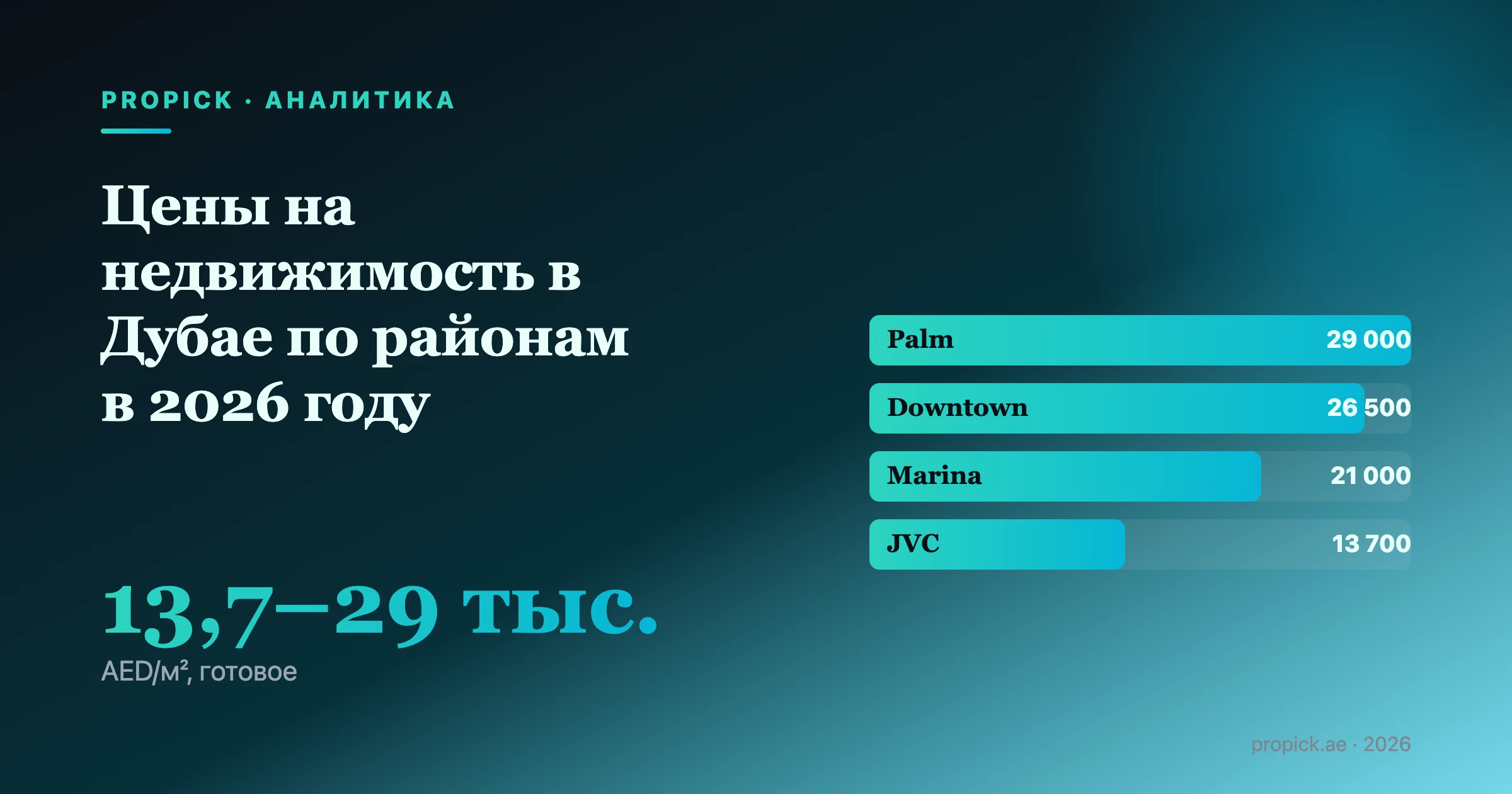
Dubai's prime apartment segment, based on DLD Open Data, currently prices at AED 19,360 per sqm in Dubai Marina, AED 26,323 per sqm in Downtown Dubai, and AED 28,702 per sqm on Palm Jumeirah (DLD Open Data). At the AED/USD peg of 3.6725, that converts to roughly USD 5,270, USD 7,168 and USD 7,815 per sqm respectively.
Singapore does not publish an equivalent absolute price-per-square-foot figure in its official releases; the URA instead tracks a quarterly Property Price Index. As at Q2 2026, the non-landed private residential index stood at 210.6, with the Core Central Region (CCR, the prime districts including Orchard Road and Marina Bay) at 161.5, the Rest of Central Region at 226.2, and the Outside Central Region at 271.1, all rebased to 1Q2009=100 (URA, Release of 2nd Quarter 2026 real estate statistics). These indices are each their own series and not directly comparable across segments in absolute terms, but the direction is clear: CCR accelerated 1.8 percent quarter-on-quarter, the fastest of the three regions, which The Business Times linked partly to "sustained wealth migration into Singapore" supporting prime-market demand (The Business Times, 24 July 2026). Government land tenders in CCR locations such as Peck Hay Road, Dunearn Road and River Valley also cleared in Q2 2026 above comparable 2025 tenders, a sign developers still expect prime Singapore land to command a premium. Singapore's Core Central Region has long ranked among Asia's costliest housing markets, and Dubai's priciest district, Palm Jumeirah, remains well below what a comparable prime Singapore address commands.
Rental yield: Dubai's structural advantage
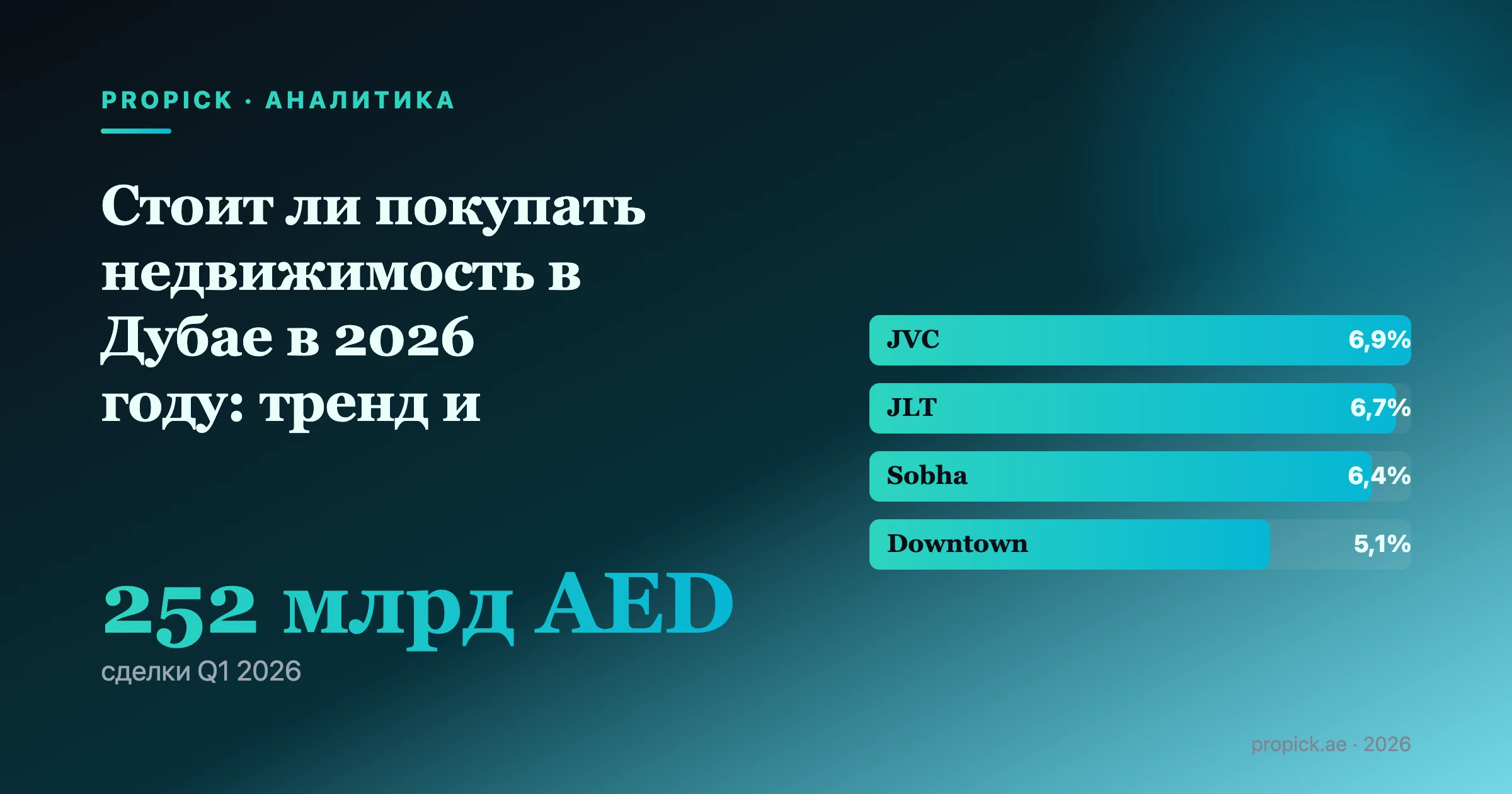
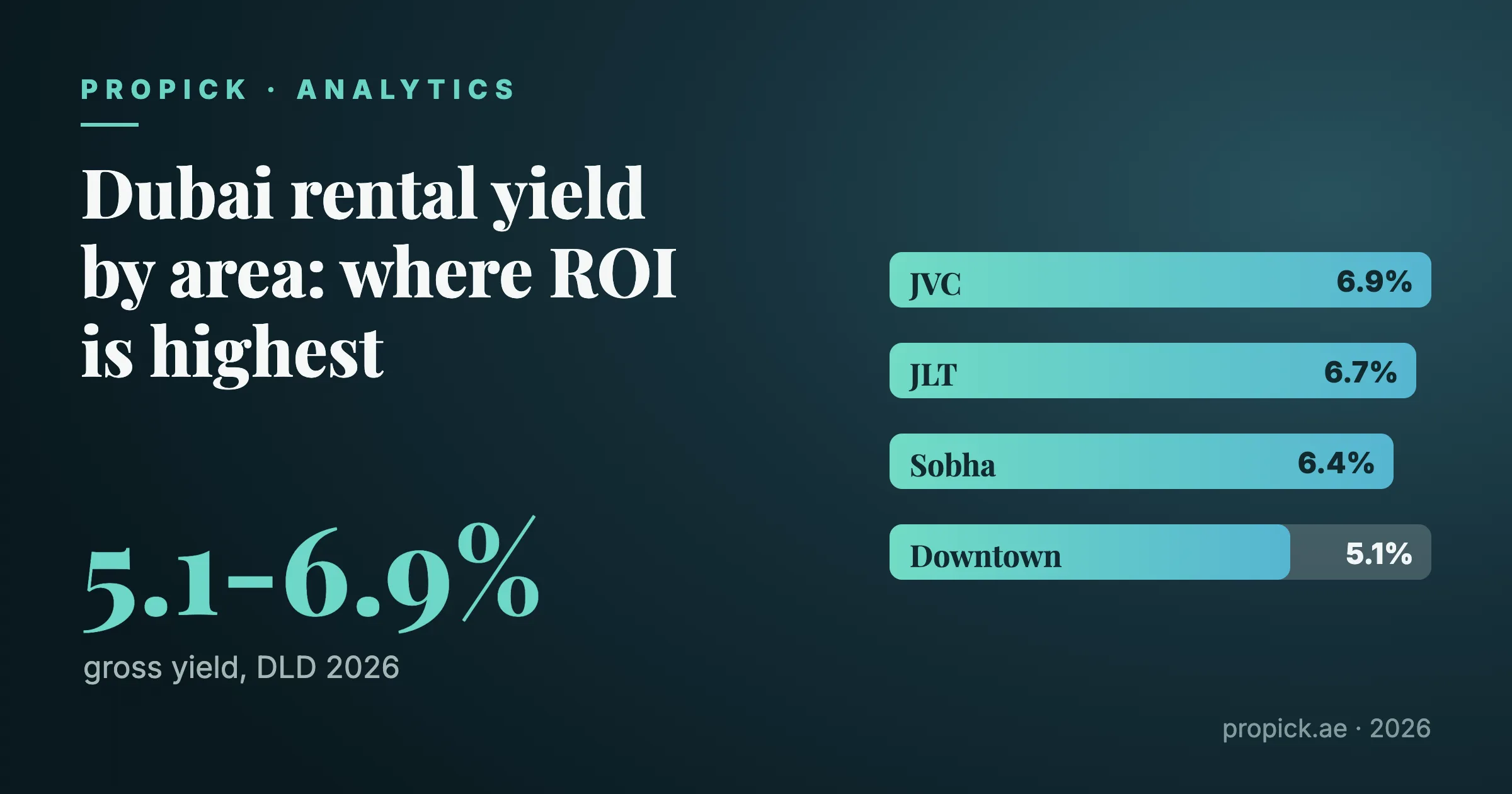
Dubai's gross rental yields, per DLD-linked market data, run 5.4 to 6.3 percent in prime areas such as Downtown and the Marina, and 7 to 9 percent in more affordable, high-demand communities. These are among the highest yields available in a major global gateway city.
Singapore does not publish a headline gross yield figure either, but the underlying index data tells its own story. The URA Q2 2026 release shows the private residential Rental Index at 162.5 against a Price Index of 219.4, both rebased to 1Q2009=100 (URA, pr26-57). Prices have climbed roughly twice as fast as rents since that base period, consistent with structurally compressed yields. Vacancy also crept up to 6.4 percent at end-Q2 2026 from 6.2 percent in Q1, even as rents ticked up 0.7 percent for the quarter, per the same URA release. Analysts quoted by The Business Times pointed to limited new completions in the CCR as the main support for rents there, rather than demand broadly outpacing supply. The practical read: Singapore private condominium yields sit well below Dubai's, because rents have grown far more slowly than the capital values investors must pay to access them.
Tax burden: the real dividing line
This is where the two markets diverge sharply, and it is the crux of the comparison. Dubai charges no annual property tax, no capital gains tax, and no income tax on rental income for individuals. The only transaction cost at purchase is the DLD registration fee of 4 percent of the sale value, which in practice is paid by the buyer (Dubai Land Department, property sale registration).
Singapore's tax stack is layered and, for a foreign buyer, considerably heavier:
- Buyer's Stamp Duty (BSD): a progressive duty of 1 to 6 percent of the purchase price or market value, whichever is higher, with the 6 percent marginal rate applying to the portion above S$3,000,000 (IRAS, Buyer's Stamp Duty). This applies to every buyer regardless of nationality.
- Additional Buyer's Stamp Duty (ABSD) for foreigners: a flat 60 percent of the purchase price or market value, whichever is higher, on any residential property, whether it is the buyer's first or fifth (IRAS, Additional Buyer's Stamp Duty). This rate has applied since 27 April 2023 and was still in force as at July 2026. By contrast, Singapore Permanent Residents pay 5 percent ABSD on a first property, and Singapore Citizens pay 0 percent on a first property. Combined with BSD, a foreign buyer's total stamp duty on a Singapore home can reach roughly 65 to 66 percent of the purchase price before any financing or legal costs.
- Annual property tax: non-owner-occupied residential property, the relevant category for almost all foreign buy-to-let investors, is taxed on a progressive scale from 12 to 36 percent of the property's Annual Value, effective from 1 January 2024 (IRAS, Property Tax Rates). Annual Value is the estimated yearly market rent of the property, not the purchase price, so the effective burden on capital value is much lower than the headline rate implies, but it is still a recurring annual cost Dubai simply does not levy.
- Tax on rental income: rental income earned by a non-resident individual is taxed at a flat rate of 24 percent, up from 22 percent before the 2024 year of assessment (IRAS, Individual Income Tax Rates).
- Exit tax on a quick resale: Singapore has no general capital gains tax, but a Seller's Stamp Duty applies if a residential property is resold within four years of purchase: 16 percent within one year, 12 percent within two years, 8 percent within three years, 4 percent within four years, and nothing thereafter, under rates that took effect on 4 July 2025 (IRAS, Seller's Stamp Duty). Dubai has no equivalent holding-period penalty at any stage.
Dubai vs Singapore at a glance
| Metric | Dubai | Singapore (foreign buyer) |
|---|---|---|
| Prime price level | AED 19,360 to 28,702/sqm (~USD 5,270 to 7,815/sqm), Marina to Palm Jumeirah | No official psf figure published; URA Price Index puts CCR (prime) at 161.5, the fastest-rising segment in Q2 2026 |
| Gross rental yield | 5.4 to 6.3% prime; 7 to 9% affordable | Structurally compressed; Rental Index (162.5) has lagged the Price Index (219.4) since 2009 |
| Purchase/transfer tax | DLD fee: 4% of sale value, paid in practice by the buyer | BSD 1 to 6% (all buyers) plus ABSD 60% (foreigners only) |
| Annual property tax | None | 12 to 36% of Annual Value, non-owner-occupied, from 1 Jan 2024 |
| Tax on rental income | None | 24% flat, non-resident individuals |
| Capital gains / exit tax | None, at any holding period | No capital gains tax, but Seller's Stamp Duty of 16/12/8/4/0% if sold within 1/2/3/4/4+ years |
Which market fits which investor
An Asian investor buying for cash flow and simplicity will find Dubai's math easier to model: a 4 percent entry cost, no recurring tax, no exit penalty, and a yield that can clear 7 to 9 percent in the right community. An investor buying in Singapore is generally not buying for yield; the 60 percent ABSD alone means the property must appreciate substantially just to offset the entry cost, so the play is capital preservation and long-term wealth storage in a top-tier Asian financial centre, a category where Singapore has few global peers. The two cities are not really competing for the same capital: Dubai competes on current income and low friction, Singapore on long-horizon store-of-value characteristics behind a wealth-tax-like entry price. Singapore's own citizens and permanent residents pay far less ABSD than foreigners, reflecting a domestic housing policy goal rather than a verdict on the asset class itself.
FAQ
Why is Singapore's Additional Buyer's Stamp Duty for foreigners so high? The 60 percent rate, in force since 27 April 2023, is a deliberate cooling measure aimed at curbing foreign speculative demand in a land-scarce city-state, not a general tax on property ownership. Singapore Citizens and Permanent Residents pay far lower rates on their first property (IRAS, ABSD).
Does Dubai charge any annual property tax at all? No. Dubai has no annual property tax, no capital gains tax, and no personal income tax on rental income. The only recurring cost is the Mollak/service charge for building maintenance, which is separate from government tax.
Can a foreigner reduce or avoid Singapore's 60 percent ABSD? Only in limited cases, such as buying jointly with a Singapore Citizen spouse, or being a national of a country with a Free Trade Agreement that grants Singapore Citizen treatment for ABSD purposes. Absent those, the 60 percent rate applies to any residential purchase by a foreign national (IRAS, ABSD).
Which market offers better rental yield for a buy-to-let investor? Dubai, by a wide margin. Its 5.4 to 9 percent gross yields sit well above what Singapore's rental index implies once the much higher entry price is factored in.
What happens if I need to sell within a year or two? In Dubai, nothing beyond the original 4 percent DLD fee; there is no resale penalty. In Singapore, selling within one year triggers a 16 percent Seller's Stamp Duty, falling to 12 percent, 8 percent and 4 percent in the second, third and fourth years, and disappearing entirely after four years (IRAS, SSD).
Sources
- Dubai Land Department, Property Sale Registration
- Dubai Land Department, Open Data: Real Estate Data
- IRAS, Additional Buyer's Stamp Duty (ABSD)
- IRAS, Buyer's Stamp Duty (BSD)
- IRAS, Property Tax Rates
- IRAS, Individual Income Tax Rates
- IRAS, Seller's Stamp Duty (SSD) for Residential Property
- URA, Release of 2nd Quarter 2026 Real Estate Statistics
- URA, Flash Estimate of 2nd Quarter 2026 Price Index
- The Business Times, "Private residential rents rise 0.7% in Q2 as home prices inch up 0.5%: URA", 24 July 2026