Every Dubai listing carries the same shorthand: a price, an area in square feet, and a per-square-foot figure the agent wants you to compare against "the market." The number looks precise. It rarely is. Two units in the same tower, on different floors, can carry a 15-20% gap in price per square foot with nothing wrong with either one, and a citywide "average" blends a Palm Jumeirah penthouse with a Dubai Sports City studio into a number that describes neither.
Price per square foot is genuinely useful once you know what it hides. This guide covers what the metric measures, why it swings between similar-looking units, how to convert between the metric area Dubai's land registry uses and the imperial figure the market quotes, and how to check a quoted price against community benchmarks pulled from official Dubai Land Department (DLD) data rather than a brochure.
What Price per Square Foot Actually Measures
Price per square foot is simply the sale price divided by the unit's quoted area. The catch is in that second word: quoted. Dubai developers and agents almost always quote the built-up area (BUA), also called saleable area, which bundles in a proportional share of lobbies, corridors and sometimes balconies, not just the walls-in living space. It is not the same as internal "carpet area," and two developers in the same neighborhood do not necessarily calculate BUA the same way, so a comparison is only fair when both figures measure the same kind of area. Before comparing two psf figures, ask what area basis each one uses; it is a simple question buyers most often skip.
Converting sqm to sqft (and Why You Need To)
Dubai's official land registry, including DLD's transaction data and title deeds, records area in square meters, the metric standard across UAE government systems. The private market, aimed heavily at international buyers, quotes almost everything in square feet instead, so anyone doing real analysis on Dubai property has to handle that mismatch first.
The conversion is fixed: 1 square meter equals 10.7639 square feet. To turn a price per square meter into a price per square foot, divide by 10.7639. DLD's ready-resale median for Business Bay works out to AED 20,306 per sqm; divide by 10.7639 and you get roughly AED 1,886 per sqft. Do the same for Downtown Dubai's AED 26,478 per sqm and you land at about AED 2,460 per sqft.
Run this conversion yourself rather than trusting a PDF brochure. A dropped decimal or rounding shortcut in a marketing document can shift a per-sqft figure by a meaningful margin, and the only way to catch it is to divide the raw price by the raw area yourself.
Why Price per Square Foot Varies So Much
A single average price per sqft for "Dubai" or even for one community hides several layers of real variation:
View and orientation. A sea-facing or skyline-facing unit typically commands a premium over an identical floor plan facing a car park, since view is one of the few genuinely non-replicable features in a high-rise.
Floor level. Higher floors generally price higher per square foot than lower floors in the same tower, reflecting less noise and better views, though the effect can flatten near the very top.
Finish and fit-out. A developer's standard finish and an owner-upgraded, premium-fitted unit are not the same product at an identical floor plan and level, and this rarely appears as a separate line item on a listing.
Off-plan versus ready. Off-plan pricing is set by the developer around a payment plan and launch incentives, not open-market bidding on a finished asset; ready-resale pricing reflects what a completed unit actually clears for. Blending the two into one community "average" describes neither segment accurately, which is why we keep them separate below; see our off-plan versus ready property guide for the fuller trade-off.
Community. The biggest driver by far: the gap between Dubai's most expensive and most affordable established communities runs to roughly 3x on a per-square-foot basis, a bigger swing than any factor above.
Why a Headline "Average" Can Mislead You
Industry reports understandably publish citywide figures. DLD's own citywide transaction and rent indices track overall volumes and price growth across the emirate, a genuinely useful gauge of the broader market's direction, but not built to tell you whether one quoted price in one building is fair, since it averages across dozens of communities with very different price levels and momentum.
That momentum point matters. Comparing ready-resale prices over the twelve months to July 2026, Business Bay's median rose 6.9% and Palm Jumeirah's rose 5.3%, while Dubai Marina edged up 3.0%. Over the same period, Downtown Dubai's median fell 3.3% and Sobha Hartland's fell 4.2%. A single "Dubai is up" or "down" headline cannot hold all five facts at once, since they are all true simultaneously in different parts of the same city; the only way to know whether a quoted psf is moving with or against its own community is to check that community, not the city as a whole.
A second, quieter distortion is mean versus median. A handful of penthouse or distressed-sale transactions can drag a mean per-sqft figure away from what a typical buyer pays, which is why the benchmarks below use medians throughout.
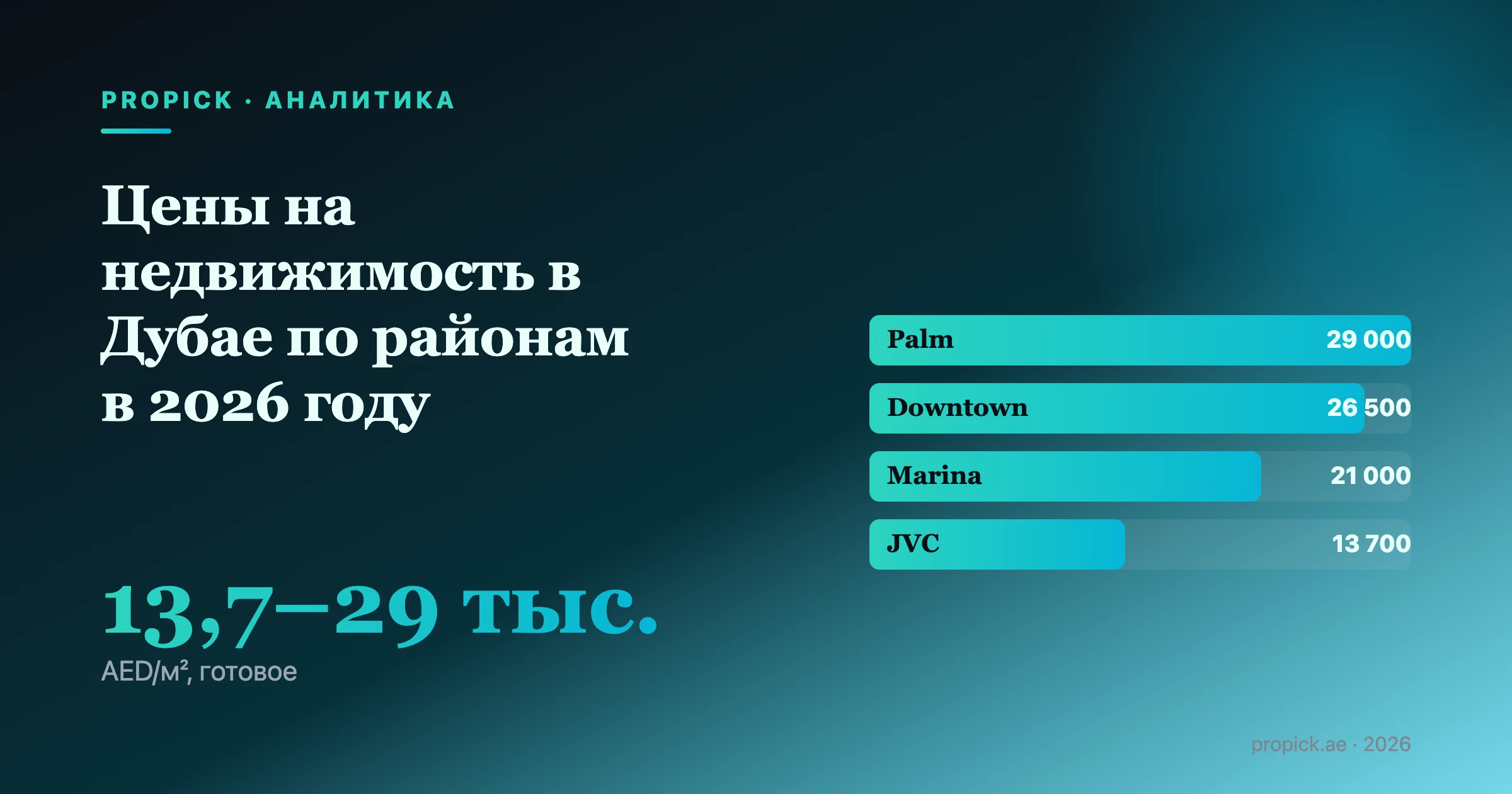
Community Benchmarks: Ready-Resale Price per Sqft (2026)
The figures below are Propick's analysis of DLD's open transaction data, covering ready (completed) apartment resales only, using community-level medians as of July 2026. The AED/sqft column is the AED/sqm figure divided by 10.7639.
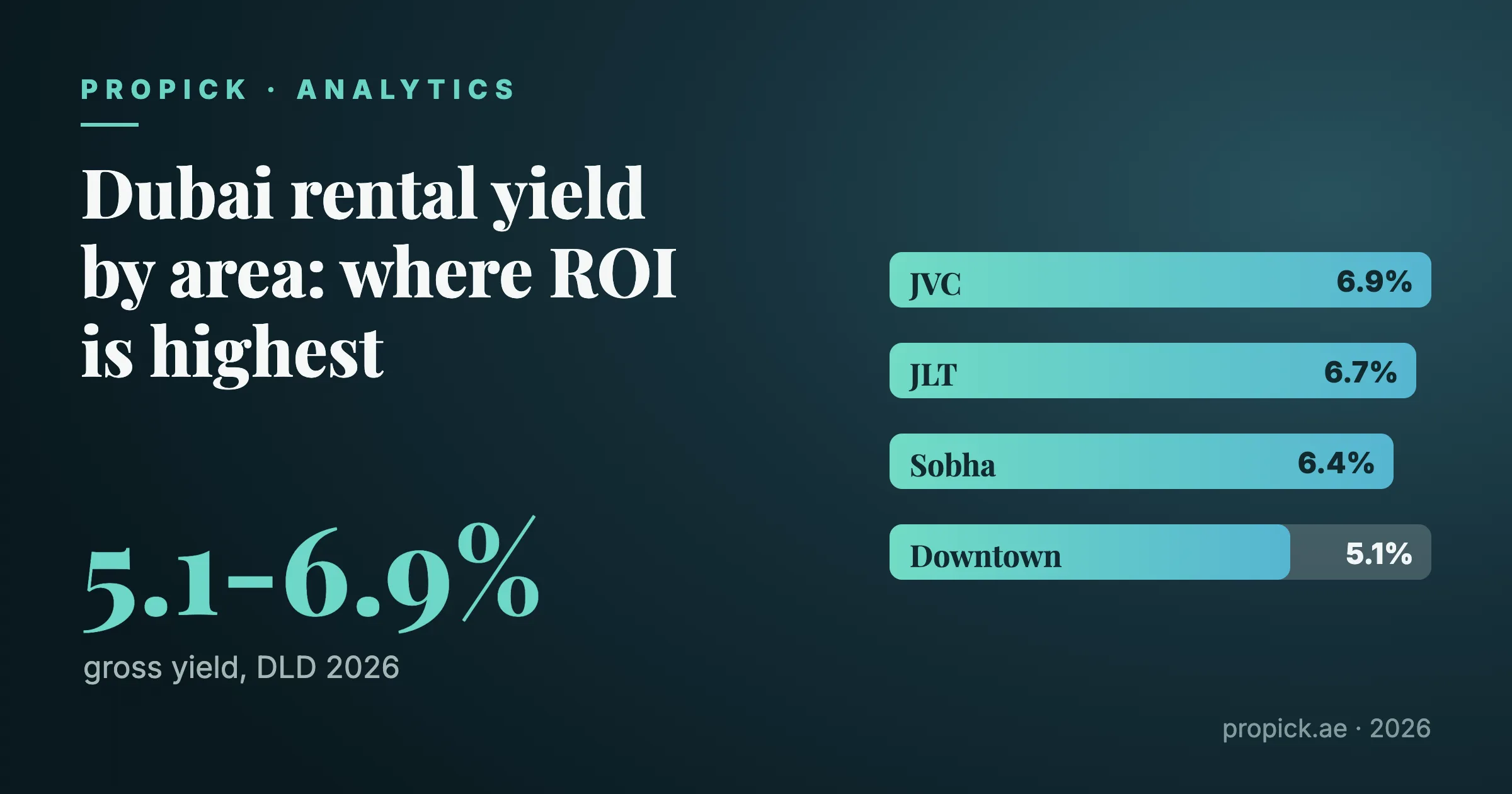
| Community | AED/sqm | AED/sqft | Gross yield | Off-plan share |
|---|---|---|---|---|
| Palm Jumeirah | 29,036 | 2,698 | 5.4% | 39% |
| Downtown Dubai | 26,478 | 2,460 | 5.1% | 32% |
| Dubai Creek Harbour | 25,224 | 2,343 | 5.4% | 70% |
| Dubai Hills Estate | 25,022 | 2,325 | 6.1% | 62% |
| Sobha Hartland | 21,649 | 2,011 | 6.4% | 20% |
| Dubai Marina | 21,028 | 1,954 | 5.2% | 22% |
| Business Bay | 20,306 | 1,886 | 5.9% | 50% |
| Meydan | 16,630 | 1,545 | 6.3% | 93% |
| JLT | 15,666 | 1,455 | 6.7% | 80% |
| DAMAC Hills | 15,405 | 1,431 | 6.9% | 42% |
| Al Furjan | 14,446 | 1,342 | 6.9% | 52% |
| Town Square | 14,398 | 1,338 | 6.7% | 54% |
| JVC | 13,697 | 1,272 | 6.9% | 51% |
| JVT | 13,140 | 1,221 | 7.8% | 83% |
| Dubai South | 11,743 | 1,091 | 7.2% | 76% |
| Dubai Sports City | 10,117 | 940 | 8.7% | 63% |
Source: Propick analysis of DLD's Transactions and Rents datasets, ready-resale apartments, community medians, data as of July 2026.
Read this table as a band, not a single number. A Business Bay listing quoted at AED 2,600 per sqft against a community median of AED 1,886 sits roughly 38% above it, a gap that should be explainable by floor, view or finish, not simply accepted because it is printed on a brochure.
How to Sanity-Check a Quoted Price Yourself
- Find the community median. Use the table above, or pull a fresher cut directly from DLD Open Data.
- Convert consistently. If the median is in AED/sqm, divide by 10.7639 to get AED/sqft.
- Confirm the area basis. Ask whether the quoted footage is built-up area, saleable area, or something else, and whether it matches how the community median was calculated.
- Check the premium is explainable. A meaningful gap above the median should map to a specific reason: higher floor, better view, upgraded finish, or ready versus off-plan status. If nobody can explain it, treat that as a warning sign.
- Pull comparable sales, not just the asking price. An asking price is what a seller wants; a DLD-registered transaction is what a buyer actually paid. The Dubai REST app lets you look up registered transaction history for a specific building.
- Remember the cost on top. Budget for the Dubai Land Department's 4% transfer fee, which in practice is paid by the buyer. It changes your all-in cost per square foot, the number that actually matters for your return.
Pulling the Data Yourself from DLD Open Data
Everything above is reproducible without relying on any broker's word. DLD's Open Data platform organizes its records into categories including Transactions (every registered sale, with price, area and community) and Rents (the Ejari data behind every registered tenancy, useful if you also want a yield). A basic workflow: filter the Transactions category by community (the "Master Project" field) and property type, exclude off-plan records for a ready-resale figure, divide recorded price by recorded area (sqm) per transaction to get AED/sqm, and take the median rather than the mean to avoid a single outlier unit skewing the result. Divide that median by 10.7639 for AED/sqft. Doing this at the building level rather than the community level gives the tightest benchmark, provided there are enough transactions for the median to hold up.
FAQ
How do I convert a Dubai property price from AED per square meter to AED per square foot? Divide the AED/sqm figure by 10.7639. For example, a community median of AED 20,306 per sqm converts to roughly AED 1,886 per sqft.
Why do Dubai listings show prices in square feet if DLD records area in square meters? DLD's registry and open datasets use square meters, the metric standard across UAE government systems, while Dubai's private market quotes in square feet, largely because it markets heavily to international buyers used to imperial units. Anyone comparing the two needs to convert consistently.
Is a lower price per square foot always the better deal? No. A lower psf can reflect a less desirable floor, view or finish rather than genuine value, or an off-plan unit years from handover compared with a ready one. Check what is driving the gap before treating a lower number as automatically better.
What's the difference between an asking price per sqft and a DLD transaction price per sqft? An asking price is what a seller requests and can be negotiable or inflated. A DLD-registered transaction price, available through DLD Open Data or the Dubai REST app, is what a buyer actually paid, making it the more reliable benchmark.
Where can I check Dubai property prices per square foot myself, for free? Start with DLD's Open Data platform for community and building-level transaction records, and the Dubai REST app for individual title and transaction lookups. Both are official DLD resources, not third-party estimates.
Sources
- Dubai Land Department, Open Data platform, Transactions and Rents datasets: https://dubailand.gov.ae/en/open-data/real-estate-data/
- Dubai Land Department, Property Sale Registration (4% transfer fee, paid in practice by the buyer): https://dubailand.gov.ae/en/eservices/property-sale-registration/
- Dubai Land Department, Dubai REST app: https://dubailand.gov.ae/en/eservices/dubai-rest