Every Dubai buyer eventually asks some version of the same question: put money into a community that is already built out, with years of resale and rental history, or into one still filling in, where most of the stock has not been delivered yet. Neither answer is universally correct. What changes between the two is the shape of the risk, not whether risk exists.
Propick's own read of Dubai Land Department transaction and rent data gives a clean way to see the difference: the share of recent deals in a community that are off-plan versus ready. A low off-plan share means most activity is resale of completed units, the mark of an established community. A high off-plan share means most activity is still developer sales of units yet to be built, the mark of a community still maturing. Sobha Hartland sits at 20% off-plan and Dubai Marina at 22%, both firmly established. Meydan sits at 93%, JVT at 83%, and Dubai South at 76%, all still heavily under construction. This article compares what that split means for entry price, supply risk, rent stability, and appreciation, using our own DLD figures.
Methodology: what "new" and "established" mean here
This is a direct read of the Dubai Land Department's own open datasets, dld_transactions and dld_rent_contracts, grouped by community (master_project_en), using the most recent 1,000 records per community as of July 2026. Ready-resale price per square metre is the median price of completed-unit transactions only. Gross yield divides median new annual Ejari rent per square metre by that price. Off-plan share is the proportion of all recorded deals, including new developer sales, that were off-plan; it is reported separately and does not feed into price or yield.
| Community | Ready price AED/sqm | Ready price AED/sqft | Gross yield | Off-plan share |
|---|---|---|---|---|
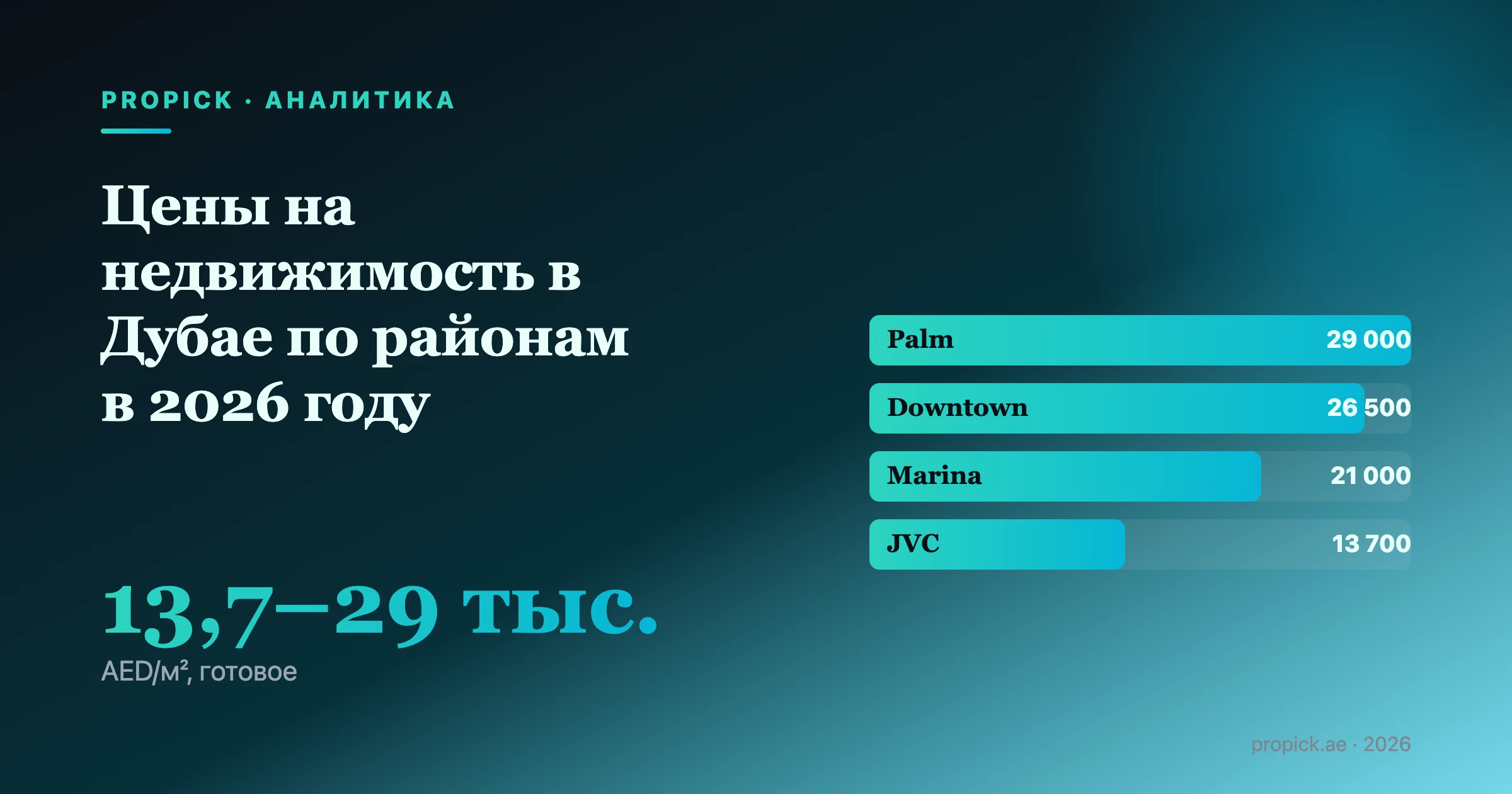
| Palm Jumeirah | 29,036 | 2,698 | 5.4% | 39% |
| Downtown (Burj Khalifa) | 26,478 | 2,460 | 5.1% | 32% |
| Dubai Creek Harbour | 25,224 | 2,344 | 5.4% | 70% |
| Dubai Hills Estate | 25,022 | 2,325 | 6.1% | 62% |
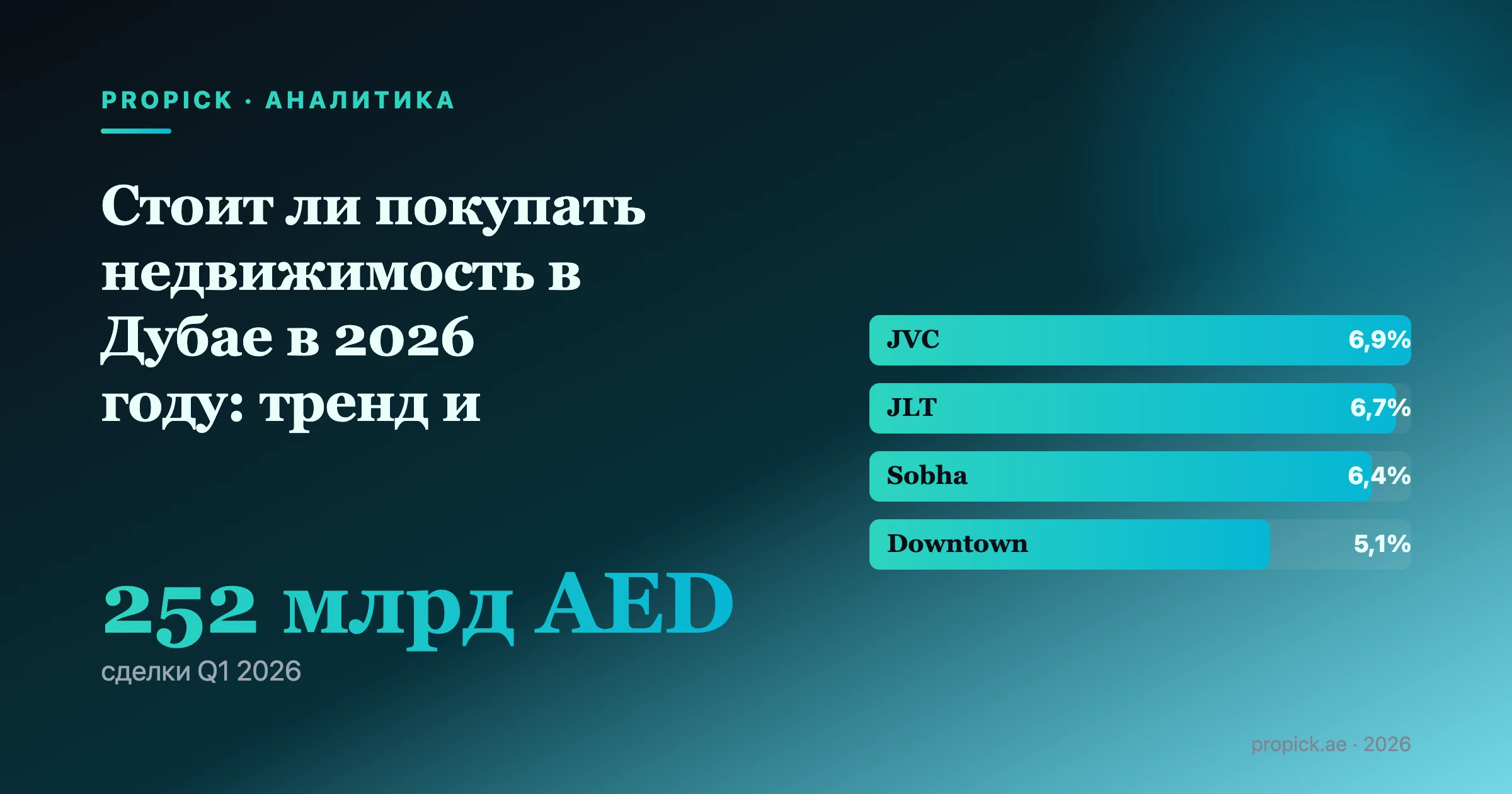
| Sobha Hartland | 21,649 | 2,011 | 6.4% | 20% |
| Dubai Marina | 21,028 | 1,954 | 5.2% | 22% |
| Business Bay | 20,306 | 1,887 | 5.9% | 50% |
| Meydan | 16,630 | 1,545 | 6.3% | 93% |
| JLT | 15,666 | 1,456 | 6.7% | 80% |
| DAMAC Hills | 15,405 | 1,431 | 6.9% | 42% |
| Al Furjan | 14,446 | 1,342 | 6.9% | 52% |
| Town Square | 14,398 | 1,338 | 6.7% | 54% |
| JVC | 13,697 | 1,273 | 6.9% | 51% |
| JVT | 13,140 | 1,221 | 7.8% | 83% |
| Dubai South | 11,743 | 1,091 | 7.2% | 76% |
| Dubai Sports City | 10,117 | 940 | 8.7% | 63% |
One outlier is worth flagging: JLT is one of Dubai's older master developments, built out through the 2000s and 2010s, yet it still shows an 80% off-plan share in current deal flow. Off-plan share tracks live construction activity right now, not how long a community has existed. A mature address with remaining plots can look "new" by this measure the moment a developer starts selling towers on them.
Trade-off one: what you pay to get in
At the top of the table, Palm Jumeirah and Downtown command roughly AED 26,000 to 29,000 per square metre with off-plan shares under 40%. At the bottom, Dubai South and Dubai Sports City sit near AED 10,000 to 12,000 per square metre with off-plan shares above 60%. As a rough pattern, a lower off-plan share correlates with a higher entry price, because established communities carry a premium for proven infrastructure, retail, schools, and a deep resale record.
The correlation is not clean, though. Sobha Hartland, at only 20% off-plan, is priced above Meydan at 93% and JLT at 80%. Location and product positioning still override the maturity signal in plenty of cases, so check the actual price line for the specific community rather than assuming.
Financing changes the calculation too. Under Central Bank of the UAE mortgage regulations, banks cap loan-to-value at 50% on off-plan units, regardless of nationality or residency. A ready property instead qualifies under Article 3 of the CBUAE Rulebook on Important Ratios for up to 80% loan-to-value for expatriates (85% for UAE nationals) on a first home under AED 5 million. A buyer targeting a heavy off-plan community is usually paying through a developer instalment plan rather than a conventional mortgage, changing the cash-flow profile even when the price per square metre looks cheaper.
Trade-off two: supply risk is real, and it is not legal risk
Off-plan buying in Dubai is well protected on the legal side. Under Law No. (8) of 2007 Concerning Escrow Accounts, buyer payments on a registered project sit in a project-specific escrow account, released to the developer only against verified construction progress. That protects your capital from being diverted to an unrelated project.
It does not protect you from a quieter risk: market supply. A community running at 76 to 93% off-plan, like Dubai South or Meydan, has a large volume of units due over the coming one to three years. When several projects hand over close together, the new stock competes for the same tenants and resale buyers, which can soften rent and resale premiums in that window, independent of anything going wrong with any single building. Established communities with low off-plan shares, such as Sobha Hartland or Marina, have less of this pipeline left to absorb, so the near-term supply picture is comparatively settled. "Settled" is not the same as "risk-free," as the appreciation figures below show.
Trade-off three: rent stability favors deep-history communities, with a caveat
Established communities carry years of Ejari contract history, so rent comparisons rest on a large, stable sample rather than a handful of first-generation leases. Once a tenant is in place, any renewal increase is capped under Decree No. (43) of 2013, calculated against the official DLD Rental Index, which limits increases to a maximum of 20% and only when current rent sits more than 40% below the benchmark for a comparable unit. With deep comparables, that benchmark is reliable.
New and maturing communities have thinner rent histories, since fewer units have completed a full lease cycle. Early asking rents are set by first movers rather than an established benchmark, and when a large batch of units hands over at once, landlords can end up competing on price to fill vacancies faster than the Rental Index has fresh comparables to catch up. It is a real, if usually temporary, source of rent volatility that established communities are largely past.
Trade-off four: appreciation does not automatically follow maturity
This is where a simple "established equals safer" story breaks down. Over the past year, our data shows Business Bay (50% off-plan, squarely in the middle band) up 6.9%, Palm Jumeirah (39% off-plan) up 5.3%, and Dubai Marina (22% off-plan) up 3.0%. But Downtown (32% off-plan) is down 3.3%, and Sobha Hartland, at only 20% off-plan, is down 4.2%.
Four of the five communities we have year-over-year figures for are established, low off-plan-share addresses, and the split among them is even: Palm Jumeirah and Marina rose, Downtown and Sobha Hartland fell. The single middle-band community in the set, Business Bay, posted the strongest gain of all five. A low off-plan share signals limited new supply, not guaranteed price growth. It can just as easily mean a community already priced in most of its gains and is now more exposed to a pullback, while a community still absorbing new stock, like Business Bay, can see prices move up alongside the pipeline rather than being weighed down by it. Do not buy into an established community assuming maturity alone protects your capital gain.
Matching the trade-off to your goals
If your priority is predictable rental income, normal ready-property financing, and a real resale record to check before you commit, established communities such as Marina, Sobha Hartland, Palm Jumeirah, or Downtown are the more defensible choice, even though yields there (5.1 to 6.4%) run lower than the market's high end and entry prices are higher.
If your priority is a lower entry price per square metre, a longer horizon, and tolerance for construction and lease-up risk in exchange for potentially stronger yield, communities with heavier off-plan pipelines such as Dubai South, JVT, or Meydan fit better, provided you size the commitment to what you can hold through a delivery wave without needing to sell immediately at a favorable price.
The middle band, Business Bay, JVC, Al Furjan, Town Square, Dubai Hills Estate, and Dubai Sports City, sitting between roughly 42% and 63% off-plan, offers a blend: enough completed stock and history to price with confidence, alongside enough remaining pipeline that entry has not fully caught up to fully mature communities.
FAQ
Is a high off-plan share in a community a warning sign? Not by itself. It means a large share of current deals are new developer sales rather than resales, signalling supply still arriving, not a bad investment. JVT and Dubai South post some of the strongest gross yields in our data despite high off-plan shares.
Which Dubai communities currently have the lowest off-plan share? As of July 2026, Sobha Hartland (20%), Dubai Marina (22%), Downtown (32%), and Palm Jumeirah (39%) sit lowest among the communities we track, meaning most recent activity there is resale of completed units.
Do established, low off-plan-share communities always appreciate faster? No. Over the past year Downtown and Sobha Hartland, both low off-plan-share, recorded declines of 3.3% and 4.2%, while Business Bay, at 50% off-plan, posted the strongest gain at 6.9%. Off-plan share measures supply, not future price direction.
Does a heavy off-plan pipeline always mean a cheaper entry price? Generally yes as a pattern, but not always. Sobha Hartland, at only 20% off-plan, is priced above both Meydan (93%) and JLT (80%), so check the specific community's numbers rather than assuming.
How does financing differ between an off-plan-heavy and an established community? Under CBUAE mortgage regulations, banks cap off-plan lending at 50% loan-to-value regardless of buyer profile, while ready property under Article 3 of the CBUAE Rulebook allows up to 80% for expatriates and 85% for UAE nationals on a first home under AED 5 million.
What fee applies to the purchase regardless of which type of community I choose? Dubai Land Department registration carries a 4% transfer fee on the sale value, whether bought off-plan through Oqood registration or ready through standard property sale registration. On the secondary market this fee is customarily paid in full by the buyer.
Sources
- Dubai Land Department / DLD Open Data, dld_transactions dataset: https://dubailand.gov.ae/en/open-data/real-estate-data/
- Dubai Land Department / DLD Open Data, dld_rent_contracts dataset: https://dubailand.gov.ae/en/open-data/real-estate-data/
- Dubai Land Department, Rental Index / Rental Increase Calculator eService: https://dubailand.gov.ae/en/eservices/rental-index/rental-index/
- Dubai Legislation Portal, Decree No. (43) of 2013 Determining Rent Increase for Real Property in the Emirate of Dubai: https://dlp.dubai.gov.ae/Legislation%20Reference/2013/Decree%20No.%20%2843%29%20of%202013%20Determining%20Rent%20Increase%20for%20Real%20Property.html
- Dubai Legislation Portal, Law No. (8) of 2007 Concerning Escrow Accounts for Real Estate Development in the Emirate of Dubai: https://dlp.dubai.gov.ae/Legislation%20Reference/2007/Law%20No.%20%288%29%20of%202007.html
- Dubai Land Department, Request to Register the Initial Sale (Oqood): https://dubailand.gov.ae/en/eservices/request-to-register-the-initial-sale/
- Dubai Land Department, Property Sale Registration (title deed, DLD fee): https://dubailand.gov.ae/en/eservices/property-sale-registration/
- Central Bank of the UAE, Regulations Regarding Mortgage Loans (CBUAE Rulebook): https://rulebook.centralbank.ae/en/rulebook/regulations-regarding-mortgage-loans
- Central Bank of the UAE, Article 3: Important Ratios (CBUAE Rulebook): https://rulebook.centralbank.ae/en/rulebook/article-3-important-ratios