Buying a whole apartment outright is still how most people invest in Dubai property, but a full purchase price, the 4% DLD transfer fee paid in practice by the buyer, and ongoing landlord duties are not the only way in. Two regulated tracks let an investor hold a slice of Dubai real estate instead of one whole unit: publicly listed, DFSA-regulated real estate investment trusts (REITs) trading on Nasdaq Dubai, and a newer generation of fractional-ownership and tokenization platforms built around the Dubai Land Department's Real Estate Tokenization initiative. Both deserve to be understood on their own terms, because "regulated" does not mean identical across the two, and neither removes every risk a direct buy-to-let purchase carries. Each simply trades one set of trade-offs for another.
Two regulated routes, one unregulated middle ground
At one end sits the REIT: a diversified, exchange-listed fund supervised by a financial regulator, bought and sold like a stock. At the other sits a specific property split into tokens or SPV shares by a fintech platform, bought directly from that platform rather than on an exchange. In between is a mainland, onshore fund regime that most retail buyers never actually touch. Knowing which bucket a product sits in changes what protection, if any, actually applies.
DFSA-regulated REITs: the most tightly supervised route
REITs here sit inside the Dubai International Financial Centre (DIFC), a common-law free zone, and are supervised as Collective Investment Funds by the Dubai Financial Services Authority (DFSA), the DIFC's independent financial regulator. A DFSA-regulated REIT pools money from many investors, holds a portfolio of income-producing property, and lists its shares on Nasdaq Dubai, so buying and selling happens the way it would for any listed stock, not through a private property negotiation.
Two vehicles cover almost this entire segment today. Emirates REIT, the region's first REIT, launched in 2010 and has traded on Nasdaq Dubai since 8 April 2014. It is incorporated in the DIFC and licensed by the DFSA, with a Sharia-compliant portfolio built around offices and schools: Index Tower, Index Mall, Lycée Français Jean Mermoz, GEMS World Academy and Durham School Dubai. Its most recently disclosed portfolio value sat at roughly USD 1.24 billion across seven properties, against a share price of about USD 0.62. ENBD REIT, also DFSA-regulated, DIFC-domiciled and Nasdaq Dubai-listed, reported a net asset value of about USD 255 million (USD 1.02 per share) as of 31 March 2026, a property portfolio worth roughly USD 430 million across ten assets weighted toward offices (72%), with residential (13%) and other alternative assets (15%), a 42% loan-to-value ratio, and 95% occupancy.
Both funds are Sharia-compliant and both pay income to shareholders as dividends rather than rent collected directly. Because they are exchange-listed, buying in can start at the price of a single share, far below the cost of a Dubai apartment, and selling is, in principle, as fast as placing an order during Nasdaq Dubai trading hours.
The onshore alternative: mainland funds under the UAE Capital Markets Authority
DIFC is not the only regulatory track. Onshore, mainland UAE real estate investment funds fall under the UAE Capital Markets Authority (CMA), the federal regulator formerly known as the Securities and Commodities Authority (SCA), which runs its own rulebook and a public register of authorized funds, separate from the DFSA's DIFC regime. In practice, most international investors encounter the DIFC-domiciled, Nasdaq Dubai-listed REITs above rather than an onshore fund. Anyone offered a "REIT" or property fund structured onshore should ask which regulator licenses it, DFSA or CMA, since the rulebook, disclosure standards and investor protections differ between the two.
Fractional ownership platforms: tokenized titles and equity crowdfunding
A second, newer track skips the exchange altogether and sells a fraction of one specific property rather than shares in a diversified fund. Two structures dominate in Dubai.
Tokenized ownership runs through the Dubai Land Department's Real Estate Tokenization initiative, a pilot program DLD runs together with the Virtual Assets Regulatory Authority (VARA), the Dubai Future Foundation and the Central Bank of the UAE. It converts a share of a specific, registered property into a blockchain token. Prypco Mint, the platform DLD partnered with to launch this, is licensed by VARA and takes investors in from AED 2,000. Prypco states that a tokenized purchase carries a reduced 2% DLD fee, compared with the 4% transfer fee a buyer pays on a standard secondary-market sale, and that token holders can resell on the Mint marketplace after a three-month lock-in, within a price band of plus or minus 15% of the latest DLD valuation. The platform advertises a projected 8-12% net annual return combining rental income and appreciation, explicitly flagged as a non-guaranteed projection rather than a fixed yield.
Equity crowdfunding takes a different legal shape. SmartCrowd, which describes itself as the region's first DFSA-regulated real estate crowdfunding platform and operates out of DIFC, pools investors from AED 500 per property. Once a listed property is fully funded, SmartCrowd forms a special purpose vehicle (SPV) that holds title, and investors receive SPV shares, out of 1,000,000 issued per property, proportional to what they put in. Legally, an investor owns a stake in the SPV, not the property's title deed directly. Exit works through a vote to sell, typically pitched around a five-year hold, or a twice-yearly Share Transfer Facility running in March and September. SmartCrowd advertises 6-12% target annual yields on hold properties and 15-20% on shorter flip deals.
REITs vs fractional platforms vs buying a unit outright
| DFSA-regulated REIT | Fractional platform (token or SPV) | Buying a unit outright | |
|---|---|---|---|
| Entry ticket | Price of one Nasdaq Dubai share | AED 500-2,000 minimum, platform-dependent | Full purchase price plus fees |
| Legal claim | Listed shares in a DIFC fund | Token or SPV shares, not a title deed | Title deed via DLD |
| Regulator | DFSA (DIFC) | VARA (tokens) / DFSA crowdfunding rules (SPV) | DLD, RERA |
| Liquidity | Exchange trading, but thin volume in practice | Lock-in period, price-banded resale, or scheduled transfer windows | Full resale process, weeks to months |
| Fees | Fund management fees, brokerage on trades | Platform fee, reduced DLD fee on tokens | 4% DLD fee, agency commission, maintenance |
| Income | Dividends from a diversified portfolio | Rental income share, target not guaranteed | Direct rent, full landlord responsibility |
| Leverage | Fund-level gearing (for example, ENBD REIT's 42% LTV) | Typically none at investor level | Investor's own mortgage, if used |
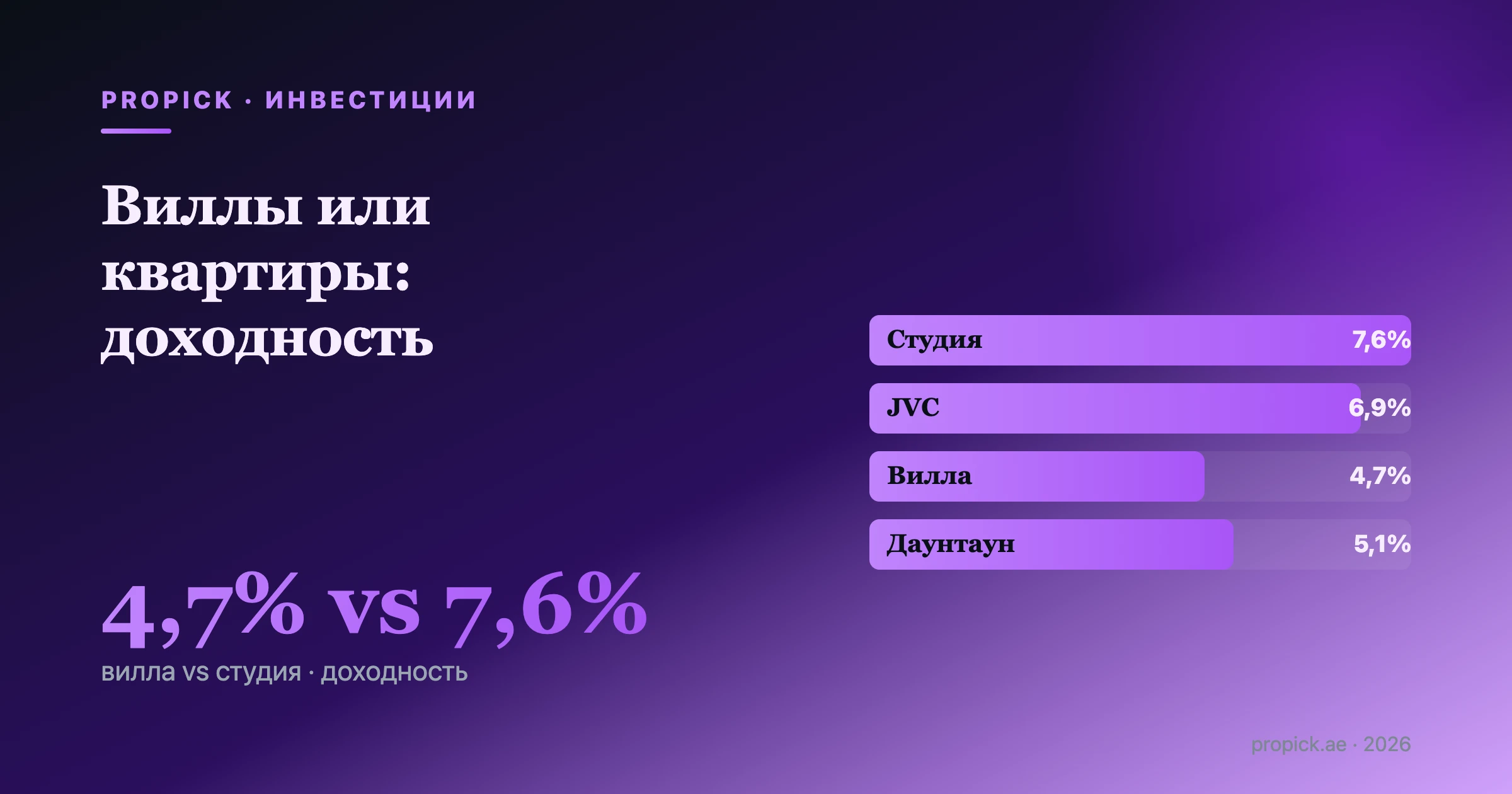
Propick's own 2026 DLD-based rental yield data shows why the fractional routes appeal to smaller budgets. Buying a ready studio directly, the segment with Dubai's highest yields at roughly 7.6%, or a JVC unit at a median AED 13,697 per sqm and 6.9% yield, still means finding the full purchase price up front, plus the 4% DLD fee, agency commission, and running the unit as a landlord. Reaching a similar building through a REIT share or a Mint token instead swaps that full commitment, and that specific yield, for a smaller ticket, no property-management burden, and typically a lower, fund-level or single-asset-basket return. ENBD REIT's 42% loan-to-value, office-heavy book, or Emirates REIT's education and office assets, behave nothing like a single JVC or Palm Jumeirah rental unit. A Palm apartment, at a median AED 29,036 per sqm, carries its own 5.4% yield and a purchase price few investors can write in cash outright. A villa purchase, median AED 3.8 million at roughly 4.7% yield, sits at the other end of the same spectrum: full control and full exposure to one asset, against a REIT or crowdfunding stake's smaller, shared claim on many. It is worth remembering, too, that roughly 81% of Dubai's residential deals are still paid in outright cash rather than mortgaged, which is part of why direct ownership remains the default for investors who can write the full check.
The honest risk and regulation picture
None of this is risk-free, and the risks are not the same across routes.
REITs carry the deepest regulatory scaffolding: DFSA oversight, DIFC's common-law courts, and Nasdaq Dubai listing rules. But the segment is small, effectively two REITs of meaningful size, and neither publishes a net-asset-value-per-share figure alongside its share price the way a fully verifiable apples-to-apples comparison would need. A public listing does not guarantee deep daily trading volume; an investor who wants to exit a sizeable REIT position quickly can still move the price against themselves in a thin market, even though the shares are technically liquid. Anyone weighing a REIT purchase should pull the fund's latest NAV disclosure directly from Emirates REIT or ENBD REIT rather than estimating it from portfolio value alone.
Fractional ownership and tokenization platforms carry a different risk profile. VARA licenses Prypco for the virtual-asset activity involved in issuing and trading tokens, a narrower regulatory perimeter than the DFSA's oversight of a listed REIT, and DLD itself still describes the tokenization initiative as a pilot phase, meaning the rules, protections and market structure around it are still being built out rather than mature. The three-month lock-in and the plus-or-minus 15% marketplace price band on Mint mean an investor's ability to exit is real but bounded, not the instant liquidity a REIT share sale implies. SmartCrowd's SPV structure means an investor's legal claim runs through a shareholding in a private company, not a title deed, so investors carry SPV and platform counterparty risk on top of the property's own performance, and exit depends on a scheduled vote or a twice-yearly transfer window functioning as advertised, not on selling whenever the investor wants to.
Across every route here, income projections, whether a REIT's dividend history, Prypco's 8-12% target, or SmartCrowd's advertised yields, are targets and past results, not guaranteed returns. None of these structures carries a deposit-style guarantee from the DFSA, VARA, or any UAE regulator. Given how fast this space is evolving, particularly the tokenization pilot, anyone considering it should confirm the current rules, licensing status and fee structure directly with DFSA, VARA, the Dubai Land Department, or a licensed financial advisor before committing capital, rather than relying on a platform's own marketing pages.
FAQ
Is investing in a Dubai REIT the same as putting money in a guaranteed, insured product? No. A DFSA-regulated REIT is a listed investment fund, not a bank deposit. Its share price and dividends can fall as well as rise, and there is no deposit-style guarantee behind it from the DFSA or any other UAE regulator.
Can a foreign, non-resident investor buy Dubai REIT shares or fractional property tokens? Generally yes. Nasdaq Dubai and the fractional platforms cited above accept international investors, though each has its own onboarding, KYC and eligibility checks, so confirm the current requirements directly with the exchange or platform before funding an account.
How does the DLD fee differ for a tokenized purchase versus a normal resale? Prypco states tokenized transactions on its Mint platform carry a reduced 2% DLD fee, versus the 4% transfer fee a buyer pays in practice on a standard secondary-market purchase. Confirm current fee levels directly with the platform and DLD, since the tokenization program is still in its pilot phase.
Do I get a title deed with fractional ownership, or only shares? It depends on the structure. DLD's tokenization initiative is designed to link a token to a registered fractional interest in the property itself, while SmartCrowd's model gives investors shares in a special purpose vehicle that holds the title, not a title deed in the investor's own name. Read each platform's own legal documentation before assuming which applies.
Which is more liquid: REIT shares or a fractional property token? REIT shares trade on Nasdaq Dubai during normal exchange hours, but daily volume in this small segment can be thin, so a large sale may still take time to fill at a good price. Tokenized shares carry a stated lock-in period and a bounded resale price band, and SPV-based crowdfunding exits depend on scheduled votes or transfer windows. None of the three offers same-day liquidity comparable to a deep, high-volume stock market.
Does a REIT or fractional platform pay a higher yield than just buying a rental unit directly? Not necessarily. Our DLD-based data shows direct ready units yielding roughly 5.1-6.9% across most established areas, up to about 7.6% on studios, the highest segment. REITs and fractional platforms trade that concentrated exposure for diversification, a smaller ticket, and no landlord duties, at a return that reflects a fund-level or basket-level average rather than one specific unit's yield.
Sources
- Dubai Financial Services Authority (DFSA). https://www.dfsa.ae
- Nasdaq Dubai, products and services. https://www.nasdaqdubai.com/
- Emirates REIT (Equitativa (Dubai) Limited, DFSA-regulated fund manager). https://reit.ae/
- ENBD REIT. https://www.enbdreit.com/
- Dubai Land Department, Real Estate Tokenization initiative. https://dubailand.gov.ae/en/eservices/real-estate-tokenization/
- PRYPCO Mint. https://www.prypco.com/mint
- Virtual Assets Regulatory Authority (VARA). https://www.vara.ae/en/
- SmartCrowd. https://www.smartcrowd.ae/
- UAE Capital Markets Authority (CMA, formerly SCA), regulations. https://www.uaecma.gov.ae/en/regulations
- Dubai Land Department, Open Data portal (dld_transactions, dld_rent_contracts). https://dubailand.gov.ae/en/open-data/real-estate-data/
- Dubai Land Department & Al Tamimi & Company, "Know Your Rights for Real Estate Investors in Dubai" (fee schedule, p.27). https://dubailand.gov.ae/media/wlzmuycr/know_your_rights.pdf