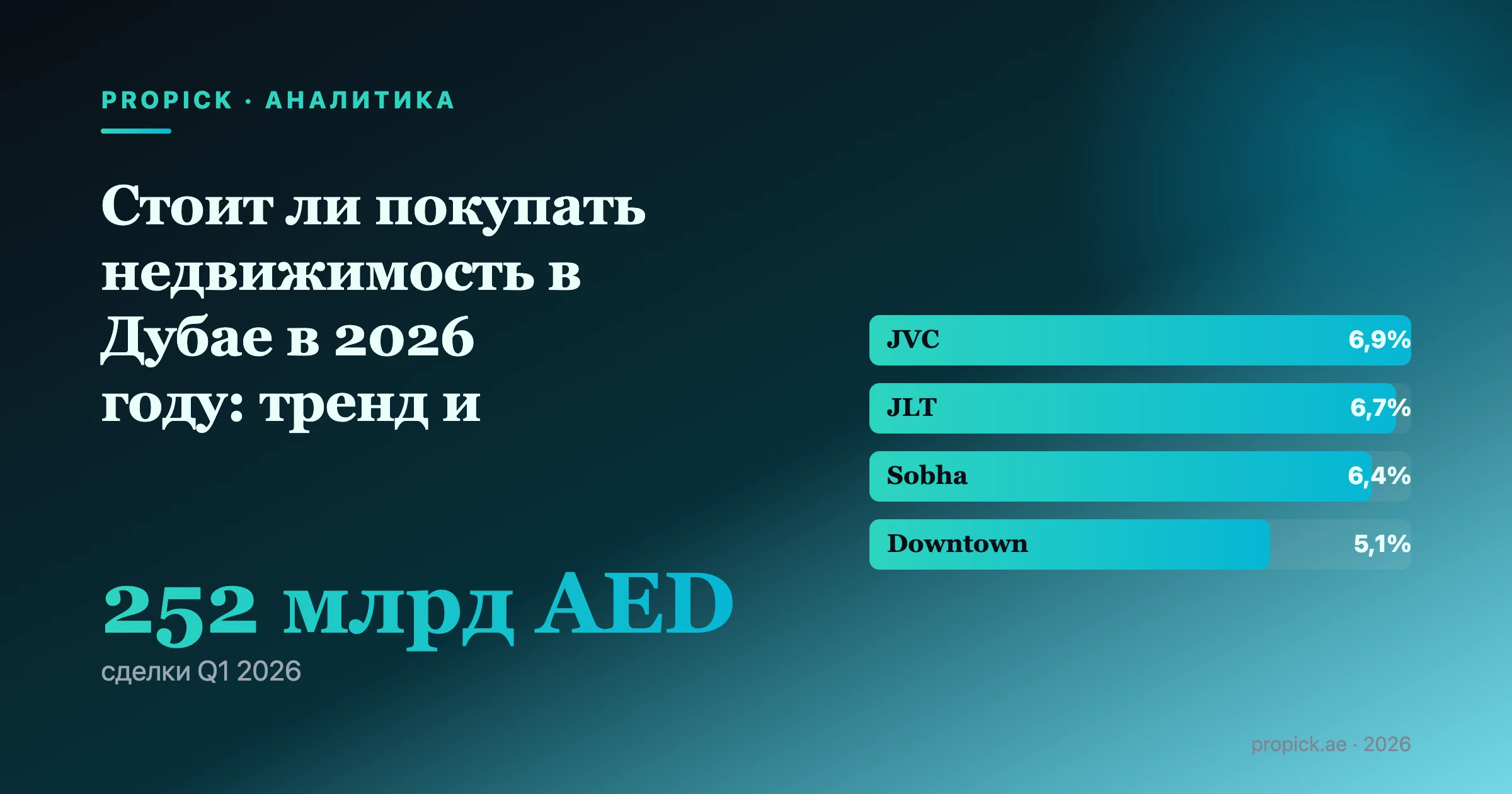
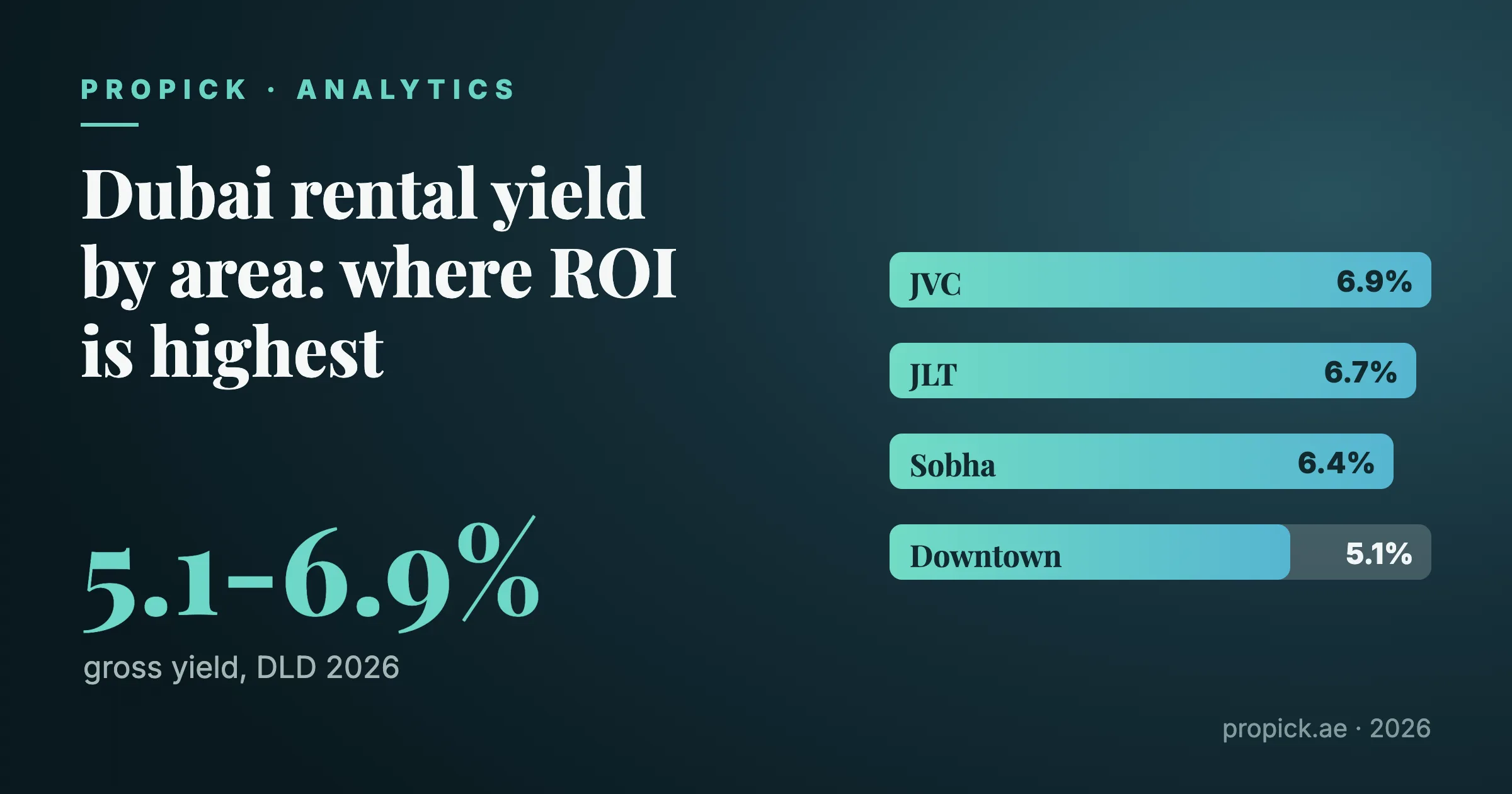
Buyers usually ask for one number: which area gives the best return. The honest answer is that "return" splits into two separate things that rarely move together, rental yield and capital growth, and the 2026 Dubai Land Department data shows the split clearly. Jumeirah Village Circle (JVC) throws off a 6.9% gross yield, one of the highest in the city, yet its resale price rose only 1.2% year on year. Business Bay, by contrast, managed both a 6.9% year-on-year price gain and a solid 5.9% yield. Downtown Dubai and Sobha Hartland, two of the most sought-after addresses in the market, saw resale prices fall 3.3% and 4.2% respectively over the same period, even as their yields held at a respectable 5.1% and a strong 6.4%.
None of that is a contradiction. It is how a maturing property market actually behaves once cheap, easy gains are gone: a community earns cash flow when its price has stayed anchored to what tenants pay, and it earns capital appreciation when demand is bidding the price up faster than rents can follow. Very few communities do both in the same twelve months, and the DLD numbers below show exactly which ones came closest, and which ones are quietly paying investors in one currency while taking back value in the other.
Methodology in one line: yields and price growth are Propick's own calculations from DLD's dld_transactions and dld_rent_contracts datasets, medians grouped by master project, ready-resale basis, growth measured 2025 to 2026 year-on-year, data as of July 2026.
Yield vs growth: the combined leaderboard
The table below ranks the nine communities where Propick has both a gross yield figure and a year-on-year price growth figure, sorted by a simple combined score (yield plus growth, added together, not compounded). It is not a forecast of total return, just a way of showing that the community with the best yield alone (JVC) and the community with the best combined score (Business Bay) are not the same place.
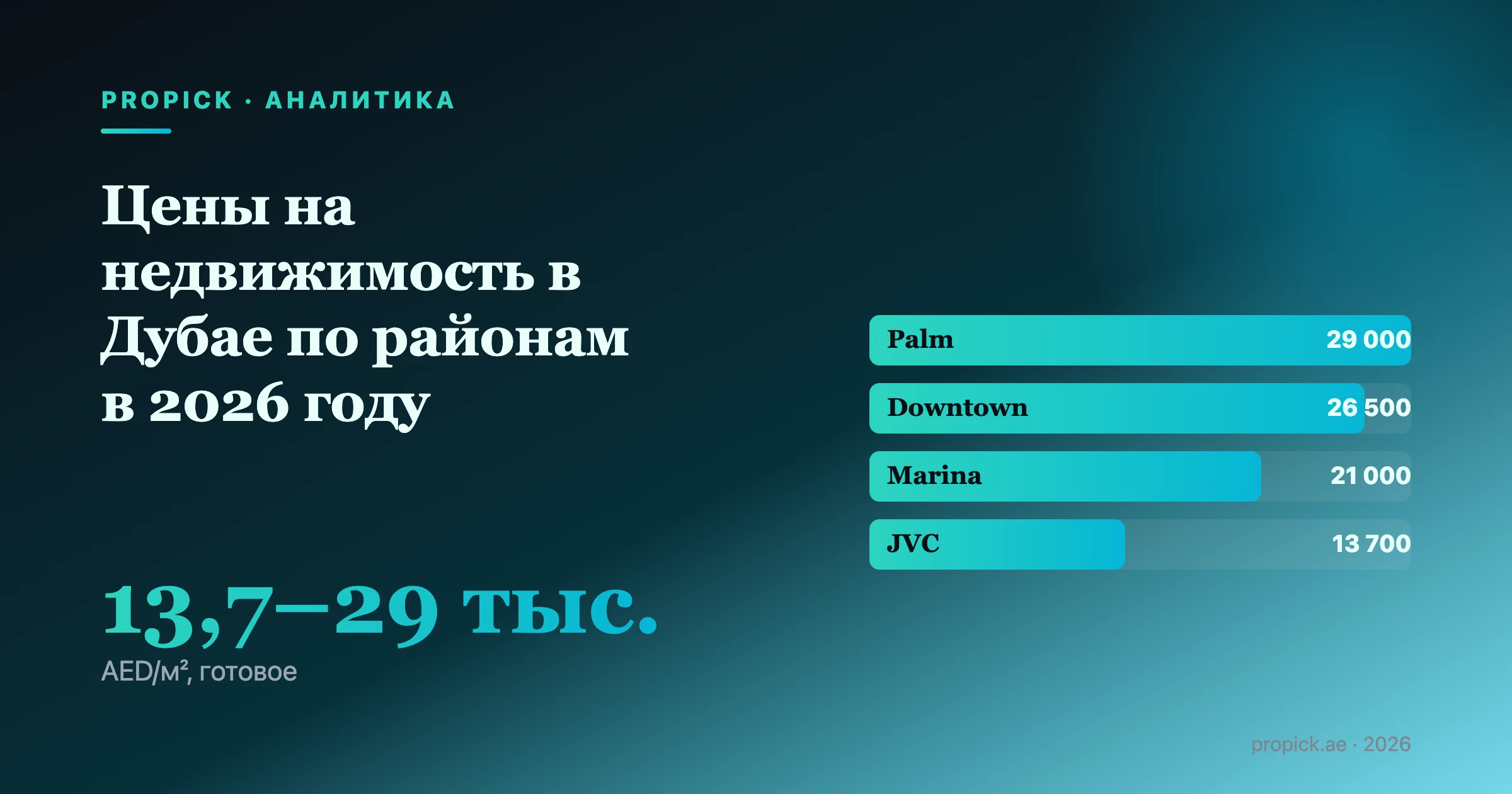
| Community | Price, AED/sqm | Gross yield | YoY price growth | Combined (yield + growth) | Off-plan share | 2026 YTD transactions |
|---|---|---|---|---|---|---|
| Business Bay | 20,306 | 5.9% | +6.9% | 12.8 | 50% | 2,829 |
| Palm Jumeirah | 29,036 | 5.4% | +5.3% | 10.7 | 39% | 593 |
| JLT | 15,666 | 6.7% | +2.5% | 9.2 | 80% | 1,554 |
| Dubai Marina | 21,028 | 5.2% | +3.0% | 8.2 | 22% | 1,762 |
| JVC | 13,697 | 6.9% | +1.2% | 8.1 | 51% | 5,583 |
| Dubai Creek Harbour | 25,224 | 5.4% | +2.3% | 7.7 | 70% | 2,242 |
| Dubai Hills Estate | 25,022 | 6.1% | +1.3% | 7.4 | 62% | 1,199 |
| Sobha Hartland | 21,649 | 6.4% | -4.2% | 2.2 | 20% | 635 |
| Downtown (Burj Khalifa) | 26,478 | 5.1% | -3.3% | 1.8 | 32% | 1,048 |
Source: Propick analysis of DLD dld_transactions and dld_rent_contracts, ready-resale medians by master project, data as of July 2026.
Read across that table and the trade-off is visible in every row. JVC has the highest transaction count on the list and one of the two highest yields, but its combined score sits mid-table because price barely moved. Downtown and Sobha Hartland sit at the bottom not because their income stopped, their yields are still among the strongest in the group, but because their prices gave back ground over the past year.
The cash-flow tier: JVC, and a yield band that runs even higher
JVC's 6.9% yield on a median AED 13,697 per sqm is the reason it remains the single most liquid community in Dubai, with 5,583 residential transactions in 2026 year to date, roughly double the next busiest market, Business Bay. Investors buying here are underwriting rent, not price momentum, and the data backs that reading: modest 1.2% price growth alongside strong, steady rental demand.
JVC is not even the top yield in Propick's full dataset. Dubai Sports City posts the highest gross yield tracked anywhere in the city at 8.7%, on a median price of just AED 10,117 per sqm. A handful of other mid-market communities sit close behind: JVT at 7.8%, Dubai South at 7.2%, and Al Furjan and DAMAC Hills tied at 6.9%. None of these currently have a matching year-on-year growth figure in our tracked set, so we cannot score them on the combined leaderboard above, and we are not going to guess. What the yield numbers alone say is consistent with JVC's story: cheaper entry prices, established or fast-filling tenant pools, and rents that have kept up with (or outrun) resale prices. That combination is the definition of a cash-flow play, not a capital-growth bet.
Business Bay: the outlier that captured both
Business Bay is the one community in this dataset that delivered strong income and strong appreciation in the same period. At AED 20,306 per sqm it still trades roughly 23% cheaper than neighboring Downtown Dubai, while offering a similar central, walkable location. That price gap appears to be closing: Business Bay's 6.9% year-on-year growth is the fastest in the entire tracked set, on top of a 5.9% yield that beats Downtown, Marina and Palm Jumeirah outright.
Two structural features likely explain it. Business Bay carries a 50% off-plan share, meaning half of recent activity is fresh launches rather than resales, a sign of live developer pipeline and buyer appetite rather than a cooling market. And it is the second-most liquid community by transaction count (2,829 deals year to date), so the price gain is not a thin-market fluke driven by a handful of trophy sales, it is showing up across genuine volume.
When prestige cools: Downtown and Sobha Hartland
Downtown Dubai and Sobha Hartland are the two communities in the tracked set that lost value over the past year, down 3.3% and 4.2% respectively. Both are also communities where yield stayed intact: Downtown at 5.1%, in line with its historical prime-address discount, and Sobha Hartland at 6.4%, actually the third-highest yield in the combined table, behind JVC's 6.9% and JLT's 6.7%. The rent side of the equation did not weaken; the price side did.
A likely factor is how each community's supply mix compares. Sobha Hartland's off-plan share is the lowest in the dataset at 20%, meaning its price benchmark is driven almost entirely by resale transactions among existing owners rather than fresh launch pricing, which leaves it more exposed when resale sentiment softens. Downtown, meanwhile, sits near the very top of the price table at AED 26,478 per sqm, second only to Palm Jumeirah, with transaction volume in the middle of the pack (1,048 deals), a combination consistent with a smaller, pickier buyer pool at that price point pulling back after a period of rapid gains, rather than a supply glut. Either way, the lesson for a prospective buyer is the same: a high price tag and a well-known name do not exempt a community from a correction, and yield alone did not offset it over the past twelve months.
Why yield and growth rarely peak together
The mechanics are straightforward once you separate the two numbers. Yield is rent divided by price, so it mechanically compresses whenever price rises faster than rent, and it mechanically holds up (or even rises) whenever price falls while rent stays flat. Growth, on the other hand, tracks fresh buyer demand and scarcity, which tends to concentrate in communities with strong pipelines, central locations, or a supply story that is tightening rather than a resale base that is simply mature.
That is why JVC's huge transaction volume translates into rental demand and yield, but not into much price movement: it is a deep, liquid, well-supplied market where new stock keeps arriving to meet demand, capping how fast prices can run. It is also why Business Bay, sitting in the middle of the price table with genuine transaction depth, was able to re-rate upward without giving up its yield. And it is why Palm Jumeirah, the least liquid community tracked (just 593 transactions year to date against JVC's 5,583), can post solid 5.3% growth on trophy scarcity alone even though its yield, at 5.4%, is unremarkable, thin trading in a fixed-supply, high-demand asset behaves differently from a deep, elastic market like JVC.
It is also worth noting that roughly 81% of Dubai's registered residential deals are outright cash sales, against about 14% mortgage registrations, so most of this price movement, in either direction, more likely reflects buyer demand and sentiment than shifts in borrowing costs, though cash buyers are not fully insulated from rate-driven effects such as opportunity cost and shifting global capital flows. Whatever moved Business Bay up and Downtown down over the past year, the high cash share suggests borrowing costs are unlikely to have been the dominant driver, rather than ruling out an interest-rate story entirely.
Matching the trade-off to your strategy
For an investor prioritizing monthly income, JVC, Dubai Sports City, JVT and Dubai South sit at the top of the yield table and, in JVC's case, also offer the deepest resale market to exit from later. For someone chasing appreciation and willing to accept thinner liquidity, Business Bay currently offers both, while Palm Jumeirah offers growth and scarcity value at the cost of yield and quick resale. For anyone drawn purely to a prestige address, Downtown and Sobha Hartland's past-year numbers are a useful reality check: strong yield did not prevent a price pullback, and any short-hold flip in a cooling segment also has to clear the 4% DLD transfer fee, paid in practice by the buyer, before it turns a real profit.
FAQ
Does a high rental yield mean an area will not see capital growth? Not necessarily, but the 2026 data shows it is common. JVC's 6.9% yield came with only 1.2% price growth, while Business Bay combined a strong 5.9% yield with 6.9% growth, the fastest in the tracked set. Yield and growth are two different mechanisms and only sometimes move together.
Why did Downtown Dubai and Sobha Hartland lose value if their yields are strong? Rents in both communities held up, which is why their yields stayed at 5.1% and 6.4%. Resale prices fell 3.3% and 4.2% year on year regardless, most likely reflecting a smaller pool of buyers at high price points and, in Sobha Hartland's case, a resale-dominated market with a low 20% off-plan share.
Which Dubai area had the best combined return in 2026? On Propick's simple combined score (yield plus growth, not compounded), Business Bay ranked highest among the nine communities with both metrics tracked, followed by Palm Jumeirah and JLT. This is not a forecast, just a summary of the past year's data.
Is Dubai Sports City's 8.7% yield the highest in the market? It is the highest gross yield in Propick's tracked dataset, ahead of JVT (7.8%) and Dubai South (7.2%). A matching year-on-year price growth figure is not yet part of our tracked set for Sports City, so it cannot be scored on the combined leaderboard.
Should I prioritize yield or capital growth when buying in Dubai? It depends on the investment goal. Income-focused buyers have historically done well in high-yield, high-liquidity communities like JVC. Buyers targeting appreciation have to accept either a Business Bay-style bet on a re-rating market or a Palm Jumeirah-style trade of yield for scarcity, with correspondingly thinner resale liquidity.
How does transaction liquidity affect this trade-off? Liquidity shapes how reliably a price trend can be trusted and how easily an investor can exit. JVC's 5,583 transactions year to date make it the deepest market tracked; Palm Jumeirah's 593 make it the thinnest. A price move in a thin market, up or down, carries more uncertainty than the same move in a deep one.
Sources
- Dubai Land Department / DLD Open Data, dld_transactions (open dataset): https://dubailand.gov.ae/en/open-data/real-estate-data/
- Dubai Land Department / DLD Open Data, dld_rent_contracts (open dataset): https://dubailand.gov.ae/en/open-data/real-estate-data/
- Dubai Land Department, Transfer of Ownership e-service (4% registration fee): https://dubailand.gov.ae/en/eservices/request-for-transfer-of-ownership/
- Dubai Land Department, Open Data portal: https://dubailand.gov.ae/en/open-data/real-estate-data/