Ask ten people in Dubai whether it is smarter to rent or buy and you will get ten confident, contradictory answers, most based on a friend's anecdote rather than a friend's spreadsheet. The honest answer is that it depends, not as a hedge but as a real conclusion: on how long you plan to stay, which community you are comparing, and whether you are paying cash or financing. This piece runs the actual numbers using Propick's own read of Dubai Land Department (DLD) transaction and rent-contract data, so you can see where the math tilts toward owning, where it tilts toward renting, and where lifestyle and visa considerations should decide it instead.
What Yield Actually Tells You
Every community-level comparison in this piece starts from one relationship: gross rental yield equals annual rent divided by price, so annual rent is roughly yield multiplied by price. That lets us translate our price data directly into real AED rent figures without needing a separate rent survey.
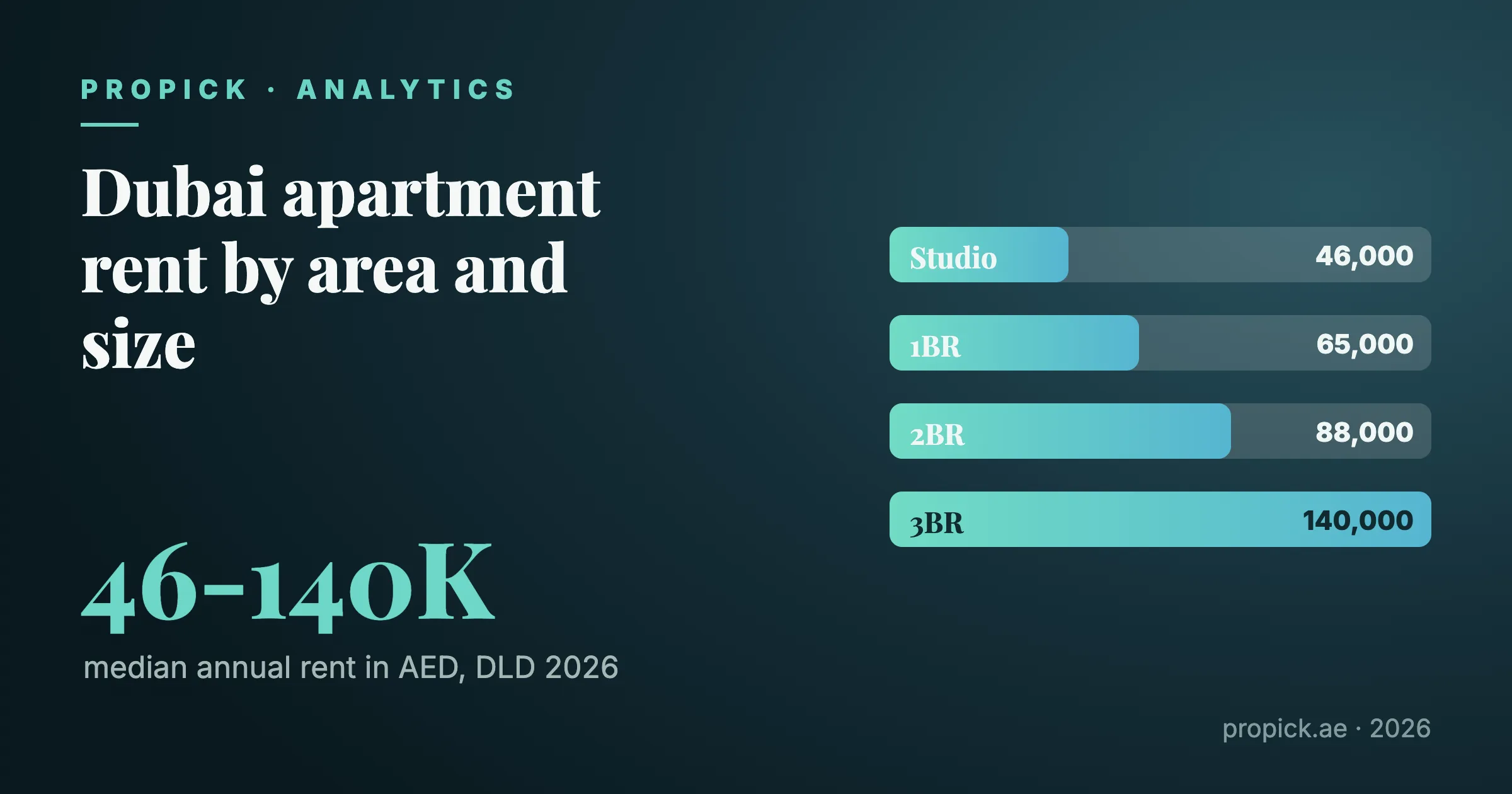
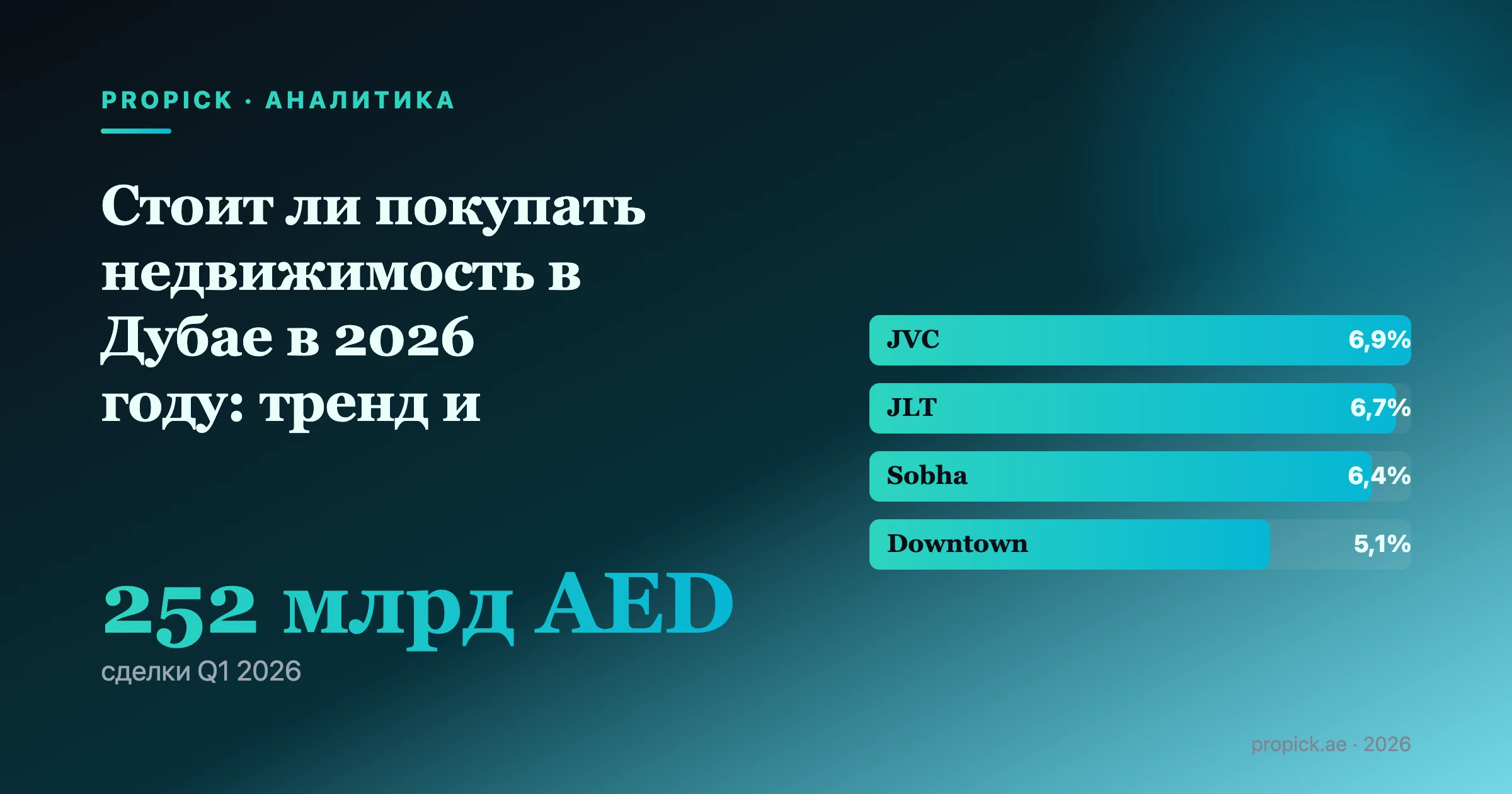
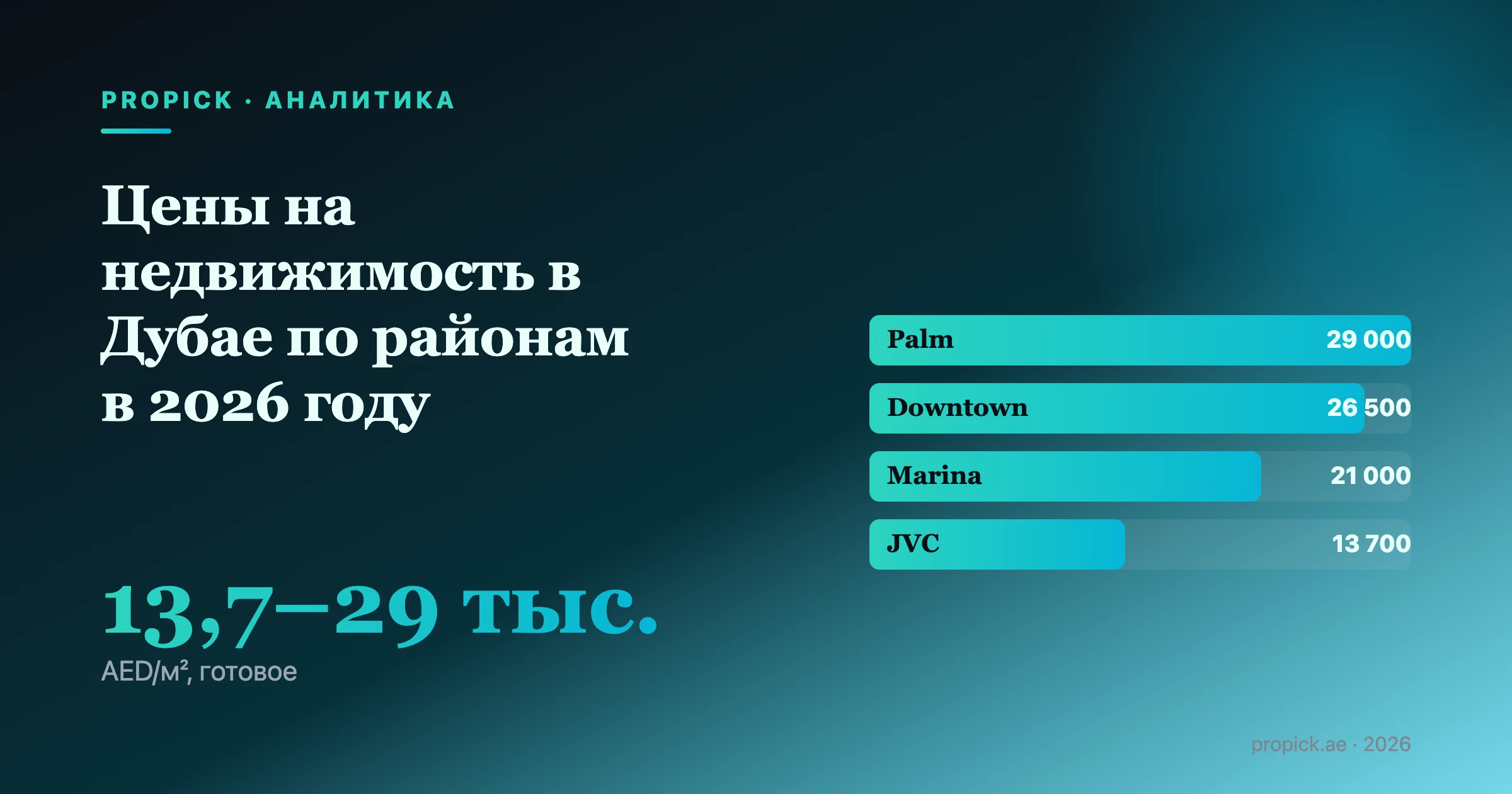
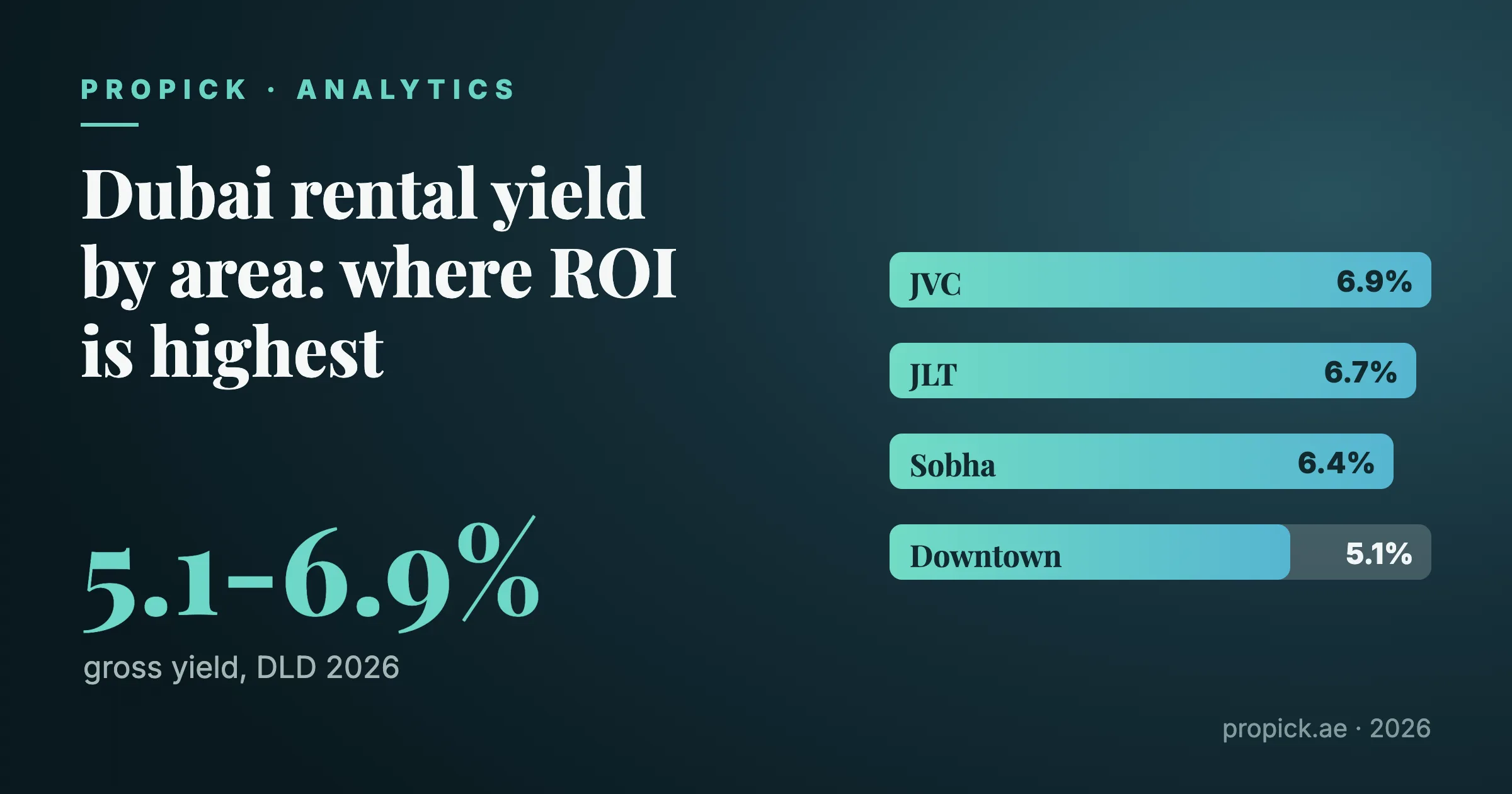
Take Jumeirah Village Circle (JVC), one of Dubai's highest-yield mainstream communities at 6.9% gross yield and a median price of 13,697 AED per sqm. A median 1-bedroom there sells for about 1.0 million AED, which at 6.9% implies annual rent of roughly 69,000 AED, the going rate for a comparable 1BR nearby. A studio at 610,000 AED implies about 42,000 AED a year in rent, and a 2-bedroom at 1.45 million implies about 100,000 AED.
Compare that to Dubai Marina, priced at 21,028 AED per sqm with a 5.2% yield. A median 1BR there runs about 1.69 million AED, roughly 69% more than JVC's, yet it implies annual rent of only about 88,000 AED, just 27% above JVC's figure. A Marina studio at 1.06 million AED implies roughly 55,000 AED in rent, and a 2BR at 2.6 million implies about 135,000 AED. The price climbs much faster than the rent does, which is exactly what a lower yield means in practice.
| Community | AED/sqm | Gross yield | Approx. rent/sqm/year |
|---|---|---|---|
| Dubai Sports City | 10,117 | 8.7% | ~880 |
| Dubai South | 11,743 | 7.2% | ~845 |
| JVT | 13,140 | 7.8% | ~1,025 |
| JVC | 13,697 | 6.9% | ~945 |
| Business Bay | 20,306 | 5.9% | ~1,198 |
| Dubai Marina | 21,028 | 5.2% | ~1,093 |
| Downtown Dubai | 26,478 | 5.1% | ~1,350 |
| Palm Jumeirah | 29,036 | 5.4% | ~1,568 |
| Villas (citywide) | ~15,230 | 4.7% | ~716 |
Studios post the highest gross yield by unit type across our sample, around 7.6%, while villas post the lowest at roughly 4.7% against a median price near 3.8 million AED. That single number, yield, is the fastest way to gauge how a community's rent-vs-buy math will behave before you even open a listing.
What It Costs Just to Sign: The Real Upfront Drag
Whatever the yield says, buying carries a cost renting never does: registering the deal itself. Dubai Land Department's official fee schedule sets a 4% property registration fee, and on the secondary market it is customary for the sale and purchase agreement to assign it to the buyer. DLD's own fee schedule adds a trustee office charge, a title deed issuance fee, and small knowledge and innovation dirham fees on top, together a few thousand AED regardless of price. Add a broker and budget a customary commission too, typically around 2% plus 5% VAT, though that figure is market convention rather than a fixed government rate.
Add it up and a cash buyer typically needs roughly 6% above the sticker price in hand before the transfer appointment, once the 4% DLD fee, trustee charges, and agency commission are all accounted for. That is real money a tenant simply does not spend, and it is the reason the break-even question matters at all.
One piece of good news: unlike many UAE purchases, a residential resale carries no VAT. Federal Tax Authority guidance on real estate treats the sale and lease of residential property as exempt or zero-rated in the relevant cases, unlike commercial property, taxed at the standard 5% rate. Confirm your specific transaction type, but for a straightforward home purchase on the secondary market, VAT is not a line item to budget for.
Cash or Mortgage: Different Race, Different Rules
Our own cut of DLD's transaction registry puts the deal-structure split at roughly 81% outright cash sales against about 14% mortgage-registered purchases for residential units, a six-to-one ratio that makes Dubai unusually cash-driven by international standards. That skew matters here because the two paths carry genuinely different cost stacks, not just a different monthly bill.
A mortgage adds its own DLD registration fee of 0.25% of the loan amount plus a small fixed charge, on top of the 4% transfer fee, plus the lender's own valuation and processing charges. It also runs into a ceiling set by the Central Bank of the UAE's loan-to-value rules: an expatriate buying a first home at or under 5 million AED can borrow up to 80%, dropping to 70% above that threshold and to 60% for a second property or investment purchase. UAE nationals get slightly more room, up to 85%, 75% and 65%. Off-plan units are capped at 50% loan-to-value for every buyer category, one reason financed buyers concentrate on ready, resale stock. The upshot: a financed buyer typically needs closer to 27 to 28% of the price in total cash once the down payment, DLD fees, and mortgage-specific charges are combined, well above the down payment alone.
Financing also has a cost renting and cash buying both avoid: interest. Bank-published rates as of July 2026 vary, for example HSBC UAE's variable rate combines a 0.99% margin with roughly 3.70% three-month EIBOR for around 4.7% per annum, while Emirates NBD's published range runs about 2.14% to 6.00% depending on product and loan-to-value. That range is the hinge the community-level comparison below turns on.
The Break-Even Horizon: How Long Before Owning Pays Off
Here is the honest version of the "does buying beat renting" question, and it splits into two very different answers depending on whether you pay cash or finance.
For a cash buyer, the roughly 6% upfront drag is recovered against avoided rent surprisingly fast almost everywhere, because Dubai's yields, 5.1% to 8.7% across our sample, are high by global standards. In JVC, a 6% drag against a 6.9% yield pays for itself in under a year of not paying rent. Even in lower-yield Downtown or Marina, the same rough math clears in twelve to fifteen months. That fast payback is the number every "just buy" argument in Dubai leans on, and on its own terms it is not wrong.
It is also incomplete, because it only counts the paperwork, not two costs a renter never carries: building service charges and, for a financed buyer, loan interest. This is where community yield stops being a rounding error and becomes the whole decision, once the mortgage rate is weighed against the loan-to-value it actually applies to, rather than against the full price. A mortgage rate is a percentage of the loan, not the property, so the real annual interest drag on the price equals the rate multiplied by the loan-to-value ratio: at the CBUAE's 60% to 65% cap for a second home or investment purchase, even a 6% rate costs only about 3.6% to 3.9% of the price a year, and even at the maximum 85% loan-to-value available to a UAE national's first home, a 6% rate costs about 5.1% of the price. In JVC, Dubai Sports City, or JVT, where yields run 6.9% to 8.7%, that leaves a comfortable cushion between rent and interest, before principal, service charges, or vacancy are even added. In Downtown, Marina, or on the Palm, where yields sit at 5.1% to 5.4%, the cushion is far thinner: loan-to-value-adjusted interest can come close to, and at the highest permitted leverage and rate combined run roughly level with, the rent, rather than clearly below it. A leveraged buyer there is often covering interest with little room to spare once service charges and any vacancy are added, and is really underwriting future price appreciation and lifestyle value rather than a clear cash-flow surplus.
For a cash buyer, the comparable question is simpler: does the yield beat what that capital could otherwise earn, safely, elsewhere. In high-yield communities the answer tends to be yes. In Downtown, Marina, and the Palm, a cash buyer is more explicitly paying for capital preservation and liquidity than for income.
None of this accounts for the biggest unknown: whether the unit's price rises or falls over your holding period. That risk cuts both ways and sits outside the yield math above.
The Variables No Spreadsheet Captures
Two personal factors regularly override all of the above, and both are worth naming honestly.
The first is mobility. A two-year work contract, an uncertain relocation, or simply not knowing where you will be living in five years all argue for renting, regardless of what the yield table says, because exit costs (the same roughly 6% you paid coming in, again on the way out, plus marketing time and price risk) can erase a favorable break-even calculation if you sell early.
The second is residency status. Property ownership above AED 2 million, mortgaged property included, is one recognized route to a long-term UAE residency permit, the Golden Visa, running for a multi-year term depending on category per the official UAE government portal. For a buyer whose plans genuinely depend on UAE residency rather than an employment visa, that non-financial benefit can outweigh a marginal yield calculation. Confirm the current threshold and conditions directly with GDRFA or ICP, since visa rules update more often than property fees.
So, Rent or Buy?
If you are cash-rich, plan to stay three or more years, and are looking at a higher-yield community like JVC, JVT, or Dubai Sports City, the numbers lean toward buying: the upfront drag pays for itself quickly and the ongoing income case is genuinely strong. If you are financing in a lower-yield community like Downtown, Marina, or the Palm, the honest read is that you are buying a lifestyle and a long-term appreciation bet, not a cash-flow-positive investment, and the mortgage rate matters more to your monthly reality than the headline yield does. If your stay in Dubai is short, uncertain, or tied to a contract you cannot guarantee will renew, renting remains the financially disciplined choice no matter how attractive a specific community's yield looks on paper. There is no single right answer here, only a right answer for your holding period, your financing, and the specific community you are comparing.
FAQ
Is the Dubai property transfer fee really 4%? Yes, in total. DLD's own fee schedule sets the rate at 4% of the sale value, and secondary-market sale and purchase agreements customarily assign it to the buyer, on top of a few thousand AED in trustee and admin charges.
How long do I need to hold a property in Dubai before buying beats renting? It depends on the community and how you finance. On a cash basis, the roughly 6% upfront cost typically pays for itself against avoided rent within roughly eight to fifteen months across our sample, since yields run 5.1% to 8.7%. That fast payback ignores service charges, financing interest, and price risk, so treat it as a floor, not a full answer, and weigh it against how long you actually expect to stay.
Is it cheaper to buy in cash or with a mortgage in Dubai? Cash avoids interest and mortgage registration fees, needing roughly 6% above the price in total upfront cash. A mortgage preserves capital but needs closer to 27 to 28% of the price upfront once the down payment and financing fees are included, and its interest cost, currently in roughly the 4.7% to 6% range at UAE banks, can exceed a low-yield community's rent, particularly in Downtown, Marina, or the Palm.
Does buying property in Dubai get me a residency visa? Property worth 2 million AED or more, mortgaged property included, is one recognized route to the UAE's long-term Golden Visa. Confirm the current threshold and category duration directly with GDRFA or ICP, since visa rules are updated more often than property fees.
Do I pay VAT when buying a home in Dubai? Generally no, on a straightforward residential resale. The Federal Tax Authority's real estate guidance treats residential sales as exempt or zero-rated in the relevant cases, unlike commercial property at the standard 5% VAT rate. Confirm your specific transaction type before assuming this applies.
How much can my landlord legally raise my rent in Dubai? It depends on how far your current rent sits below Dubai's official rental index, on a sliding scale from 0% up to 20%, calculated through DLD's Rental Index tool. It is not a flat annual percentage, so run your specific address through the calculator rather than assuming a fixed figure.
Sources
- Dubai Land Department, Property Sale Registration fee schedule
- Dubai Land Department, Request for Mortgage Registration fee
- Central Bank of the UAE, Article 3: Important Ratios (CBUAE Rulebook)
- Federal Tax Authority, VAT: Real Estate
- GDRFA Dubai, Investor Golden Residence Permit criteria and fees
- UAE Government Portal, Golden Visa
- Dubai Land Department, Rental Index / Rental Increase Calculator
- HSBC UAE, Mortgage rates
- Emirates NBD, Home Loan Key Facts Statement, fixed and variable rates
- Dubai Land Department / DLD Open Data, dld_transactions and dld_rent_contracts datasets