An owner looking at a JVC one-bedroom priced around AED 1,000,000 sees two numbers on the table. A long-term tenant signs an Ejari lease near the community's median rent. Or the same unit goes on Airbnb and Booking.com at a nightly rate several times higher on paper. The math looks lopsided enough that short-term seems the obvious choice. It is not, automatically. Short-term letting is a licensed, taxed, actively managed activity with its own cost structure, and once that structure is subtracted from the headline rate, the gap to a long-term lease narrows a great deal, and in some communities closes entirely.
This is a head-to-head for an owner choosing between the two formats on one unit: DET's holiday-home rules for the short-term side, DLD data for the long-term side.
The Two Formats, in Brief
Long-term renting is a tenancy of a year or more, registered on Ejari with the Real Estate Regulatory Agency (RERA) under Law No. 26 of 2007: one rent, one contract, rent-increase caps, one tenant relationship.
Short-term letting is nightly or weekly stays through platforms like Airbnb or Booking.com, requiring a Holiday Homes permit from DET under Decree No. (41) of 2013, entirely outside Ejari: nightly pricing, constant guest turnover, and its own tax and fee regime on every stay.
The Long-Term Baseline: What Ejari Actually Pays
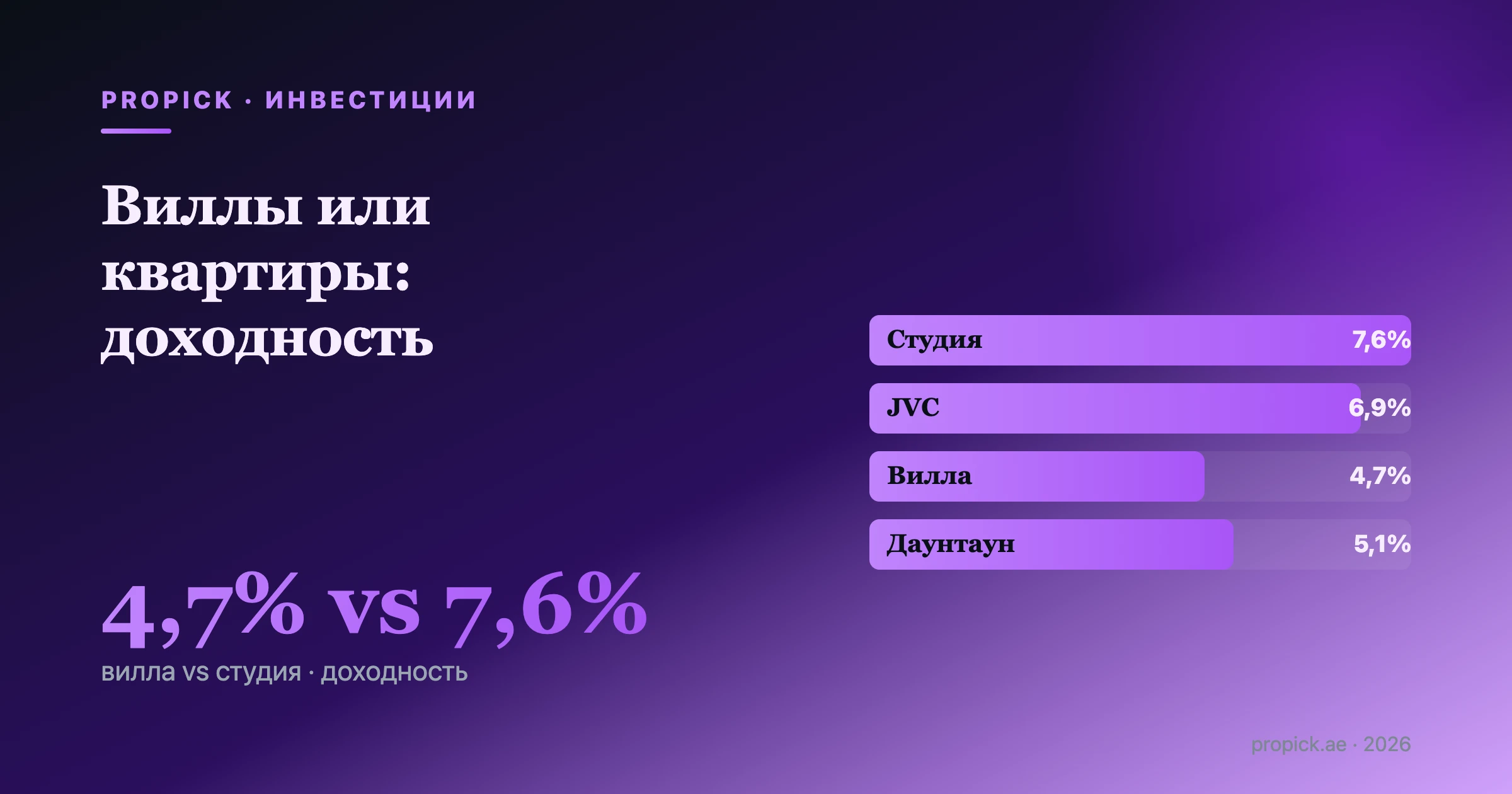
Long-term gross yield is the one number both sides of this comparison can check against real data. Propick's analysis of DLD's dld_transactions and dld_rent_contracts datasets, ready-resale medians as of July 2026, shows a wide spread by community:
| Community | AED/sqm | Gross yield (long-term) | Reference price point |
|---|---|---|---|
| Dubai Sports City | 10,117 | 8.7% | median unit AED 660,000 |
| Dubai South | 11,743 | 7.2% | - |
| JVT | 13,140 | 7.8% | - |
| JVC | 13,697 | 6.9% | 1BR AED 1,000,000 |
| Business Bay | 20,306 | 5.9% | - |
| Marina | 21,028 | 5.2% | 1BR AED 1,690,000 |
| Downtown Dubai | 26,478 | 5.1% | - |
| Palm Jumeirah | 29,036 | 5.4% | - |
| Villas (all areas) | 15,230 | 4.7% | median AED 3,800,000 |
Studios run highest of any unit type, around 7.6% gross. Gross yield is annual rent divided by price, so annual rent is roughly yield times price: a JVC one-bedroom at AED 1,000,000 on 6.9% throws off about AED 69,000 a year.
Gross is not net. A landlord still owes the building's service charge (varies by building, check the DLD Service Charge Index, fed by Mollak), an Ejari renewal fee of roughly AED 177.75 to 220, a market-rate leasing commission, and a modest void between tenancies. For that JVC one-bedroom, a reasonable stack (service charge ~AED 9,000, 5% leasing commission ~AED 3,450, Ejari renewal ~AED 200, a short void) brings net rent to roughly AED 55,000, a net yield near 5.5%, the baseline any short-term comparison needs to start from.
The Short-Term Path: Permit, Fees, and Tax Before a Single Guest Checks In
Short-term letting carries its own cost layer that a long-term lease does not, and none of it is optional.
Building consent. The owner needs written consent from the building's management company or Owners' Association. Not every tower allows it, and DET rejects applications without it; the decision sits with the developer or OA, not the regulator.
The permit. Under Executive Council Resolution No. (49) of 2014, fees run AED 100 for initial approval, AED 500 to issue or renew, AED 300 per bedroom capped at AED 1,200 a year per unit, and AED 300 per inspection, roughly AED 1,100-1,200 in year one for a one-bedroom. DET has also been waiving permit and licence fees for a set window as part of a temporary incentives package; confirm current status on the DET portal (Dubai Media Office, 21 May 2026).
Tourism Dirham. A nightly levy per guest, capped at 30 consecutive nights, collected from the guest and remitted to DET monthly under Administrative Resolution No. (2) of 2020. The rate depends on the category declared at registration, published on DET's Tourism Dirham page; it is a guest-funded pass-through, not a deduction from owner revenue, but the owner or operator must collect and remit it.
VAT. Short-term letting with guest services is not VAT-exempt residential leasing. It sits at the standard 5% rate as effectively a commercial activity, per the FTA's Real Estate VAT Guide (VATGRE1), mandatory above AED 375,000 in taxable turnover and voluntary from AED 187,500 (FTA registration rules).
Fines. Letting without a permit costs AED 5,000 on a first offence under the same Resolution No. (49) of 2014, doubling on repeat within a year up to a AED 100,000 ceiling, with suspension or cancellation also possible.
None of this disqualifies short-term letting, it is simply a cost layer a long-term lease never touches.
Gross vs Net: Where the Real Comparison Happens
Run the honest test on that JVC one-bedroom, long-term net rent of roughly AED 55,000 a year as the number to beat.
A long-term day-equivalent rate on AED 69,000 gross works out to about AED 189 a night. Short-term listings typically price well above that, but neither DET nor DLD publishes verified occupancy or average daily rate data for short-term lets, so any multiplier here is illustrative, not official. Using a commonly cited (not government-verified) assumption of roughly double the long-term day rate, and modelling three occupancy scenarios after 5% VAT, a management commission in the high-teens to twenties percent of revenue (market rate, not government-set), cleaning between stays, and the DET fee stack above:
| Occupancy | Illustrative gross revenue | After VAT, commission, cleaning, DET fees | vs long-term net (~AED 55,000) |
|---|---|---|---|
| 40% (146 nights) | ~AED 55,000 | ~AED 37,000 | Loses |
| 55% (200 nights) | ~AED 76,000 | ~AED 52,000 | Roughly ties |
| 70% (256 nights) | ~AED 97,000 | ~AED 66,000 | Wins clearly |
Treat this as a modelled scenario, not a forecast for any specific unit. The qualitative conclusion holds under different rate assumptions: short-term needs sustained, not just peak, occupancy to beat a long-term lease. But the exact break-even occupancy percentage shifts with the assumed nightly-rate multiplier, a stronger tourist address in peak season could plausibly command more than double the long-term day rate, which would pull the crossover point lower, while a more modest multiplier pushes it higher. Below whatever that threshold turns out to be for a given unit, a higher nightly rate cannot outrun a cost stack a long-term lease never carries, because voids on a short-term calendar are structural, not incidental. Demand is also seasonal, arrivals build from roughly November to April and thin out in the summer heat of June to August, exactly the stretch where a long-term tenant keeps paying rent regardless of the weather.
Stability Is the Other Half of the Decision
A long-term lease is a materially more predictable one. Rent cannot move outside the bands set by Decree No. (43) of 2013, from no increase up to a 20% ceiling depending on how far current rent sits below the RERA rental index, checked through the DLD Rental Index calculator. A rent change needs at least 90 days' written notice, and reclaiming a unit at lease expiry for the owner's own use needs a 12-month notarised or registered-mail notice, under Law No. (33) of 2008 amending Law No. (26) of 2007. One signature, one renewal a year, income locked for the term.
Short-term income carries none of that ceiling and none of that protection. A well-run unit in a strong season can beat its long-term equivalent by a wide margin; the same unit in a slow month can sit empty while still owing its service charge, permit renewal, and management contract.
Matching the Format to the Community
The community data above splits cleanly by which format suits it. JVC, JVT, Dubai South, and Dubai Sports City post the strongest long-term gross yields (6.9% to 8.7%), but they are residential, budget-oriented communities where tourist footfall is thin and building consent for short lets is harder to secure. Marina, Downtown, Business Bay, and Palm Jumeirah sit at the bottom of the long-term yield table (5.1% to 5.9%) precisely because they are priced for lifestyle and scarcity, and it is exactly these addresses where tourist demand and short-let-friendly buildings concentrate. Chasing short-term revenue in a yield-first community rarely pays off since visitor demand is not there to fill the calendar.
The Honest Verdict
There is no blanket winner. Short-term letting can out-earn a long-term lease, but only when three things line up: a building that permits it, a location tourists actually want, and occupancy that holds up across the slower months, not just peak season, since permit fees, VAT, commission, and cleaning are due whether the calendar is full or not. Long-term renting earns less on paper in most communities, but with one signature, one predictable rent figure inside RERA's caps, and none of the nightly operational load. For an owner who wants minimal admin, or who owns in a yield-strong, tourist-thin community, long-term through Ejari is usually the better-net choice even where the short-term gross number looks larger. For an owner in a tourist-facing address who can secure consent and manage it well, short-term is worth modelling, provided the occupancy assumption is realistic, not aspirational.
FAQ
Which earns more, short-term or long-term rental in Dubai? It depends on occupancy, not the nightly rate alone. In our modelled JVC example, working from the same table above, short-term only overtakes long-term net income once occupancy climbs to roughly 58-60% or higher, and that crossover point moves with the assumed nightly-rate multiplier; below it, DET fees, VAT, commission, and cleaning erode the higher gross rate faster than most owners expect.
Do I need a permit to run an Airbnb-style rental in Dubai? Yes. Decree No. (41) of 2013 requires a DET Holiday Homes permit, and the building's management company or Owners' Association must consent first.
Is rental income taxed differently under the two formats? Yes. Long-term residential leasing is exempt from the UAE's 5% VAT; short-term letting with guest services is treated as commercial and carries the standard 5% rate above the FTA's registration threshold, per the FTA Real Estate VAT Guide. Neither is subject to UAE personal income tax.
What's the single biggest hidden cost in short-term letting? No single line item, it's the combination: commission in the high-teens to twenties percent of revenue as market practice, plus VAT, cleaning, DET fees, and structural void nights in low season, eroding the headline nightly rate far more than most first-time owners budget for.
Can rent be increased freely under a long-term Ejari lease? No. Any increase is capped by Decree No. (43) of 2013, based on how far rent sits below the RERA rental index, up to a 20% ceiling, with 90 days' written notice.
Can I switch one unit between long-term and short-term? Yes, but not on the same day. Ending an Ejari lease and obtaining a DET permit (with building consent) are separate registrations, and switching back needs a fresh Ejari registration once a tenant is found.
Sources
- Dubai Legislation Portal. Decree No. (41) of 2013 Regulating the Activity of Leasing out Holiday Homes in the Emirate of Dubai. https://dlp.dubai.gov.ae/Legislation%20Reference/2013/Decree%20No.%20%2841%29%20of%202013.html
- Dubai Legislation Portal. Executive Council Resolution No. (49) of 2014 Approving the Fees and Fines Related to the Activity of Leasing out Holiday Homes in the Emirate of Dubai. https://dlp.dubai.gov.ae/Legislation%20Reference/2014/Executive%20Council%20Resolution%20No.%20%2849%29%20of%202014.html
- Dubai Legislation Portal. Administrative Resolution No. (2) of 2020 Prescribing the Rules for Calculating, Collecting, and Paying the Tourism Dirham Fee in the Emirate of Dubai. https://dlp.dubai.gov.ae/Legislation%20Reference/2020/Administrative%20Resolution%20No.%20%282%29%20of%202020%20Prescribing%20the%20Rules%20for%20Calculating,%20Collecting,%20and%20Paying%20the%20Tourism%20Dirham%20Fee%20in%20the%20Emirate%20of%20Dubai.html
- Dubai Department of Economy and Tourism (DET). Tourism Dirham. https://www.dubaidet.gov.ae/en/legislative-news/tourism-dirham-executive-council-resolution-no-2-of-2014
- Dubai Media Office. Hamdan bin Mohammed approves second, larger AED 1.5 billion economic incentives package, including temporary exemption from holiday home permit/licence fees (21 May 2026). https://mediaoffice.ae/en/news/2026/may/21-05/hamdan-bin-mohammed
- Federal Tax Authority (FTA). VAT Guide - Real Estate, VATGRE1 (April 2021). https://tax.gov.ae/DownloadOpenTextFile?fileUrl=en/VAT_VAT_Guides/Real_Estate_Guide/Real_Estate_Guide_VATGRE1_EN_19_04_2021_EN.pdf
- Federal Tax Authority (FTA). VAT Registration, mandatory threshold AED 375,000, voluntary AED 187,500. https://tax.gov.ae/en/taxes/Vat/vat.topics/registration.for.vat.aspx
- Dubai Legislation Portal. Law No. (26) of 2007 Regulating the Relationship Between Landlords and Tenants in the Emirate of Dubai. https://dlp.dubai.gov.ae/Legislation%20Reference/2007/Law%20No.%20%2826%29%20of%202007.html
- Dubai Legislation Portal. Law No. (33) of 2008 Amending Law No. (26) of 2007 (90-day rent-change notice, 12-month eviction notice). https://dlp.dubai.gov.ae/Legislation%20Reference/2009/Law%20No.%20%2833%29%20of%202008%20Amending%20Law%20No.%20%2826%29%20of%202007.html
- Dubai Legislation Portal. Decree No. (43) of 2013 Determining Rent Increase for Real Property in the Emirate of Dubai. https://dlp.dubai.gov.ae/Legislation%20Reference/2013/Decree%20No.%20%2843%29%20of%202013%20Determining%20Rent%20Increase%20for%20Real%20Property.html
- Dubai Land Department. Rental Index / Rental Increase Calculator eService. https://dubailand.gov.ae/en/eservices/rental-index/rental-index/
- Dubai Land Department. Register/Renew Ejari Tenancy Contract eService. https://dubailand.gov.ae/en/eservices/register-renew-ejari-contract/
- Dubai Land Department. Service Charge Index Overview. https://dubailand.gov.ae/en/eservices/service-charge-index-overview/
- Mollak (RERA/DLD). About Us. https://mollak.dubailand.gov.ae/publicpages/about-us.html
- Dubai Land Department / DLD Open Data. Datasets "dld_transactions" and "dld_rent_contracts". https://dubailand.gov.ae/en/open-data/real-estate-data/
- Dubai Land Department. Property Sale Registration (4% registration fee, in practice paid by the buyer on the secondary market). https://dubailand.gov.ae/en/eservices/property-sale-registration/