Ask any agent in Dubai Marina or JVC and you will hear the same line: studios always win on yield. It is true, and our own numbers prove it, but the full picture is more interesting than the sound bite. We pulled unit-level sale prices from the Dubai Land Department's dld_transactions dataset and matched them against active Ejari rental contracts in dld_rent_contracts, both published on DLD Open Data. The result: studios in ready buildings post a median gross yield of roughly 7.6%, the highest of any unit type in Dubai's apartment stock. But that top-line number hides a tighter tenant pool, shorter average stays, and higher turnover cost, three things a small-budget investor needs to weigh before assuming "smallest unit, best return" is the whole story.
This is exclusive data. Brokerages publish price-per-sqft heat maps and community rankings, but yield broken out strictly by unit type, cross-checked against actual registered rent contracts rather than asking-price listings, is not something competitors put in front of readers. Here is what the DLD data actually shows.
The headline number: studios lead, but the gap narrows fast
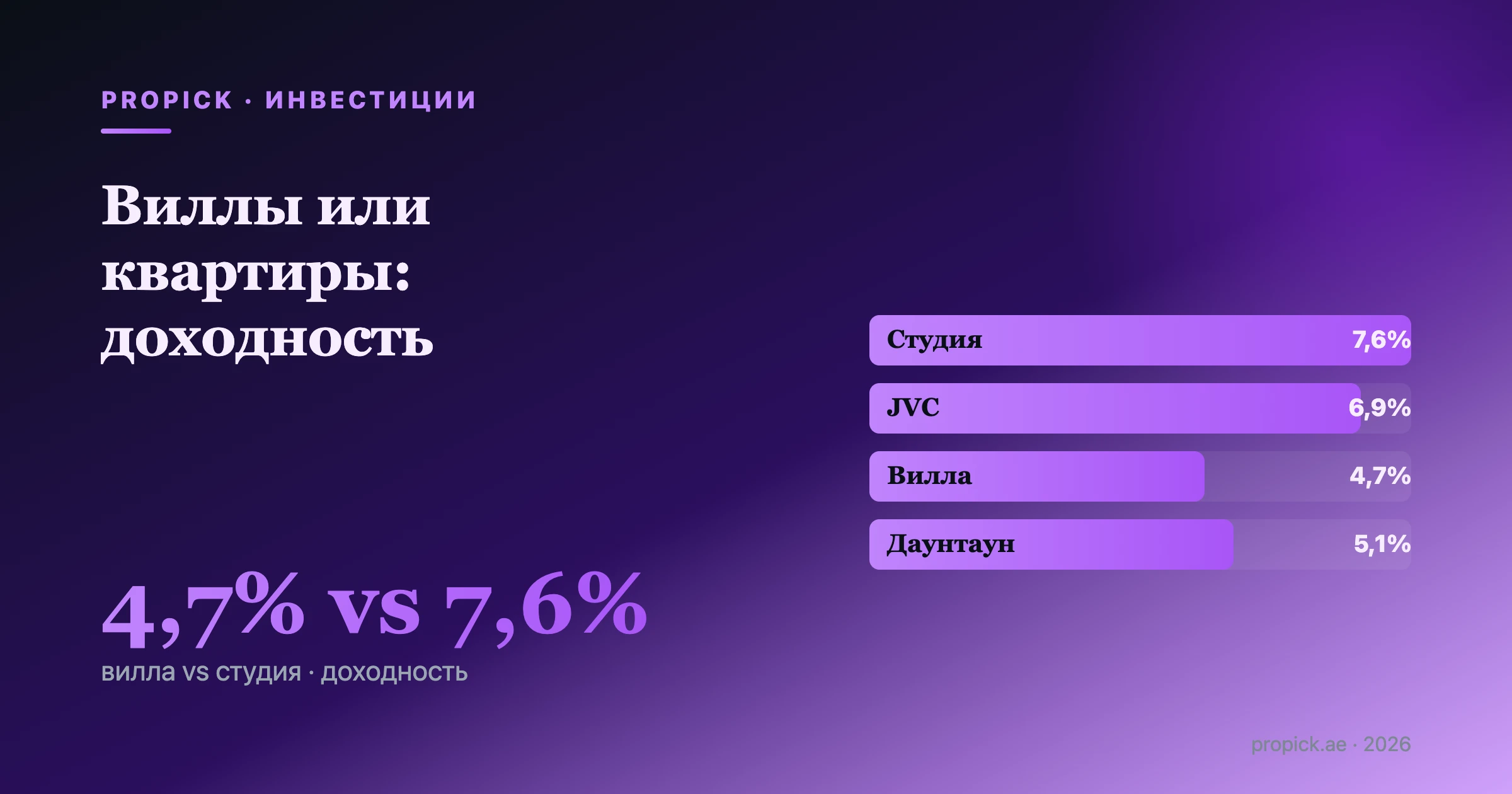
Our sample covers ready (completed, resale-eligible) apartments only, excluding off-plan units where no rent contract yet exists. For studios, the median transaction price works out to AED 14,151 per square meter, against a median contracted rent of AED 1,076 per square meter per year. Divide one into the other and you get a gross yield of approximately 7.6%, the strongest of any configuration we measured.
| Metric (ready studios, DLD data) | Value |
|---|---|
| Median price per sqm | AED 14,151 |
| Median rent per sqm/year | AED 1,076 |
| Implied gross yield | ~7.6% |
| Yield rank vs. other unit types | Highest |
The mechanism is straightforward and well understood in real estate economics: rent per square meter falls more slowly than sale price per square meter as unit size increases. A landlord renting out a 35 sqm studio can command a rent premium per square meter that a 90 sqm one-bedroom simply cannot match, because tenants pay for a functioning home, not for square meters in isolation. As unit size climbs from studio to one-bedroom to two-bedroom, our data shows both price per sqm and yield stepping down in tandem, a pattern consistent across almost every community we checked. We do not have a stable, statistically robust median for 1BR and 2BR gross yield at the citywide level in this cut (sample sizes per bedroom count vary heavily by building age and community), which is why the more reliable investor-facing number is the community-level blend below.
Where the community numbers actually sit
Layering our unit-type finding on top of the community-level yield analysis we ran earlier (also from DLD transaction and rent-contract data, ready-resale stock, median-based), the spread across Dubai's major masterplans is 5.1% to 6.9%, a full 1.8 percentage point range depending purely on where you buy.
| Community | Median price/sqm (AED) | Gross yield |
|---|---|---|
| JVC | 13,697 | 6.9% |
| JLT | 15,666 | 6.7% |
| Sobha Hartland | 21,649 | 6.4% |
| Dubai Hills | 25,022 | 6.1% |
| Business Bay | 20,306 | 5.9% |
| Marina | 21,028 | 5.2% |
| Dubai Creek Harbour | 25,224 | 5.4% |
| Palm Jumeirah | 29,036 | 5.4% |
| Downtown Dubai | 26,478 | 5.1% |
The pattern here reinforces the unit-size story rather than contradicting it. JVC and JLT, the two highest-yielding communities in this table, are also where studios and compact one-bedrooms make up the largest share of ready stock. Downtown and Palm, the lowest-yielding, skew toward larger, higher-ticket units where price per square meter is driven by brand and location premium rather than rentability. A studio bought in JVC is compounding two yield tailwinds at once (unit-type premium and community-level affordability), which is part of why the "buy a studio in JVC" advice circulates so widely. It is directionally correct. The question is whether the yield premium survives contact with occupancy reality.
The catch: thinner tenant pool, faster turnover
Smaller units rent to a narrower demographic, mostly single professionals, students, and short-term postings, who move more often than families in one- and two-bedroom units signing multi-year leases. Every re-lease cycle brings direct costs that eat into the headline yield: a re-letting agent commission (commonly around 5% of the annual rent in the Dubai market), unit refresh and touch-up costs between tenancies, and a void period where the unit earns nothing while it sits vacant. CBRE's Q1 2026 UAE Real Estate Market Review notes that Dubai rental growth eased to roughly 4.1% year-on-year as new supply reached the market, a dynamic that widens tenant choice most in the small-unit, high-turnover segment where studios and compact one-bedrooms compete directly with each other and with serviced apartments.
None of this shows up in a static gross yield calculation built from a snapshot of price and rent. A one-bedroom with a tenant on a two- or three-year renewal history effectively earns its yield with far fewer transaction costs and far less landlord admin than a studio that turns over every 12 months. For an investor comparing two units on paper, the studio's 7.6%-class yield and the one-bedroom's lower but stickier yield are not directly comparable numbers; one is gross and idealized, the other is closer to what actually lands in the bank net of turnover friction.
What this means for a small-budget buyer
If your entry budget genuinely only stretches to a studio, the data supports the purchase: studios are not a compromise on yield, they are the top of the table. The practical adjustment is in underwriting, not in unit choice. Budget for at least one re-let per year in a high-turnover studio building, price in the agent commission and refresh costs rather than assuming 12 months of uninterrupted rent, and lean toward communities like JVC or JLT where the unit-type premium and the community premium stack rather than a prestige address like Downtown or Palm where you would be paying for brand on top of a smaller, less family-durable unit.
If your budget stretches further, a one-bedroom in a 6%-plus community (Dubai Hills, Sobha Hartland, Business Bay) gives up roughly one to two points of theoretical gross yield against a studio in the same building class, but claws much of it back in stability: fewer turnovers, fewer void months, and a broader resale pool of buyers should you want to exit into either an end-user or investor market later.
Methodology note
Figures are computed from two DLD Open Data open datasets: dld_transactions (sale transaction records) and dld_rent_contracts (Ejari registered rental contracts). We restrict the sample to completed (ready) apartment units to ensure a rent contract can exist against the same asset, and use median price per square meter and median rent per square meter, grouped by master_project_en and, for the unit-type cut, by bedroom configuration as recorded in the transaction record. Medians are used rather than means to reduce distortion from outlier penthouse or distressed-sale transactions. Gross yield is calculated as median annual rent per sqm divided by median transaction price per sqm; it is a pre-cost figure and does not net out service charges, void periods, maintenance, or the 4% DLD transfer fee, which in practice is paid by the buyer on the secondary market. Community-level figures reflect our earlier area-by-area DLD analysis on the same basis. Data reflects contracts and transactions on record as of July 2026; sample depth varies by community and bedroom count, and communities with very low transaction counts in a given quarter are excluded to avoid unstable medians.
FAQ
Is a 7.6% studio yield realistic to expect on a new purchase? It reflects the current median relationship between price and contracted rent per square meter across ready studio stock, not a forward guarantee. New buyers pay today's price against tomorrow's rent, and rental growth has been moderating, so treat 7.6% as a benchmark for like-for-like comparison rather than a promised return.
Why do studios yield more per square meter than larger units? Rent scales with the utility of having a functioning home, which does not fall in direct proportion to size, while sale price scales more closely with square meters. The result is that small units carry a higher rent-to-price ratio, which is what gross yield measures.
Does the 7.6% studio figure already account for vacancy and turnover costs? No. It is a gross yield calculated from median price and median contracted rent per square meter. Turnover costs (re-letting commission, refresh, void periods) are real deductions that apply more heavily to studios than to one- and two-bedroom units and are not included in this figure.
Which is the better buy for a first-time small-budget investor, studio or one-bedroom? Both work; the choice is about your tolerance for landlord admin. A studio in a high-yield, high-liquidity community like JVC or JLT delivers the strongest headline return but needs active management. A one-bedroom in a mid-yield community trades one to two points of theoretical yield for a calmer tenancy pattern.
Do these yields include the DLD transfer fee? No. The 4% DLD transfer fee is a one-time acquisition cost, in practice paid by the buyer on the secondary market, and is separate from the ongoing gross yield calculation shown here.
Where does this data come from and can I check it myself? Both datasets are public. Sale transactions come from DLD's dld_transactions dataset and rental contracts from dld_rent_contracts, both hosted on DLD Open Data / data.dubai.ae. Our numbers are our own median-based computation from those raw records, not a broker-reported figure.
Sources
- Dubai Land Department, dld_transactions dataset, DLD Open Data: https://dubailand.gov.ae/en/open-data/real-estate-data/
- Dubai Land Department, Ejari rental contracts dataset (dld_rent_contracts), DLD Open Data: https://dubailand.gov.ae/en/open-data/real-estate-data/
- CBRE, UAE Real Estate Market Review, Q1 2026: https://www.cbre.ae/press-releases/uae-real-estate-market-review-q1-2026
- Dubai Land Department, transfer and registration fee schedule: https://dubailand.gov.ae/en/eservices/registering-the-sale-of-a-mortgaged-property/